

A sharp rise in the numbers of smaller residential investors relying on credit has been increasing the risk to the Auckland housing market, according to the Reserve Bank.
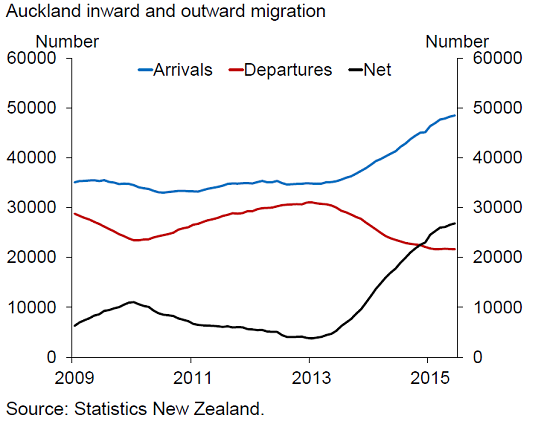
And the RBNZ has also highlighted the big surge in migration as a contributor to Auckland's rising house prices, calculating that perhaps as many as a third of Auckland house purchases in the past year could have been to those recently arrived in the country.
Additionally, the central bank has hinted that a recent strengthening of house markets elsewhere in the country could see the planned future removal of the 'speed limit' on high loan to value lending outside of Auckland delayed.
RBNZ Deputy Governor Grant Spencer, who is also the bank's Head of Financial Stability, said in a speech in Auckland today that residential investors were now making up 41% of house purchases in Auckland.
“We have seen a particular increase in purchases by smaller investors and investors reliant on credit. Half of the new lending to investors is being written at loan-to-value ratios of over 70%.
“This trend is increasing the risk inherent in the Auckland market. The increasing investor presence is likely to amplify the housing cycle, and worsen the potential damage from a downturn, both to the financial system and the broader economy.”
The RBNZ last week reaffirmed its plans for special LVR rules for Auckland residential property investors, albeit with slightly looser terms than first mooted and with a starting date pushed back to November from the originally intended October.
Measures 'will reduce risk'
Spencer said the RBNZ believed that the new measures would reduce heightened financial system risk, and help moderate the Auckland housing market cycle.
It is planned that the 'speed limit' on owner-occupied properties in Auckland will stay at 10%, but that the speed limit on high LVR mortgages outside Auckland will be relaxed from 10% to 15%, but Spencer signalled a note of caution on this.
"That easing [of the speed limit from 10% to 15%] reflects the low and steady rates of house price inflation in most other parts of the country, and our stated intention to begin removing LVR restrictions when they are no longer warranted. In recent months, there have been some signs of housing demand spilling out of Auckland, with house price growth starting to increase in Hamilton and Tauranga.
"If this strength persists, full removal of LVR restrictions outside of Auckland could be delayed. The Bank will continue to monitor housing market developments and modify its macro-prudential policies accordingly."
He said that in line with the increased share of investor sales in Auckland, there had been a "disproportionate expansion" in mortgage credit to residential investors.
"The dollar value of new mortgage lending for all borrowers grew by 28% nationally, in the year to June 2015, reflecting increased house sales as well as higher average prices.
"Over the same period, new lending to investors increased nationally at a much greater rate of 40%. While some new lending represents ‘churn’ as borrowers refinance existing loans and/or switch between banks, the sharp lift in new investor lending is consistent with greater investor participation in the housing market."
Spencer said the rising market share of investors had "primarily" been driven by investors with two to four properties, as opposed to investors with larger property portfolios.
Fewer cash sales
"We have also seen a reduction in the share of investor cash sales in Auckland from over 25% in late 2013 to around 20% currently. This sort of profile – i.e. smaller investors who are reliant on credit – suggests that the new LVR restrictions on Auckland residential investors are likely to have an impact on overall demand. This is particularly so when we consider that over half of investor lending is currently being written at high LVRs – that is LVRs of over 70%."
Spencer said that "much" had been said recently regarding the contribution of foreign investor purchases to price pressures in Auckland.
"Given that we do not have data on purchases by non-residents, it is not possible to make an accurate assessment of the extent to which such flows are adding to price pressures and also financing new housing construction. The role of non-resident investors in the Auckland market will become more apparent once the new requirements for purchasers to provide tax numbers are introduced in October."
The "main underlying cause" of the housing shortage in Auckland was the continuing record net inflow of migrants, against a background of very low residential construction activity over many years, Spencer said.
"In the year to June 2015, almost 50,000 permanent and long-term migrants arrived in Auckland, including New Zealand citizens returning from abroad. If these new residents have similar rates of home ownership and household sizes to existing residents, we estimate they could account for around one-third of the 30,000 Auckland house sales in the past year."
Responding to criticism
Spencer sought to deflect criticism of the RBNZ for tightening lending rules even though the banks here had done well in 'stress tests' conducted by the RBNZ.
"Sometimes commentators incorrectly interpret the aim of macro-prudential policy as preventing bank insolvency. From a macro-prudential perspective, we may wish to bolster bank balance sheets beyond the point of avoiding insolvency. Stress tests help to inform our assessment of the adequacy of capital and liquidity buffers held by the banks. However, they are only one of the tools contributing to that assessment.
"In a downturn, banks will typically become risk averse and start to slow credit expansion in order to reduce the risk of breaching capital and liquidity ratios. In a severe downturn, faced with a rise in impaired loans and provisions, banks may start to contract credit which can quickly exacerbate the economic downturn. In this way, a financial downturn can have severe consequences for macro-financial stability well before the solvency of banks becomes threatened," he said.
In 2014, the four largest New Zealand banks completed a stress testing exercise that featured a 40% decline in house prices in conjunction with a severe recession and rising unemployment, Spencer said.
While this test suggested that banks would maintain capital ratios above minimum requirements, banks reported that they would need to cut credit exposures by around 10% (the equivalent of around $30 billion) in order to restore capital buffers.
"Deleveraging of that nature would accentuate macroeconomic weakness, leading to greater declines in asset markets and larger loan losses for the banks. Such second round effects are not reflected in the stress test results. A key goal of macro-prudential policy is to ensure that the banking system has sufficient resilience to avoid such contractionary behaviour in a downturn."
'More needs doing on supply'
In terms of the shortage of supply of housing in Auckland, Spencer reiterated the RBNZ's view that still more needed to be done.
"Supply-side constraints remain a hindrance to faster rates of building. The key issues remain: a limited supply of land ready for building; restrictive planning processes, and a lack of coordinated planning in infrastructure development. Since the Housing Accords and Special Housing Areas Act 2013, there have been some encouraging developments, such as the proposed relaxation of density rules and initiatives to develop Crown land. However, more needs to be done and Special Housing Area building activity has remained very slow to date, with around 800 dwellings consented and 860 sections created in the 86 SHAs."
Spencer said the RBNZ supported the recent draft findings of the Productivity Commission on using land for housing.
"...The recommendations should be considered carefully.
"Recommendations that have the potential to improve the responsiveness of housing supply include the promotion of less restrictive planning rules and streamlined planning processes. For example, reviewing and relaxing rules in district plans, clarifying the RMA to include land use for housing as a priority, and ongoing RMA reform to streamline plan development. The Bank also supports measures that encourage the timely and coordinated provision of infrastructure to support new housing developments, and policies that reduce incentives for land banking."
This is the press release the RBNZ issued about Spencer's speech:
Investor LVR limits to reduce financial system risk
The Reserve Bank expects new lending limits for Auckland property investors will reduce heightened financial system risk, and help moderate the Auckland housing market cycle, Deputy Governor Grant Spencer said today.
Speaking to the Northern Club in Auckland, Mr Spencer said that the resurgence in Auckland house prices over the past year has increased the Bank’s concerns about financial stability risks.
Mr Spencer said that Auckland prices have risen a further 24 percent over the past year, compared to 3 percent for the rest of the country.
“This has stretched the price-to-income ratio for the Auckland region to 9, double the ratio for the rest of New Zealand, and places Auckland among the world’s most expensive cities.
“New housing supply has been growing, but nowhere near fast enough to make a dent in the existing housing shortage. In the meantime, net migration is at record levels, and investors continue to expand their influence in the Auckland market.”
Mr Spencer said that investors are now accounting for 41 percent of Auckland house purchases, up 8 percentage points since late 2013. “We have seen a particular increase in purchases by smaller investors and investors reliant on credit. Half of the new lending to investors is being written at loan-to-value ratios of over 70 percent.
“This trend is increasing the risk inherent in the Auckland market. The increasing investor presence is likely to amplify the housing cycle, and worsen the potential damage from a downturn, both to the financial system and the broader economy.”
Mr Spencer said that macro-prudential policy can assist in moderating the risks to the financial sector and broader economy associated with Auckland’s housing market.
“A sharp fall in house prices has the potential to accentuate weakness in the macro-economy, particularly if banks tighten lending conditions excessively, leading to greater declines in asset markets and larger loan losses for the banks. A key goal of macro-prudential policy is to ensure that the banking system maintains sufficient prudential buffers to avoid this sort of contractionary behaviour in a downturn.
“Modifications to the Reserve Bank’s LVR policy, announced in May, are targeted specifically at Auckland residential investors. The speed limit has been eased for the rest of the country where housing markets are not subject to the same pressures.”
Mr Spencer said that the Bank recognises that low interest rates are contributing to housing demand pressures, and this is a factor the Bank takes into consideration when setting monetary policy. “However, the current weakness in export prices, economic activity and CPI inflation means that interest rate increases are likely to be off the table for some time,” he said.
He noted that the Bank’s macro-prudential policy is one of many measures aimed at reducing the imbalances in the Auckland housing market.
“Much more rapid progress in producing new housing is needed in order to get on top of this issue. Tax policy is also an important driver, and we welcome the changes announced in the 2015 Budget, including the two year bright-line test, the proposed non-resident withholding tax and the requirement for tax numbers to be provided by house purchasers.”
We welcome your comments below. If you are not already registered, please register to comment
Remember we welcome robust, respectful and insightful debate. We don't welcome abusive or defamatory comments and will de-register those repeatedly making such comments. Our current comment policy is here.