

By Greg Ninness
Lower quartile house prices have plateaued in almost all parts of the country and have declined in Auckland for the last three months in a row, suggesting the lower end of the property market has peaked in its latest cycle, according to the interest.co.nz Home Loan Affordability Report for August.
The report tracks monthly movements in the Real Estate Institute of New Zealand's (REINZ) lower quartile selling prices throughout the country, the price at which 25% of sales would be below that point and 75% would be above it, and this shows that the national lower quartile price peaked at $308,500 in March and has since remained within a fairly narrow range, to end up at $299,125 in August.
In the overheated Auckland market a clearer trend is evident, with the lower quartile selling price peaking at $616,500 in May and then declining in each of the following three months to hit $600,700 in August.
The lower quartile price was below it's peak in 10 of the REINZ's 12 sales regions in August, including other recent property hot spots such as Queenstown Lakes where it peaked at $403,900 in June and then declined to $371,900 in August.
In Wellington the lower quartile price peaked at $327,700 in February and was down to $311,500 in August, and in Canterbury/Westland it peaked at $354,900 in April and was $350,600 in August.
Overall the figures suggest that prices for more affordable properties have flattened or declined slightly in recent months.
The only regions where August's lower quartile price was below the previous peak were Hawke's Bay, where August's lower quartile price of $224,900 was equal to the previous peak in February, and Nelson/Marlborough where the lower quartile price hit an all time high of $308,800 in August.
Good news for first home buyers
The latest figures are consistent with recent reports suggesting that many residential investors have been selling their properties as the near term prospects for further capital gains recede.
However is it good news for first home buyers because the easing in prices has occurred at the same as recent falls in mortgage interest rates, which has had a substantial impact on the cost of buying a home at the lower quartile selling price, particularly in Auckland.
The average two year fixed mortgage rate offered by the major banks has declined in each of the last three months and was 5.08% in August, the lowest it has been since interest.co.nz began calculating average mortgage interest rates in 2002.
According to the Home Loan Affordability Report, the combined effects of the easing in the lower quartile price and falling mortgage rates, reduced the mortgage payments on a lower quartile-priced home in Auckland from $821.83 a week in May to $759,04 a week in August, a saving of $62.79 a week for a typical first home buying couple, (an explanation of the methodology used in the report is at the bottom of this article).
In Wellington the weekly mortgage payments for a lower quartile priced home reduced from $406.05 a week in May to $366.07 in August (-$39.98 a week), and in Canterbury the weekly mortgage payments for a lower quartile priced home declined from $429.08 a week in May to $419.20 in August (-$9.88).
Nationally, the weekly mortgage payments on a lower quartile priced home dropped form $376.15 in May to $349.25 in August (-$26.90).
Auckland still unaffordable
However, while the fall in mortgage costs will be welcome news for first home buyers throughout the country, prices in Auckland remain at elevated levels which means they will still be beyond the reach of many first home buyers.
As well as tracking changes in house prices and mortgage rates, the Home Loan Affordability Report also tracks changes in net household income for typical first home buyers, and how much of their income would be eaten up by the mortgage payments on a lower quartile-priced home.
Mortgage payments are considered affordable if they take up no more than 40% of a couple's net (after tax) pay, and unaffordable if mortgage payments take up more than 40% of their net pay.
The Home Loan Affordability Report shows that even after taking into account the latest falls in prices and interest rates, the mortgage payments on a lower quartile-priced home in Auckland would still take up 49.7% of a typical first home buying couple's take home pay, which means Auckland housing remains squarely in unaffordable territory for first home buyers.
However housing is still affordable for first home buyers in all other regions, with mortgage payments on lower quartile-priced homes in all regions except Auckland taking up less than 40% of a typical first home buying couple's take home pay.
After Auckland, the next most expensive region is Central Otago Lakes, where the mortgage payments on a lower quartile-priced home would take up 31.9% of a typical first homes buying couple's take home pay, followed by Canterbury (27.7%), Nelson/Marlborough (25.5%) and Wellington (23.4%).
The most affordable region in the country is Southland, where mortgage payments would be just 10.3% of a typical first home buying couple's take home pay, leaving them with plenty to invest or spend on other things.
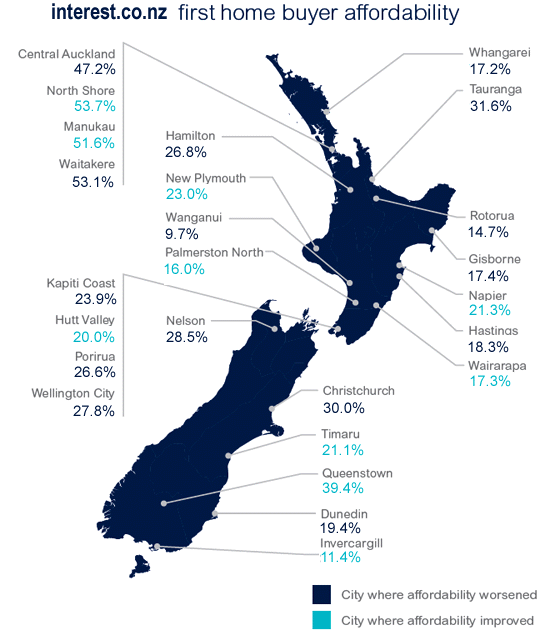
See the chart below to compare affordability in all regions of the country.
*Home Loan Affordability Report methodology:
The interest.co.nz Home Loan Affordability Report calculates the mortgage payments on homes if they were purchased at the REINZ's lower quartile selling price in each region, and then calculates how much of a typical first home buying couple's income the mortgage payments would consume.
The mortgage payments are based on a 25 year mortgage at the average of the major banks' interest rate for a two year fixed rate loan, while typical first home buyers' after tax incomes in each region are based on the regional median incomes for couples where both are aged 25-29, which are taken from Statistics NZ's Linked Employer-Employee Data Survey.
The deposits needed to buy a lower quartile-priced house in each region are calculated as the lesser of 20% of the purchase price, or the amount that would be accumulated if the couple saved 20% of their net income for four years, and earned interest at the average 90 day bank deposit rate.
We welcome your comments below. If you are not already registered, please register to comment
Remember we welcome robust, respectful and insightful debate. We don't welcome abusive or defamatory comments and will de-register those repeatedly making such comments. Our current comment policy is here.