
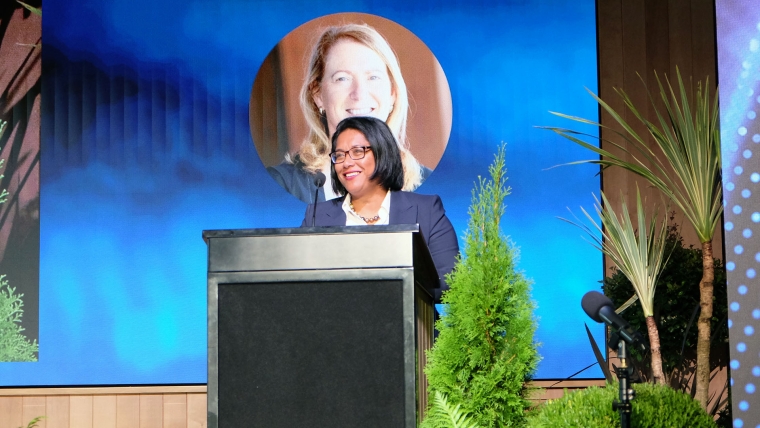
This year’s theme at the New Zealand Economics Forum is ‘big choices for a small nation’ and Labour’s finance spokesperson Barbara Edmonds says it could not be more timely for Aotearoa.
“New Zealand is in a moment of urgency and extraordinary opportunity. As a small country, the choices we make now matter more than ever," Edmonds told the audience in Hamilton on Thursday.
“When we get decisions right, we can move fast and prosper when we get them wrong, the consequences do linger a lot longer.”
The choices made now won’t just impact the next budget or election, Edmonds says.
“They will shape the kind of country we become over the next decade and beyond. And those choices aren’t just about how fast the economy grows. They’re about who benefits from that growth because an economy can be growing on paper, but while too many people are going backwards in real life.”
“Growth that pulls at the top while wages lag and essentials rise, that's not success," Edmonds says.
Economic leadership
New Zealand should be doing better, Edmonds says. She pointed to having a skilled workforce, great ideas and a history of innovation.
“But decades of under investment and short term thinking have held us back. Productivity has stagnated. Wages remain low, despite New Zealanders working some of the longest hours in the world.”
She spoke about the economy becoming smaller in size, unemployment and wages not keeping up.
“While the cost of essentials like food and power continue to rise, they are failing on the basics. And New Zealanders feel it and they understand it. They feel it at the petrol pump. They feel it at the checkout."
“They feel it when they have to dip into their KiwiSaver to make hardship withdrawals to make ends meet. They feel it when they put off seeing a doctor because they can't afford a visit. The Government did promise their choices would make life better.”
Edmonds says there was a lot of blame being flipped around on the Labour Party but also on global conditions, and US President Donald Trump and his tariffs.
“It does not absolve the Government’s responsibility of their choices. In uncertain times, we need leadership.”
She acknowledged that the world was volatile, global markets were uncertain and the rules-based order the country relied on for trade and stability was under pressure.
“That is exactly why economic leadership matters, why investment matters in uncertain times. Disciplined public investment isn’t reckless. It's how small countries like ours protect themselves and position their economies to grow.”
She says the question must not be whether the Government should invest. “The question is how and to what purpose.”
“Ask yourselves this, why did Australia, the UK and Japan grow over the last few years while our economy went backwards? It's because of choices. Leadership is about setting direction, not standing back and hoping for the best.”
Long-term fiscal pressures
The country is facing big and long-term fiscal pressures, she says. Examples she uses are an ageing population, rising healthcare costs, and growing risks from climate change and natural disasters.
Edmonds says the focus is often on New Zealand Superannuation and age.
“But how people retire is actually far more complex. It depends on whether they own a home, what savings they have and increasingly how their KiwiSaver supports their income in later life.”
Decisions around retirement should not be made in isolation, she says.
Housing, for example, is part of the wider retirement system and during her question and answer session, Edmonds says she wants house prices to be stable.
Speaking to reporters about her comment on wanting housing prices to be stable, Edmonds says; “ultimately, what that means is you don’t want those troughs and you don’t want those peaks.”
“We know that housing is an important part of that wider picture. Again, for me, it’s around stability.”
Edmonds says any changes to the retirement age isn't a decision just for the Labour Party and National Party to make, it needs to be a wider Parliament discussion.
“This is a pretty big conversation that we actually need to have as adults.”
‘Not growth for growth’s sake’
Edmonds also discussed Labour’s Future Fund, its capital gains tax, and its proposal to increase subsidies for video game developers and add small-scale studios to the scheme as part of an economic plan to support new industries and jobs in New Zealand.
“The strong economy is not just measured by numbers on a chart but whether people are getting ahead, where families feel secure, where children are able to learn in school, healthy, fed and with shoes on their feet.”
It was also whether “businesses have confidence to invest, whether where you start doesn't determine where you finish, whether the wealth we create stays here and lifts everyone”, she says.
“This is the standard we should hold ourselves to as a nation, and that's the standard I intend to deliver as the Minister of Finance. Not growth for growth's sake, but growth that makes life better for everyone.”
Evidence-based approach
Edmonds says her party will take an evidence-based approach when it comes to the investment boost tax policy and a potential levy on banks.
This comes as Finance Minister Nicola Willis spoke at the New Zealand Economics Forum and called for bipartisan support on the investment boost tax policy as “tax policy certainty needs to span successive governments”.
The investment boost tax policy was the centrepiece of the 2025 ‘Growth Budget’ offering a $1.7 billion annual tax incentive for investments in productivity-enhancing capital assets. The policy allows businesses to immediately deduct 20% off the cost from their taxable income, and still claim depreciation on the remaining 80% over time.
This effectively brings forward the tax benefit and lowers the cost of investment by shifting some of the risks and opportunity costs from firms to the Crown. This encourages earlier and larger investment in productive assets than would otherwise occur, and Treasury estimated in 2025, it will increase gross domestic product by up to 0.5% over the next five years.
Edmonds told reporters that Labour would make a decision on whether to continue the investment boost tax policy based on evidence.
“We’ve been asking the Minister of Finance [for] the six months around the effectiveness of the policy … We’ll make a measured and considered decision based on evidence.”
Reporters also put questions to her about a levy on banks - something Willis also responded to, saying the Government was looking at the comparability of their tax settings.
Edmonds says for most New Zealanders, they want to make sure that the fees that they’re paying at the banks are fair and reasonable.
“We’ve had a banking inquiry. We had some banks come again for the second part of that inquiry in front of the [Finance and Expenditure] Select Committee in the last couple of days."
“Ultimately for us, it needs to be evidence based so if [Willis is] going to be doing a review, provide some evidence based [information] and we’ll act on it,” Edmonds says.
We welcome your comments below. If you are not already registered, please register to comment
Remember we welcome robust, respectful and insightful debate. We don't welcome abusive or defamatory comments and will de-register those repeatedly making such comments. Our current comment policy is here.