

By Gareth Vaughan
BNZ has topped up its loan provisioning by $108 million, lifting total provisions to $776 million against a $90 billion loan book, as it settles into a world ravaged by COVID-19.
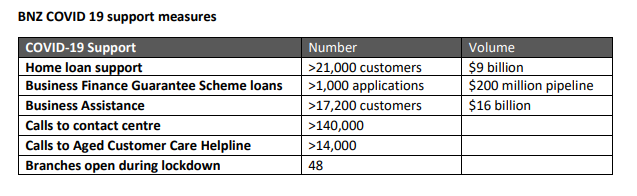
The bank also says it has provided assistance to 16,000 home loan customers and 17,000 business customers covering combined loan volumes of $23 billion.
BNZ on Tuesday posted a $183 million drop from last year's record high interim profit thanks to a software capitalisation policy change, a big rise in credit impairments and higher operating expenses. BNZ says net profit after tax fell 33% to $367 million for the six months to March 31 from $550 million in the same period of its previous financial year.
The bank said without a software capitalisation policy change that reduced its capitalised software balance, net profit after tax would've fallen $74 million, or 14%. Software capitalisation involves the recognition of internally developed software as fixed assets. The policy change increased the minimum threshold at which software is be capitalised to $5 million from $2 million.
BNZ reported credit impairments of $151 million versus $46 million a year earlier, and $68 million in the six months to September last year. The increase stems from an "economic adjustment" to the uncertainties and challenges of a COVID-19 world.
CEO Angela Mentis told interest.co.nz it was an unprecedented and very challenging time for everyone, with "a once in a hundred year public health shock that's having such a profound impact on economic and financial systems around the world and in New Zealand."
Mentis said BNZ sees the economy contracting by about 9% during 2020 as unemployment "goes towards" 10% and "house prices come off" by about 10%.
Chief financial officer Peter MacGillivray said on a business as usual basis BNZ's loan provisioning, being expenses reserved for default/bad performing loans, would've been about $43 million.
"[But] we took the opportunity based on various scenarios we've run and those key economic indicators around GDP, unemployment and housing, and we included a $108 million top up to our economic adjustment, and that then provides a total provisioning number of around about $776 million on our balance sheet," MacGillivray said.
The bank reported total operating income rose $15 million, or 1%, to $1.317 billion, with net interest income up $17 million, or 2%, to $1.051 billion. Operating expenses rose $164 million, or 33%, to $656 million.
BNZ said loans and advances grew 2% in the March half from the September half to $89.5 billion, and deposits and other borrowings grew 7% to $73 billion from $66.4 billion. At March 31 total assets reached $118.5 billion, up 9% since September 30.
The bank outlined its COVID-19-related customer assistance efforts, detailed in the table below.
"Together with the New Zealand Government and Reserve Bank, our focus has been on rapidly responding to assist our customers as they navigate this very difficult time," Mentis said.
"I have spoken to over 100 businesses. Everyone is using it as an opportunity to really look at their businesses, what is their cost base, have they moved their fixed costs to variable? I've also heard of many businesses using this as an opportunity to go digital. [And] a lot are looking at right sizing their businesses as well," Mentis said.
Capital 'strong'
MacGillivray said BNZ's capital position is strong, with a total capital ratio of 14.1% as a percentage of total risk weighted exposures, and a common equity tier one capital ratio of 11.6%. The Reserve Bank mandated minimums are 10.5% and 7%, respectively.
He also said the bank had seen "quite an inflow" of customer deposits over the last five weeks, whilst at the same time the "housing market has slowed considerably," without providing specific details.
In terms of past due loans or defaults, Mentis and MacGillivray said they weren't seeing immediate stress, and the support measures taken by the Government, Reserve Bank and banks "will cushion some of that blow across New Zealand businesses and consumers."
MacGillivray said BNZ has utilised the Reserve Bank's Term Auction Facility, which lends money to banks for up to 12 months, but just via a couple of transactions to date with one being a test. It has also used the Reserve Bank's Open Market Operation (OMO), "placing some treasury notes and government stock" into the OMO, which is designed to inject cash into the banking system. He didn't provide details of the size of the transactions.
On Monday BNZ's parent National Australia Bank (NAB) posted a 51% fall in March half-year cash profit to A$1.436 billion as its credit impairment charge ballooned to A$1.161 billion from A$449 million in the March half last year. NAB also unveiled plans for a A$3.5 billion capital raise, and slashed its interim dividend by A53 cents to A30c per share, equivalent to just 35% of cash profit.
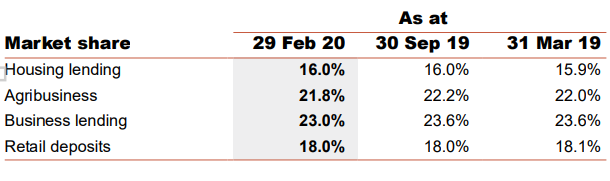
NAB said the net interest margin at its New Zealand banking unit fell six basis points year-on-year to 2.24% for the March half, with the cost to income ratio down 160 basis points to 36.2%. The table below, with NZ market shares, also comes from NAB.
We welcome your comments below. If you are not already registered, please register to comment
Remember we welcome robust, respectful and insightful debate. We don't welcome abusive or defamatory comments and will de-register those repeatedly making such comments. Our current comment policy is here.