
It is likely the Treasury is going to have to issue more debt than planned to help the Reserve Bank (RBNZ) remove some of the “printed” money it’s injected into the financial system.
The RBNZ, in its Monetary Policy Statement released on Wednesday, confirmed that from July it will start selling $5 billion of New Zealand Government Bonds (debt) per year back to the Treasury.
The RBNZ bought $54 billion of New Zealand Government Bonds on the secondary market between March 2020 and July 2021 in order to put downward pressure on interest rates to boost inflation and employment, in line with its monetary policy mandate.
It also bought $1.8 billion of Local Government Funding Agency bonds, which it will leave to drop off its balance sheet as they mature.
While the Treasury is currently sitting on a lot of cash - $35.7 billion as at January - it may need to borrow more in the future to fund these bond buybacks.
It confirmed it will update its forecast debt issuance programme on May 19, when Budget 2022 is released.
The Treasury noted the RBNZ’s decision doesn’t influence its debt issuance plans for between now and June 30, when the current fiscal year ends.
Why this matters
Should the Treasury have to issue new bonds (as it probably will) to buy old bonds back from the RBNZ, New Zealand taxpayers will ultimately be indebted to investors (on and offshore) for Covid-related expenditure, rather than the RBNZ, as is currently the case.
More debt also equals more costs for the Treasury, particularly in a rising interest rate environment.
The other takeout is that the RBNZ selling bonds back to the Treasury could put upward pressure on interest rates.
This could mean the RBNZ might not have to increase the Official Cash Rate (OCR) by as much as would otherwise be the case. However, it is unclear at this stage how much of an impact the sell-down will have on rates.
Background
The RBNZ bought the bonds in the first place because the OCR was already very low. If the Bank cut it more, it would’ve gone into unchartered negative territory.
The RBNZ’s willingness to become a large player in the bond market was convenient for the Treasury, as it meant there was a buyer for the big wad of bonds it issued to pay for Covid-related expenses like the wage subsidy and vaccines.
Now that inflation has surpassed the RBNZ’s target range, it is trying to put upward pressure on interest rates.
The main way it is doing this is by increasing the OCR. On Wednesday, it forecast increasing the OCR by more than previously expected (to 3.4% by 2025), possibly lifting it in 50-point increments in the future, rather than the usual 25 points.
Now that the RBNZ is firmly in tightening territory, it considers it a good time to start clearing the decks/downsizing its bond holdings to make it easier for it to potentially use bond purchases again in a future downturn.
Details
The RBNZ plans to sell the bonds to the Treasury rather than other investors on the secondary market to avoid its sales distorting the market or getting in the way of the Treasury’s debt issuance plans. The Treasury has agreed to this.
When the Treasury buys the bonds back, its cash account with the RBNZ (a liability on the RBNZ’s balance sheet, known as the Crown Settlement Account), will be debited. This effectively removes the liquidity that was injected into the system when the RBNZ created money in 2020 and 2021 to buy the government bonds/credit the Treasury’s cash account.
To put the planned $5 billion per year of buybacks in perspective, pre-Covid, the Treasury expected to issue only $8 billion of New Zealand Government Bonds in the year to June 2023. In December its forecast issuance for the 2022/23 year sat at $18 billion.
Impact on interest rates unclear
While $5 billion of buybacks per year will make for notable transactions between two arms of government, the RBNZ does not want this to impact monetary conditions.
“The bond holdings will not be actively used to remove monetary stimulus,” it said in its Monetary Policy Statement.
“Bond holdings will be gradually reduced to minimise unnecessary volatility in interest rates.”
However, the RBNZ said some members of its Monetary Policy Committee “noted that some longer-term interest rates may change as the market analyses the net effect on bond supply”.
ANZ senior strategist David Croy believed the sales would put upward pressure on rates.
However, he couldn’t specify exactly what $5 billion of quantitative tightening per year equated to in terms of equivalent OCR hikes. He suspected the RBNZ didn’t know either.
He noted that while on the one hand the RBNZ said it didn’t expect its bond sales to influence monetary conditions, on the other hand it noted the sales could “put some upwards pressure on longer-term interest rates”. It said this was one of the reasons it only hiked the OCR by 25 points, not 50 points.
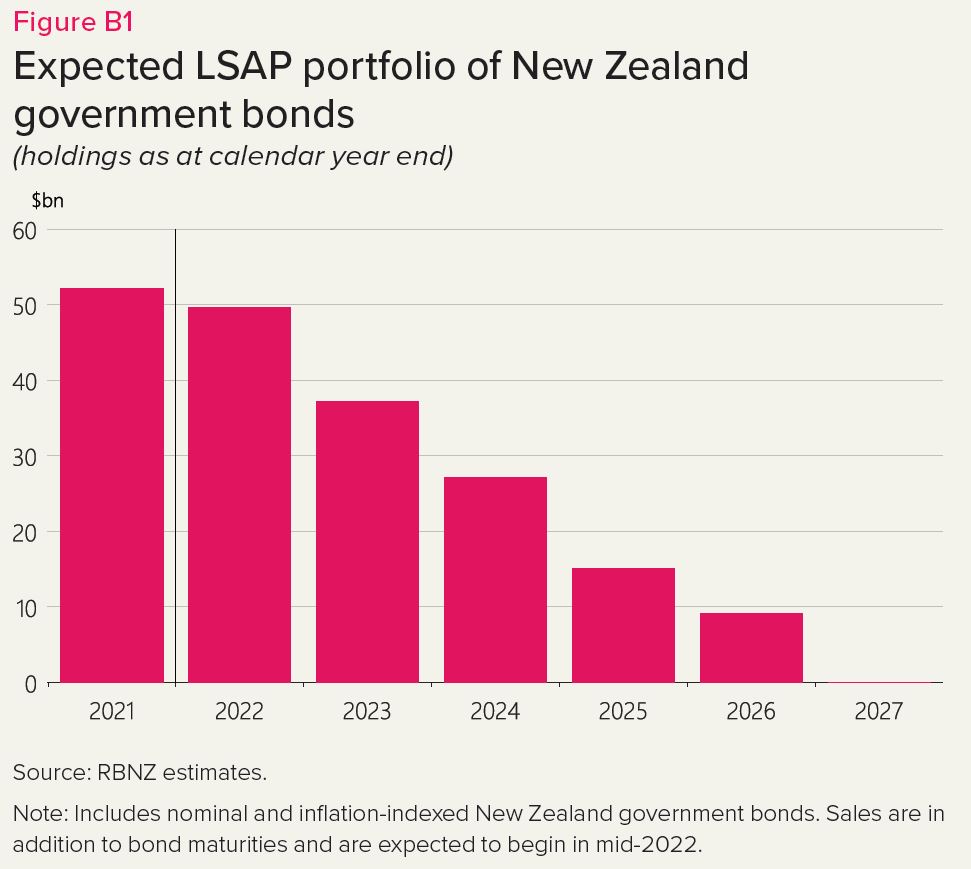
RBNZ’s LSAP bond holdings could hit zero by 2027
Digging further into the detail, Croy believed the RBNZ would sell its longer-dated bonds, leaving its shorter-dated ones to naturally drop off its balance sheet in the near-term.
Depending on which bonds the RBNZ sells, Croy said the LSAP programme could be fully unwound by 2027. The RBNZ alluded to this too, including the graph below in its Monetary Policy Statement. Without the sales, this point would only be reached in 2041.
All this said, the RBNZ made a disclaimer: “The Committee reserves the right to change the rate of sales or halt sales should conditions change, but do not foresee such changes to be common.”
We welcome your comments below. If you are not already registered, please register to comment
Remember we welcome robust, respectful and insightful debate. We don't welcome abusive or defamatory comments and will de-register those repeatedly making such comments. Our current comment policy is here.