

By Gareth Vaughan
Combined shocks to the closely linked residential mortgage and corporate lending portfolios of New Zealand's big four "too big to fail banks" would put pressure on their capital meaning there's merit in them having higher minimum capital requirements, the International Monetary Fund (IMF) says.
In a working paper entitled New Zealand Banks’ Vulnerabilities and Capital Adequacy, authors Byung Kyoon Jang and Masahiko Kataoka suggest given the large size of the four major banks - ANZ, ASB, BNZ and Westpac - and the fact they all have similar business models, careful attention must be paid to their vulnerabilities and resilience to shocks.
"The paper finds that, given New Zealand’s conservative approach in implementing the Basel II framework, New Zealand banks’ headline capital ratios underestimate their capital strength. A comparison with Canadian, UK and Australian banks highlights the impact of New Zealand’s more conservative approach," the authors say.
"Stress tests in the paper show that four large New Zealand banks could withstand sizable stand-alone shocks to their exposure to either residential mortgages (calibrated on the Irish crisis experience) or corporate lending."
However, combined shocks to both residential mortgages (which alone represents about 45% of the four banks’ total lending) and corporate lending (including loans to the agriculture sector this represents about 27% of total loans) would put more pressure on the banks’ capital. Given high bank concentration and large offshore wholesale funding needs, the merits of higher minimum capital requirements for systemically important domestic banks could be considered, together with other measures to be implemented."
The IMF working paper's suggestion New Zealand's big four banks ought to have higher regulatory capital requirements comes despite the Reserve Bank of New Zealand (RBNZ) being one of the first central banks in the world to implement Basel III, new beefed up global capital adequacy requirements. This means that since January 1 all New Zealand's banks must have a tier one capital ratio, which represents shareholders' funds in the bank, of 8.5% up from 4% previously. They must have a total capital ratio of 10.5%, up from 8%.
Based on their latest general disclosure statements, all New Zealand's big banks meet these Basel III requirements. And the IMF paper says the total capital ratio of New Zealand banks reached about 13% in 2012, below the 2011 average above 14% across 30 advanced countries.
'Too big to fail'
The IMF paper notes that any distress in one of the four banks could have significant repercussions for the entire New Zealand financial system and, in turn, the country's real economy. The big four banks combined gross loans - as at September 30 - of about NZ$270.7 billion, are equivalent to about 130% of the NZ$208 billion spending on Gross Domestic Product (GDP) in the year to September 2012. Or put another way, the combined assets of the four are equivalent to about 160% of GDP. And the combined assets of the four comprise almost 90% of total banking sector assets and they account for about 95% of the residential mortgage market.
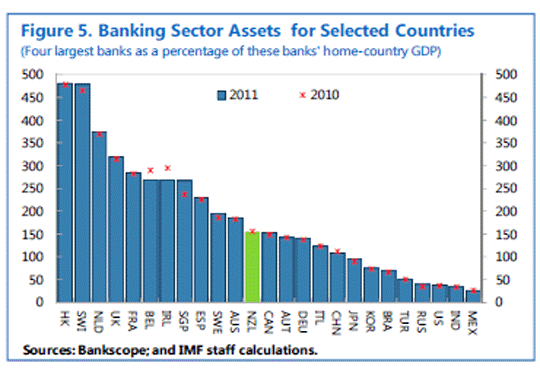
"Given the (big four NZ) banks’ size, markets and rating agencies perceive them as too big to fail and they could pose a sizable potential fiscal liability," the IMF paper says.
Although the authors' work suggests the big four banks could withstand sizable stand-alone shocks to either mortgage or corporate lending, the IMF paper notes the risks are highly linked and sizable combined shocks to both mortgages and corporate lending would put more pressure on the banks’ capital.
"For example, a hard landing in China, and thus Australia, would consequently reduce demand for New Zealand exports, worsen terms of trade, and could trigger a sudden decline in house prices. This could in turn weaken consumer demand and growth, and negatively affect banks’ balance sheets. The downside macroeconomic impact of such a scenario could be substantial."
The IMF paper suggests New Zealand banks face a number of risks. These include large exposure to highly indebted households and to the agriculture sector. On top of this, although household net wealth (mainly housing) exceeds 500% of disposable income, household debt remains high at over 140% of disposable income. The authors say a rise in mortgage rates together with an increase in unemployment could lead to an increase in nonperforming loans.
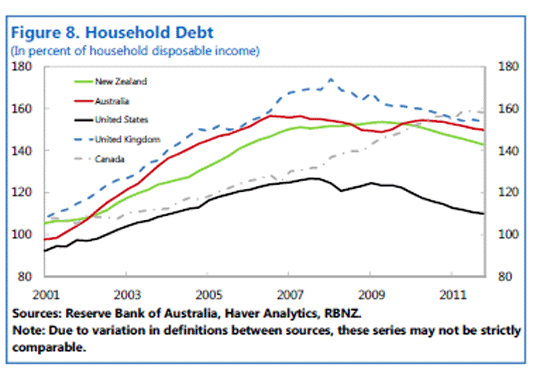
"(NZ) residential house prices are estimated to remain elevated about 10-20%. (And) a large fall in commodity prices would impair the quality of agricultural loans, but the capital requirements for these loans have been strengthened since mid-2011."
Then there's New Zealand banks’ reliance on short-term offshore funding as an additional vulnerability given exposure to potential disruptions in global financial markets.
"After the collapse of Lehman Brothers, banks came to the Reserve Bank of New Zealand for liquidity support and used the government’s wholesale funding guarantee to gain access to international markets. Parent banks in Australia also provided funding to their subsidiaries in New Zealand."
"New Zealand banks, however, have made steady progress in lengthening the maturity profile of their wholesale funding since 2008 and increasing the share of retail deposits. But New Zealand’s short-term external debt (mostly held by banks) remains sizable at about 50% of GDP, and loan-to-deposit ratios are high."
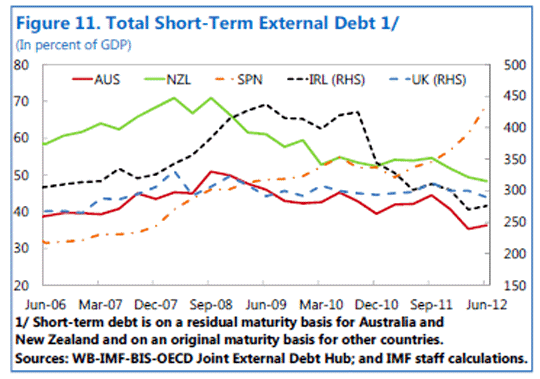
Figures from PwC last year showed that during the six months to March 2012 the big five banks' (adding Kiwibank) proportion of wholesale funding fell to 39% of total funding from 42% in the previous six months, and their proportion of overseas funding fell to 34% from 36%.
Advice for the RBNZ on future stress tests
The IMF authors note the Reserve Bank undertook stress tests jointly with the Australian Prudential Regulatory Authority (APRA) last year to assess the four large banks’ resilience to severe shocks. These tests included factoring in a 40% drop in the world price of New Zealand’s commodity exports, a six-month freeze in wholesale debt markets, a cumulative output loss of 4%, a rise in unemployment to 11.4%, and a fall in house, farm and commercial property prices of about 30%.
"This scenario resulted in Tier 1 capital ratios falling from over 10% to around 6% over three years, which is broadly similar to the result of the combined shocks to both residential mortgages and corporate lending."
As interest.co.nz reported last year, as a result of the stress tests, the Reserve Bank suggested if a serious global downturn were to hit the New Zealand economy the big banks would be expected to bolster their capital positions rather than slash new lending.
However, the IMF suggests that following experiences in other countries such as Japan, Greece, Spain, Britain and the USA, and New Zealand banks’ high exposure to residential mortgages, future stress test scenarios could consider a longer time horizon than the three year one assessed by the RBNZ and APRA to take into account the impact of sustained high unemployment. The report notes risk horizons in recent British, German and Dutch stress tests were five years.
"In light of New Zealand banks’ dependence on offshore funding, future stress tests could also consider a jump in global longer-term interest rates, which could come from a rise in global rates and an increase in New Zealand banks’ risk premium."
"While continued strong bank supervision will play an important role in maintaining financial stability in New Zealand, options to strengthen prudential norms if needed could include higher minimum capital requirements for systemically important domestic banks to provide higher loss absorbency, taking into account the currently evolving international standards and other measures to be implemented in New Zealand."
"More robust capital levels for systemically important domestic banks would be beneficial, particularly in times of market uncertainty and given their large wholesale funding needs. While the (RBNZ's) proposed 'Open Bank Resolution' could help limit the fiscal costs of a bank failure, higher capital requirements could reduce the fiscal risk further. In addition, higher capital buffers would limit the risk that a deterioration in bank asset quality could raise their cost of capital and create offshore funding difficulties."
'Raise the core funding ratio higher than 75%'
"The core funding ratio could also be raised to more than the planned 75% to reduce short term external debt further. The planned counter-cyclical capital buffer framework and other macroprudential instruments under consideration would help improve the resilience of New Zealand’s banking system to extremes in the credit cycle."
Introduced in April 2010 as a move designed to reduce New Zealand banks' reliance on short-term overseas borrowing, the core funding ratio sets out that banks must secure at least 75% of their funding from either retail deposits, or wholesale sources such as bonds with durations of at least a year. The Reserve Bank lifted the core funding ratio to 70% from 65% on July 1, 2011 and to 75%, from January 1, 2013.
Based on RBNZ data, banks as a group had a core funding ratio of 85.2% as of November last year.
The RBNZ is working with Finance Minister Bill English and Treasury on potential macro-prudential tools including housing loan-to-valuation ratio limits.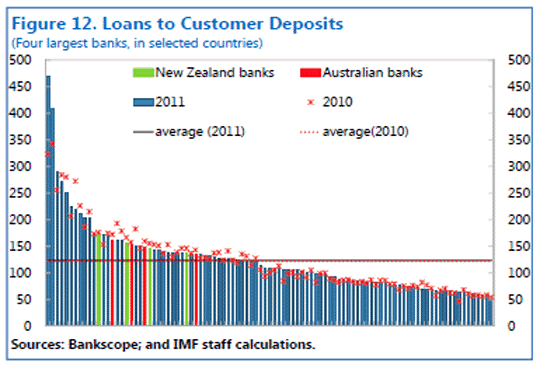
This article was first published in our email for paid subscribers. See here for more details and to subscribe.

We welcome your comments below. If you are not already registered, please register to comment
Remember we welcome robust, respectful and insightful debate. We don't welcome abusive or defamatory comments and will de-register those repeatedly making such comments. Our current comment policy is here.