

By Gareth Vaughan
Will the development of the Reserve Bank's so-called macro-prudential tools give it any silver bullets to fire at an over heating housing market?
Based on the statement accompanying the Reserve Bank's latest Official Cash Rate review the boffins there are getting worried. Their concern appears to be over the return of double digit annual house price growth, New Zealanders leveraging against the rising value of their homes to splurge on cars and flat screen TVs, and the potential for a major house price correction at some point.
As politicians at both a local and national level bicker and promise, demand outstripping supply has seen Auckland and Christchurch lead the national median house price up 10% over the past year with housing affordability, alongside unemployment, this year's big political issue. Now focus is going on the Reserve Bank and its toolbox.
So could any of the macro-prudential tools the central bank boffins, their Treasury counterparts and Finance Minister Bill English are looking into, work as a hand brake to slow down an overheating housing market? Or could they go even further and encourage banks to lend more money to productive, job creating businesses and rein in residential mortgage lending?
A consultation paper on the tools is due out sometime in March.
So let's take a look at exactly what the four macro-prudential tools under consideration are, what impact they might have, and what the Reserve Bank has already had to say about them.
One: The counter cyclical capital buffer - ambulance at bottom of cliff
Firstly there's what's known as a counter cyclical capital buffer. The Reserve Bank has given itself the discretion to utilise this tool from 2014. It would be a buffer of common equity added to banks' regulatory capital requirements during periods of "excessive" credit growth. The aim would be to help protect the financial system during a subsequent downturn. The Reserve Bank says it could vary from 0 to 2.5% of risk-weighted assets, but it's possible no formal maximum size will be set, meaning the scale could be set according to circumstances.
It would come on top of existing capital adequacy requirements including a new 2.5% conservation buffer being brought in from 2014. The conservation buffer's designed to ensure banks maintain breathing space above the minimum capital ratio requirements to be used to absorb losses in times of financial and economic stress. Banks' minimum tier one capital ratio, representing shareholders' funds in the bank, is now 6% of risk weighted exposures. Banks' minimum total capital ratio is 8%.
The Reserve Bank has said banks will get up to 12 months notice before the implementation of a counter cyclical credit buffer.
Two: The core funding ratio - banks in clover
Secondly is the core funding ratio.
Introduced in April 2010 as a move designed to reduce New Zealand banks' reliance on short-term overseas borrowing, the core funding ratio initially set out banks had to secure at least 65% of their funding from either retail deposits, or wholesale sources such as bonds with maturities of at least a year.
Lifted to 70% in 2011 and then 75% from January 1, the latest Reserve Bank data shows banks' had a combined ratio of 85.2% at the end of November, or NZ$236.5 billion worth of core funding.. So they're not exactly struggling with it.
Even if it's lifted higher still covered bonds, which carve off residential mortgages written by the banks as security and for which there's a strong appetite especially in Europe, and vanilla bonds issued cheaply to yield deprived overseas investors like the Swiss, both qualify. We're also in an environment where the banks have taken in NZ$29 billion more in deposits than they've lent out over the last three years.
Lending growth is showing signs of a resurgence however. December home loan growth rose 3.7% year-on-year, its fastest rate since January 2009. Agriculture debt was up 5.1%.
Three: Increasing the risk weight on mortgage lending - hasn't slowed rural credit growth
Thirdly is adjustments to risk weights on sectoral lending. Basically this means changing the amount of regulatory capital banks must hold against loans in case they go pear shaped.
Gareth Morgan, for one, is excited at the prospect of this. But Reserve Bank Deputy Governor Grant Spencer recently wrote a widely published article seemingly trying to hose down expectations that changing risk weights on residential mortgages, about 56% of bank lending books, would lead to significant change in lending behaviour.
Regulatory capital minimums on residential mortgages are lower than those on other lending such as business and farm loans, personal loans and credit cards. For example, ANZ's most recent disclosure statement shows a 26% risk weight on retail mortgages, a 59% one on corporate (business and farm) loans, and 73% on other retail including personal loans and credit cards.
It's also worth noting the rules differ among the banks. The big four banks - ANZ, ASB, BNZ and Westpac - use what's known as the internal ratings-based approach. This means they build their own models to calculate their regulatory capital requirements and must then get them approved by the Reserve Bank. All other banks run what's known as the standardised approach where the Reserve Bank prescribes their risk weights.
For the big four, capital requirements are determined by multiplying risk-weighted assets by 8%. (See table below).
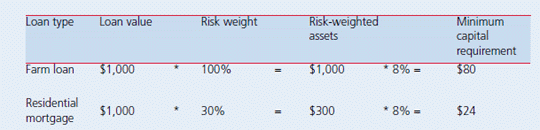
By increasing the risk weight on an asset class, such as home loans, banks' incentive to lend to that sector could be reduced because it should cost them more to do so. And if banks' pass their increased costs on to customers, the latter will pay higher interest on their loans. However, the Reserve Bank argues banks' own funding costs, their assessment of the riskiness of a loan or sector, and their competitive positioning are, and always will be, the most important factors setting loan pricing.
In terms of credit growth, let's look at what has happened since the Reserve Bank tightened the rules on the big four banks' farm loans in June 2011. It did this in the wake of falling dairy payouts and concern over loose rural lending by the banks. The changes mean the big four banks now have to apply risk weights of up to 90% of a farm loan instead of 50%. All other banks already had to apply risk weights of 100% to all farm loans.
Note the Reserve Bank did initially delay the increases to farm loan risk weights after banks said the move would see farmers paying between 30 and 50 basis points more to borrow.
And what has happened to rural lending growth since June 2011? It's up NZ$2.6 billion to a record high of NZ$49.77 billion. The Reserve Bank warned in November's Financial Stability Report the dairy sector appeared more vulnerable to a sharp decline in the payout than at the time of the peak in dairy prices four or five years ago.
Back to risk weights on home loans. I for one won't be holding my breath for major changes to be made given Spencer's article said: "Risk weights on housing lending in New Zealand are relatively high by international standards, the average in New Zealand being almost three times that of the Canadian average or around 1.5 times that of Australian or UK banks, according to a recent International Monetary Fund study. So the NZ regime does not favour housing lending compared to international norms."
Four: LVR limits - John Key not a fan
And fourth is limits on loan-to-valuation ratios (LVRs). This, for example, could set out a rule whereby borrowers must have a deposit of at least 20% when taking out a residential mortgage. It could also exclude first home buyers.
Worth noting here is the Reserve Bank looked at this option seven years ago and dismissed it. On top of this Prime Minister John Key has publicly expressed scepticism about this concept.
In 2005-06, at the height of the naughties cheap credit bubble, Reserve Bank and Treasury boffins teamed up in what was called a Supplementary Stabilisation Instruments project. This looked into tools, directly affecting the housing market and/or the market for residential mortgage credit, that could supplement the central role of the Official Cash Rate in managing inflation. The tools they looked at included LVR limits.
In a letter to Finance Minister Michael Cullen in March 2006 Reserve Bank Governor Alan Bollard and Secretary to the Treasury John Whitehead concluded: "There are no simple, or readily implemented, options that would provide large payoffs in the near-term."
An LVR limit, on all loans secured on residential property by all lenders would have a direct impact on the most leveraged portion of the housing market, Bollard and Whitehead said.
"However, the rules for such a limit would be difficult to define and difficult to enforce. The pressure for disintermediation would be very great. The report also notes that the segment of the market most affected by this measure contains a high proportion of low income earners and first home buyers."
And the report itself said: "This instrument should not be developed further."
Meanwhile, Key has said: "Any consumer can effectively go around that [LVR controls]. All historical attempts to stop that haven’t been very successful."
“You can certainly protect the banks’ balance sheets from over-exposure to the property market, but the capacity of someone to go to their friend or lawyer or some other institution to get that other piece of equity that they don’t have, is always real," added Key.
Bollard blamed past LVR limits for the growth of finance companies
And in even stronger criticism of the concept than in his 2006 letter to Cullen, Bollard told interest.co.nz last year:"A loan to value ratio might be the least desirable of the ones we might look at."
"Those sorts of direct interventions (were used in the 1970s) and they ended up with lots of distortions, and they ended up with people finding other ways to get money, and that's where some of our current crop of finance companies came from, ways to get around bank regulation in the 1970s," Bollard said. "They're distortions."
It's hard to believe the view on LVR limits has changed much at the Reserve Bank since the arrival of new Governor Graeme Wheeler. However, responding to a question at a November press conference he did at least note there had been some success overseas where LVR limits have been introduced with first home buyers exempt.
"When those measures have been applied they've tended to supply some degree of relief for first home owners. They tend to look more at people who are trading up or people who own second or third homes," Wheeler said.
But he then went on to say that even if such a tool was available, it wasn't something the Reserve Bank believed the current state of the housing market justified using.
Epiphany or politicians
And as Spencer pointed out at the same November press conference macro-prudential tools are about countering systemic risks, i.e. protecting banks from themselves, rather than necessarily cooling a housing market with growing affordability problems.
"We would have to consider, in order to use such a tool, that there was really a risk situation that was building in the banking system that needed countering through macro-prudential policy that wasn't being handled sufficiently by the micro-prudential tools that we use as a matter of course," said Spencer.
So unless there's a major epiphany at the Reserve Bank and Treasury within the next few weeks, it looks like any serious steps to cool the housing market are up to the politicians.
This article was first published in our email for paid subscribers. See here for more details and to subscribe.
We welcome your comments below. If you are not already registered, please register to comment
Remember we welcome robust, respectful and insightful debate. We don't welcome abusive or defamatory comments and will de-register those repeatedly making such comments. Our current comment policy is here.