

By David Hargreaves
The Reserve Bank says its forecasting ability would be greatly improved if Statistics New Zealand began producing monthly inflation data - rather than quarterly as at the moment.
The RBNZ's Assistant Governor and Head of Economics John McDermott says those at the central bank are "not fortune tellers" and "more often than not" the world does not turn out as they forecast. The RBNZ's forecasts are "highly conditional" based on information currently available.
"...However, forecasting is still a valuable and necessary part of the monetary policy process. Producing forecasts and allowing them to be publicly subject to challenge enables us to build a solid foundation for policy decisions, learn from developments, and improve our policy outcomes. Forecasting is not supposed to be prophecy; rather, it is about being precise about our thinking."
In a speech entitled "The Value of Forecasting in an Uncertain World" delivered to the New Zealand Manufacturers and Exporters Association (NZMEA) in Christchurch on Monday, McDermott said over the past few decades, increases in computing power have enabled the RBNZ to vastly expand its modelling and research capability.
"...However, one significant limiting factor to forecast improvement is data: macroeconomic statistics have not fundamentally changed over the 30 years we have been using inflation targeting.
"For instance, New Zealand is one of only two advanced countries that use a quarterly consumer price index rather than monthly.
"This is likely to be a fruitful avenue for future improvement that would greatly improve the Bank’s forecasting ability," McDermott said.
McDermott doesn't mention Statistics New Zealand by name - though it is the organisation that produces NZ's CPI inflation figures. He gives no further detail in the speech as to whether such an initiative is in train, or whether it is something the RBNZ is actively pushing for behind the scenes.
Benign forecasts
The speech by McDermott came only four days after the RBNZ had surprised markets by producing an unchanged and extremely benign set of forecasts for future inflation in its latest Monetary Policy Statement - despite recent sharp rises both in actual inflation and in public expectations of future inflation.
Given the proximity to the release of the latest MPS, McDermott's speech is likely to be seen by the marketplace as an attempt to explain its current thinking given how much that thinking appeared to run counter to market thinking.
McDermott gave a detailed explanation of the RBNZ's forecasting approach and the philosophy behind it.
"So how do we make policy for an uncertain future? The approach that the Bank takes is to develop forecasts that are highly conditional on the information currently available," McDermott said.
"That is, our forecasts are subject to revision when additional information comes to light. These forecasts are then used in what [eminent American economist] Alan Blinder would describe as a ‘dynamic programming’ plan. This means thinking about what you want to achieve in the future and working backwards to form a plan today that will deliver that goal. In our case the goal is inflation near 2% in two or three years’ time, and the plan is given by the forecast of the Official Cash Rate (OCR). If events broadly unfold as envisaged then we carry out that plan, if not, then we adjust the plan," McDermott said.
"Forecasting is a valuable part of the monetary policy process, helping the Bank to plan for the future, make well-founded policy decisions, communicate its understanding and intentions, and accommodate new information as it appears. It requires the Bank to be rigorous, unbiased, and open to new ideas in formulating and implementing monetary policy," McDermott said.
"Because we operate in a world of radical uncertainty, we do not know what might happen in the future; we are not fortune tellers.
"However, because we want our forecasts to be relevant and useful, we present them numerically, an approach that comes with risks."
'RBNZ does not want to be safe'
The RBNZ did "not want to be safe", as it welcomed scrutiny, both internally and externally, as this built understanding and fostered accountability.
Good forecasting happened, McDermott said, when the numbers were supported by evidence and reasoning, and subject to public scrutiny.
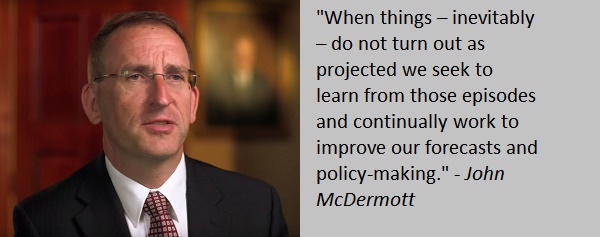
"When things – inevitably – do not turn out as projected we seek to learn from those episodes and continually work to improve our forecasts and policy-making."
The 2014 rate hikes
McDermott produced a 'case study' based on what happened in 2014 when the RBNZ raised the Official Cash Rate four times - increases that were subsequently more than reversed.
"At the start of 2014 the global economy appeared to be recovering from the 2008/9 global financial crises, with the IMF asking whether the 'tide was rising'. The New Zealand economy was growing strongly: the terms of trade had reached their highest level in 40 years; construction activity was robust; immigration was boosting housing and consumer demand; and monetary policy was providing substantial stimulus to the economy.
"Under these circumstances, we judged that there was a high probability that inflationary pressures were rising, contingent on the global and domestic economy developing as forecast and our knowledge of the structure of economic relationships. This view about rising inflation pressures was shared by the private sector forecasters and the IMF. Consequently, the OCR, which was set at an accommodative level of 2.5%, was raised by a total of 1.0 percentage points at successive OCR reviews in the first half of 2014.
'Not developing as expected'
"However, by September 2014 it had become apparent that the forecast contingencies were not developing as expected. Firstly, uncertainty around the central scenario had risen: the global economy was not strengthening as anticipated and New Zealand terms of trade had fallen by about 7% since the start of 2014. Secondly, uncertainty about the structure of the domestic economic relationships was becoming apparent as CPI inflation remained moderate despite the inflationary pressures. Under these circumstances the Bank judged it appropriate to put a hold on interest rates, await the flow of new economic data, and investigate the evolution of domestic economic relationships.
"In the event, this decision proved correct. Global economic growth continued to be sluggish through 2015 and 2016. The Bank’s analysis of the domestic economic relationships concluded that resource pressures were not as strong as previously estimated, in part due to the record level of migration that the New Zealand economy was experiencing. Low inflation had also changed the price-setting behaviour of New Zealand businesses, who were placing a greater weight on recent low inflation (rather than expectations of future inflation) in their wage-setting and pricing decisions.
"Incorporating these lessons into our forecasting framework meant that by mid-2015 the most probable scenario had changed to a continuation of low inflation . The Bank commenced a new cycle of reducing the OCR, to an eventual low of 1.75% in November 2016.
"Today, in May 2017, the most likely scenario is for the OCR to remain stable for some time, although uncertainty remains high."
At the heart of forecasting
McDermott said at the heart of RBNZ's forecasting was its structural model, the New Zealand Structural Inflation Model (NZSIM).
"This is a theoretically rich framework that describes key behavioural relationships in the New Zealand economy and how they influence inflation. NZSIM generates the core forecasts for informing monetary policy decisions, and helps us identify the fundamental economic drivers and empirical relationships to explain the observed economic data.
"The information collated over the forecast round is fed into NZSIM, and the theoretical structure of the model ensures that our forecasts are consistent. For example, the national income accounting discipline is preserved, we can distinguish between domestic and imported inflation which sum up to CPI inflation, and we are able to trace the forces driving economic growth.
"During the monetary policy decision-making process, the NZSIM forecasts are cross-checked with other modelling, and where appropriate modified to take into account additional information not directly represented in the model. That is, our forecasts are ‘model-assisted’ rather than ‘model-produced’. NZSIM also can consider alternative scenarios, meaning that we can test competing ideas and assess how monetary policy should respond if circumstances develop differently.
"NZSIM necessarily abstracts from reality, and (as with any modelling) requires some difficult tradeoffs to be made, balancing the amount of detail that can be incorporated without sacrificing the ease of interpretation and resulting policy recommendations.The combination of tractable model outputs and the expert judgement of Bank colleagues and Committee members forms the basis for building nuanced and detailed policy recommendations."
We welcome your comments below. If you are not already registered, please register to comment
Remember we welcome robust, respectful and insightful debate. We don't welcome abusive or defamatory comments and will de-register those repeatedly making such comments. Our current comment policy is here.