

Business confidence has plunged to its lowest level in 10 years according to the NZ Institute of Economic Research's latest Quarterly Survey of Business Opinion (QSBO).
Coming hard on the heels of a similarly downbeat ANZ Business Outlook Survey from last week, the latest survey is likely to heap more downward pressure on the outlook for interest rates.
Already it is widely expected that the Official Cash Rate will be lowered to 1.25% (from the current 1.5%) by the Reserve Bank next month, after the RBNZ said last week that "a lower OCR may be needed over time".
With the mood of business now in its deepest funk since the global financial crisis and Australian rates seen as almost certainly being trimmed later on Tuesday, the prospect of the RBNZ having to go lower even than 1.25% becomes very real. The ANZ economists had already previously predicted that it will drop to 1% this year.
The detail of the NZIER's latest QSBO shows business confidence fell to its lowest level since March 2009, with a net 31% of businesses expecting a deterioration in general economic conditions over the coming months.
Arguably the more indicative measure in such surveys is what firms are predicting in terms of their own activity - and this is real bad as well.
A net 4% of businesses reported reduced demand in the June quarter just gone.
A net 4% of businesses also expect demand to fall in the next quarter – which is the weakest level since June 2009.
"These measures suggest a softening in annual GDP growth to below 2% over the second half of 2019," the NZIER said.
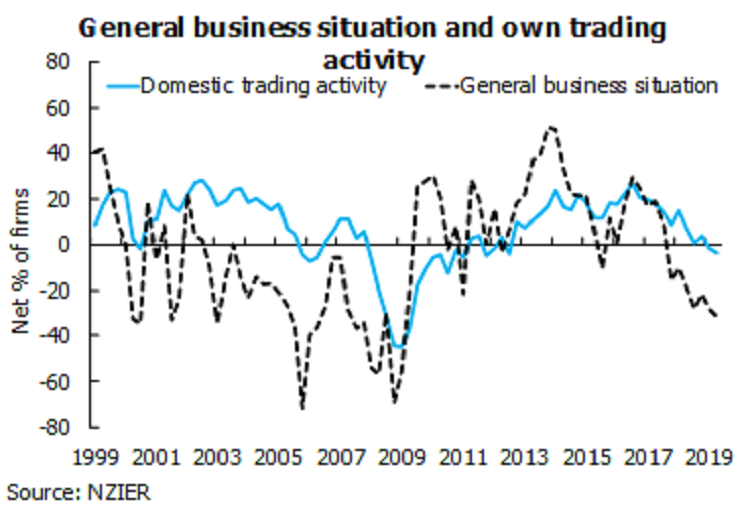
Surveys can be open to political influence in the sense that they can be seen as a 'protest vote' from businesses. And it's true that generally business confidence has been down since the Coalition Government came into power towards the end of 2017.
But when businesses talk about their own prospects and pulling back on future activity - that's when a downbeat mood can become a self-fulfilling prophesy.
And to that extent, the suggestion that the latest survey is pointing to GDP growth below 2% will now get the country's economists reshaping (down) their forecasts and there will inevitably be suggestions that the RBNZ will have to do more in terms of OCR cuts to restore the growth path for the economy.
ASB now sees OCR at 1%
The response of ASB economists on Tuesday was immediate, with ASB senior economist Jane Turner saying they now expect the RBNZ will cut the OCR twice more, in August and November, bringing the Official Cash Rate (OCR) to 1%.
"We feel an OCR cut in August is a done deal and the timing of the second cut will remain dependent on domestic data, global events, the NZD and actions of offshore central banks."
ANZ senior economist Miles Workman described the outcome of the latest NZIER survey as "a dose of cold water".
"We are forecasting economic momentum to gradually lift from the second half of the year, but with headwinds persisting, we expect this to be relatively hard yards versus the RBNZ’s February expectation of a rapid bounce-back (last week’s OCR Review suggests the RBNZ’s forecast will be revised down).
"...We think the RBNZ will conclude that additional monetary stimulus is needed to address this, and are forecasting two further 25bp OCR cuts, in August and November."
This is the full NZIER release:
The latest NZIER Quarterly Survey of Business Opinion (QSBO) shows business confidence fell to its lowest level since March 2009, with a net 31 percent of businesses expecting a deterioration in general economic conditions over the coming months.
Adding to the negative news was a further decline in firms’ own trading activity, with a net 4 percent of businesses reporting reduced demand in the June quarter. A net 4 percent of businesses also expect demand to fall in the next quarter – the weakest level since June 2009. These measures suggest a softening in annual GDP growth to below 2 percent over the second half of 2019.
Manufacturing sector the most pessimistic
Sentiment remained the weakest in the manufacturing sector. Confidence amongst manufacturers fell to its lowest level since December 2008, with over half of manufacturers surveyed expecting economic conditions to worsen over the coming months. Deteriorating profitability contributed to the pessimism, with a net 3 percent of manufacturers cutting prices despite rising costs over the past quarter. This led manufacturers to pare back on hiring in the June quarter.
The pipeline of construction work has improved, but building sector firms’ expectations of output for the next quarter are subdued. However, pricing power has improved for firms, with more firms able to raise prices to recoup margin.
There are also signs retailers are finding it easier to increase prices, although over half of retailers still reported rising cost pressures. Retailers are reducing headcount, likely in response to softening demand and rising labour costs given the increases in the minimum wage.
Further weakening in profitability
Although profitability in some sectors is starting to show signs of improvement, overall profitability has fallen to its lowest level since March 2011. Firms have reduced headcount but are feeling more optimistic about investing in plant and machinery and buildings. We expect that as wage growth continues to pick up this should encourage more firms to invest in labour-saving technology.
Firms downbeat across most regions
The downbeat mood was broad-based across most regions, with West Coast and Tasman the exceptions. In particular, weaker demand in the Bay of Plenty is weighing on pricing power and hence having a negative impact on profitability amongst firms in the region.
We welcome your comments below. If you are not already registered, please register to comment
Remember we welcome robust, respectful and insightful debate. We don't welcome abusive or defamatory comments and will de-register those repeatedly making such comments. Our current comment policy is here.