

Summary of key points: -
- Risk of tightening NZ monetary and fiscal policy too quickly
- US Federal Reserve’s “lift-off test” soon to be met
Risk of tightening NZ monetary and fiscal policy too quickly
From the bullish and optimistic forecasts of strong post-Covid growth of only a few short months ago, the outlook for the New Zealand economy today is far less certain with risk clouds gathering.
The lockdowns have caused the economy to lose all its positive impetus from the strong numbers in the June quarter.
The economy is now in a transition phase from the extreme levels of monetary and fiscal policy stimulus implemented last year in response to the Covid shock to a period of where the artificial stimuli are now being quite quickly withdrawn.
The question is whether the economy can gain sufficient traction under its own steam from here without the special life support measures? We have been very lucky that export commodity prices have lifted to record highs over the period to compensate the economic activity we lost from foreign tourism.
Two major risks for the NZ economy in 2022 stem directly from what policy changes the Reserve Bank and the Government will make with monetary and fiscal policy respectively from here: -
- If the RBNZ over-react to the sudden surge in the inflation rate by tightening monetary policy too rapidly over coming months, they run the risk of unnecessarily sending the economy into recession. Should the RBNZ endorse the current aggressive forward interest rate market pricing at their next monetary policy statement on 24 November, they will increase the risk of economic recession. They have the opportunity to hose-down the over-hyped interest rate market expectations of much tighter policy conditions, but there is a big question as to whether the RBNZ will have the intestinal fortitude to give the markets the finger! The central bank Governors of Australia and England did exactly that this last week. As the Bank of England Governor, Andrew Bailey stated a few days ago "Putting interest rates up, I'm afraid, isn't going to get us more gas".
- A damning report from the Government Treasury last week warned Finance Minister, Grant Robertson that economic growth over coming years will not be enough to provide extra revenue into the Government to repay all the additional debt that has been taken on over the last 18 months. Fiscal policy will need to be tightened by either increasing tax rates or reducing Government spending. A Labour Government will not be doing the latter, so businesses and households should strap themselves in for taxation increases that will impede both consumer spending and investment.
The probability of the “doomsday” scenario for the NZ economy in 2022 of falling house prices, falling commodity export prices, a global equity market downward correction and both monetary and fiscal policy being tightened by too much at the wrong time, has arguably gone up a notch.
Implications for the value of the NZ dollar from the RBNZ’s upcoming monetary policy forward guidance will be negative if they correctly dial-back on the speed of interest rate hikes.
However, the Kiwi dollar will appreciate further if the RBNZ endorse the rapid monetary tightening currently priced-in to the interest rate market.
They will be the lone shag on the rock in doing so, as the Aussies, the Brits and the Americans are all adopting a much more cautious approach.
US Federal Reserve’s “lift-off test” soon to be met
Whilst a relatively poorer economic performance by New Zealand in 2022 would not be a positive for the Kiwi dollar, an NZD/USD exchange rate in the 0.6000’s does not seem likely in an international environment of a weaker US dollar against all currencies.
The bearish case for the USD in the medium term remains, based on their dual deficit problem and all the good news on US interest rate increases being fully priced into the US currency value well in advance.
The timing of US interest rate increases next year is now the debate the FX markets will have over coming months.
As expected, the Federal Reserve last week confirmed the tapering of their bond buying programme over the next eight months.
Fed Chair Jerome Powell clearly enunciated the prerequisites and conditions for the Fed to provide the signal to increase interest rates next year.
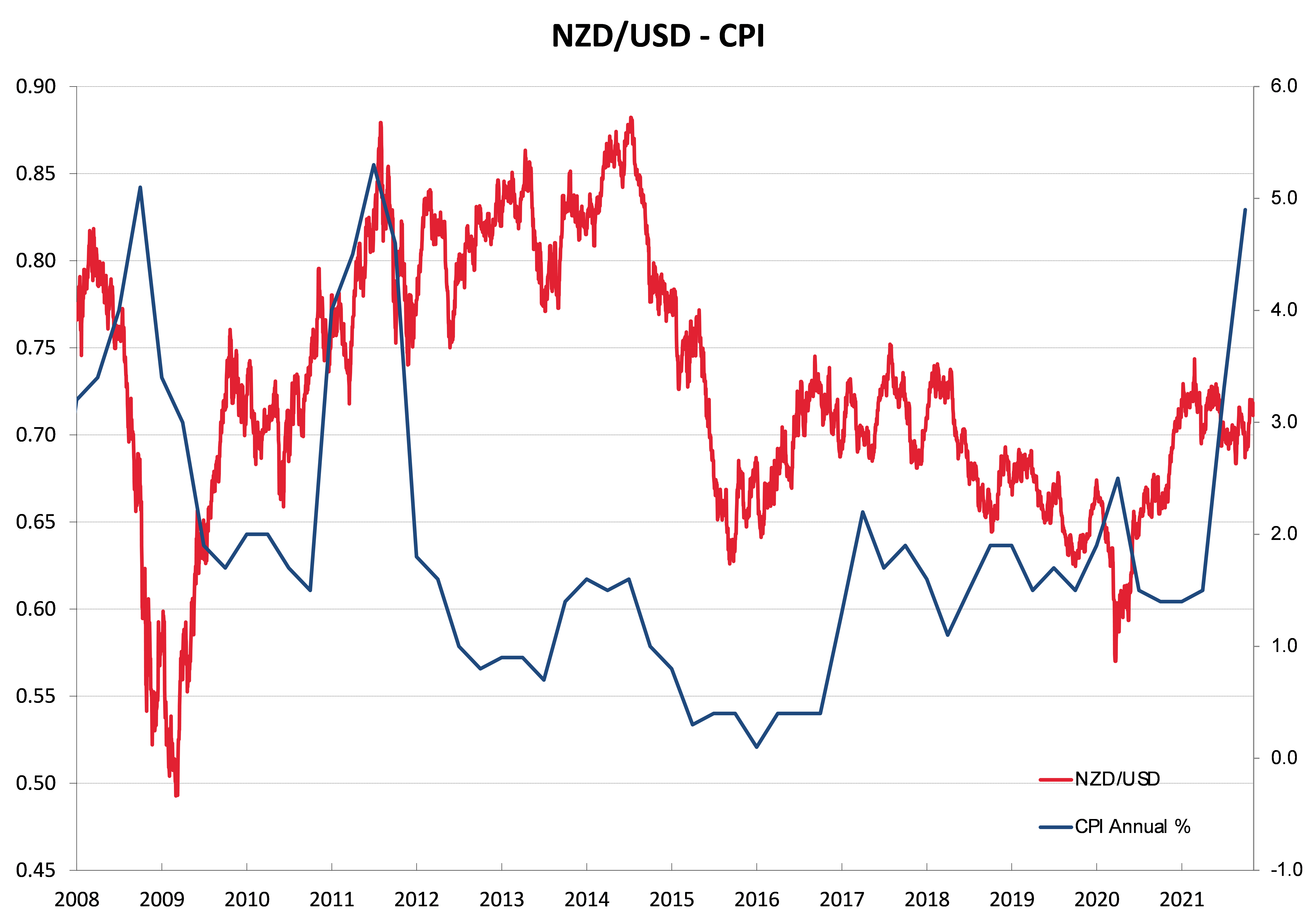
His “lift-off test” for inflation being above the desired level has certainly been met with US annual inflation running close to 5%.
The “lift off test” for employment levels in the US economy has however not yet been met. Whilst the labour market is very tight in the US with shortages and wages also up near 5%, the growth in new jobs being filled through the months of August and September was slower than expected due the Covid delta outbreak and schools being slow to return to full operation.
Should the US employment data bounce back at a stronger pace then the Fed expect over coming months, the Fed’s message was that they would not hesitate to signal an earlier increase in their interest rates than late 2022.
Following the Fed’s meeting last week the forex markets were somewhat mixed in their reaction, the USD failing to make gains as some players had obviously expected a more hawkish tone with the tapering confirmation.
However, the October jobs data two days later on Friday 5th November was above consensus forecasts at 531,000 and the USD strengthened against the Euro to a low of $1.1515.
The unemployment rate reduced again from 4.8% to 4.6% and another one or two months of strong jobs increases will have the financial and investment markets concluding that Jerome Powell’s “lift-off test” for full employment (the unemployment rate being close to 4.0%) will also be met.
There was strong growth in jobs in the hospitality/leisure, services and manufacturing sectors during October. However, reductions in US Government jobs (schools) was still a detractor to the overall employment numbers.
The prospect for continuing strong jobs increases of above 500,000 per month over coming months looks good as those Government sector jobs increase instead of reducing.
We are getting very close to the timing of when all the positive news of interest rate increases over the second half of 2022 will be fully priced into the USD’s value today. Therefore the US dollar is still on track to weaken through the early part of 2022 and only a major downward correction in equity markets would disrupt that forecast.
The USD side of the NZD/USD exchange rate still dominates the day-to-day movements.
It was instructive that the NZ dollar failed to strengthen on our local “stellar” September quarter employment figures last week.
The FX markets, along with many others, rightly questioning the true accuracy of the strong employment growth and the unemployment rate plummeting to 3.4% in the middle of a Covid lockdown!
The low unemployment rate is not signalling a strong NZ economy, it merely reflects the absence of immigrant workers.
One last push by the EUR/USD rate below $1.1500 (stronger USD) over the next few weeks will pull the NZD/USD rate lower to around 0.7000 from its current 0.7120 level, thereafter the greater risk looking into next year is USD weakness and a higher NZD/USD exchange rate.
Daily exchange rates
Select chart tabs
*Roger J Kerr is Executive Chairman of Barrington Treasury Services NZ Limited. He has written commentaries on the NZ dollar since 1981.
We welcome your comments below. If you are not already registered, please register to comment
Remember we welcome robust, respectful and insightful debate. We don't welcome abusive or defamatory comments and will de-register those repeatedly making such comments. Our current comment policy is here.