

Okay, it's officially 'avert your eyes time' again.
Yep, the latest GDP figures (for the December 2023 quarter) are out in the coming week, on Thursday, March 21 - and they are not likely to be flash.
Consider if you will, what the previous four quarters have brought us:
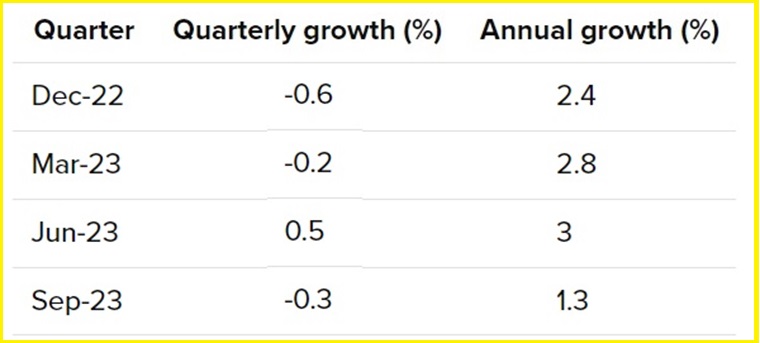
No, not particularly pretty reading. But we were warned. We were warned that an at least semi-tanking economy would be the consequence of the Reserve Bank (RBNZ) trying to squeeze the life out of inflation by cranking the Official Cash Rate (OCR) up all the way from just 0.25% to 5.5%. And so it is.
The intention of what the RBNZ has done is to slow spending and activity so the heat comes out of the economy and inflation comes down. And it IS working. Inflation's still way too high for now (annual rate 4.7% as of the December 2023 quarter). But that's down from a high of 7.3% in June 2022. It IS on the way down.
Anyway, as you can see, three of the four quarters gone saw the economy contracting. As we know, two consecutive quarters of negative GDP is regarded, in a pretty simplistic kind of way, as a 'technical' recession.
The release of the September quarter GDP figures in December was a bit of a doozy - since it revealed, due to extensive prior periods revisions, a 'recession' we didn't know we had earlier in the year, and also revealed a rather nasty surprise fall of 0.3% for the September quarter. The RBNZ had picked 0.3% growth.
Clearly, the RBNZ was a bit perturbed. In a February Monetary Policy Statement (MPS) that was much less 'hawkish' than had been expected the RBNZ's OCR-setting Monetary Policy Committee commented:
Members noted that gross domestic product (GDP) declined by 0.3 percent in the September 2023 quarter. This was weaker than projected in the November Statement. Revisions to GDP going back several years imply that potential GDP – the amount of production that the economy can supply sustainably – has also been lower than previously assumed. On net, these factors imply that the starting point for capacity pressures in the New Zealand economy is only slightly lower than previously assumed. The Committee discussed the low rate of productivity growth implied by recent GDP data. If sustained, lower productivity would contribute to a lower rate of potential growth of the economy. This would limit the rate at which the economy can sustainably grow without generating inflation.
So, the coming week's GDP figures are going to be of, shall we say, more than passing interest for the RBNZ. The RBNZ wants a slowing economy - not one that is getting down on to its knees.
If the December quarter figure happens to have a minus in front of it, we will of course have once again recorded two consecutive negative quarters. But, we should not get distracted by that, unless its a really BIG negative - IE another -0.3%. But nobody's forecasting such a dire outcome - that I'm aware of.
The fact is regardless of whether there's another negative or not, the real point is that any figure we get will show an economy performing in a very underwhelming manner. And remember also, the NZ population - courtesy of surging inbound migration - increased 2.8% last year. That's right, there's a whole lot more people driving the economy and yet it's going nowhere. So, on a per capita basis our GDP is really flagging.
In its February Monetary Policy Statement the RBNZ's forecast figure for GDP for the December quarter was 0.0%. If the RBNZ's right we will have averted another 'recession'. It's just that our economy won't be growing either. So, big deal.
"Flat as a pancake" is the title Westpac senior economist Michael Gordon has chosen for his preview of the GDP figures. He's picking a 0.0% outcome as well.
"If our pick for the quarter is correct," Gordon says, "that will also mean that the economy has been dead flat over the last year. (Indeed, given that the seasonal adjustment factors for GDP are still in flux, we would put more stock in our annual growth forecast than in the quarterly one.)
"That’s happened at a time when the country has seen the strongest population growth in its modern history, with inward migration playing catch-up after three years of the border being closed.
"As a result, GDP per person has fallen by almost 4% from its peak," Gordon says.
"Normally, a fall of that size would be associated with a severe recession. But in this case it reflects how overheated the economy had become in the first place."
ANZ senior economist Miles Workman said overall, the ANZ economists' expectation that the economy expanded 0.1% in the December quarter is driven by:
- Services industries (around two thirds of GDP) lifting 0.1% q/q (making a 0.1ppt contribution to headline growth).
- Goods-producing industries expected to contract 0.2% q/q (making a flat (0.0%pt) contribution to headline growth at one decimal place).
- Primary industries expected to contract 0.3% q/q (with its contribution to headline GDP also coming in flat).
Workman said by their forecasts, the fourth quarter of 2023 will mark five consecutive quarters of negative per capita GDP growth, down 3.7% from Q3 2022.
"And with net migration still very elevated, we think this measure has further to fall over coming quarters.
"For context, per capita GDP contracted for seven consecutive quarters (4.2% peak to trough) following the Global Financial Crisis."
BNZ head of research Stephen Toplis and senior economist Doug Steel say in their GDP preview that they judge GDP rose 0.1% in Q4.
"If that comes to pass, we will let others debate whether that means NZ was in recession or not in the second half of last year (after Q3’s -0.3%) – and whether subsequent revisions change that prognosis," they say.
"We will stick with our now well-worn line that growth last year was bumping along the bottom. A quarterly outcome as we see it would result in annual growth steadying from -0.6% in Q3, to 0.1% in Q4. That’s anaemic. And cements the idea of the per-capita recession rolling on."
Taking a quick look at the details for the quarter by industry, the BNZ economists say negativity seems to have been centred in the distribution sectors of retail and wholesale trade along with the associated transport and storage industry.
"Construction might hold up in the quarter, judging by last week’s not-as-weak-as-expected building work figures, even if looks to be within a broader downtrend."
Toplis and Steel say there remains "considerable noise" in the quarterly data, such that they certainly wouldn’t rule out the possibility of another negative quarter in GDP itself.
"But, to be frank, the difference between -0.1% or +0.1% is well within the margin of error."
Kiwibank economist Sabrina Delgado is expecting a flat (IE 0.0%) result, but also points out the GDP-per capita issue.
"...Aggregate output may be unchanged, but for the average Joe or Jane, the numbers will likely show a shrinking slice of the economic pie. So, on the ground, it will still feel like a recession," she says.
She says weakness will be notable "across the board".
"We are expecting the goods producing industry to continue in decline as manufacturing remains a sore spot and a still- lukewarm housing market weighs on construction. Activity within the primary production industry is also expected to be weak. Meanwhile, service industry also continues to be weighed down by businesses and households that continue to pull back."
But she says the turning point is on the horizon. "2024 may not be the year of growth but it is the year of central bank rate cutting."
It shouldn’t be too much longer before the RBNZ can cut rates here.
"We’re pencilling in November. And expect to see growth pick up into 2025 as rate cuts are delivered and stimulate domestic demand."
Economic growth
Select chart tabs
*This article was first published in our email for paying subscribers early on Friday morning. See here for more details and how to subscribe.
We welcome your comments below. If you are not already registered, please register to comment
Remember we welcome robust, respectful and insightful debate. We don't welcome abusive or defamatory comments and will de-register those repeatedly making such comments. Our current comment policy is here.