
Here's our monthly currencies outlook and review with HiFX's Senior Dealer Dan Bell including a look at the correlation between the New Zealand dollar and the gold price, and a prediction the Kiwi could fall to as low as US75 cents by the end of the year.
Bell has been looking at the relationship between gold and the New Zealand dollar, noting both are now down from similarly timed peaks.
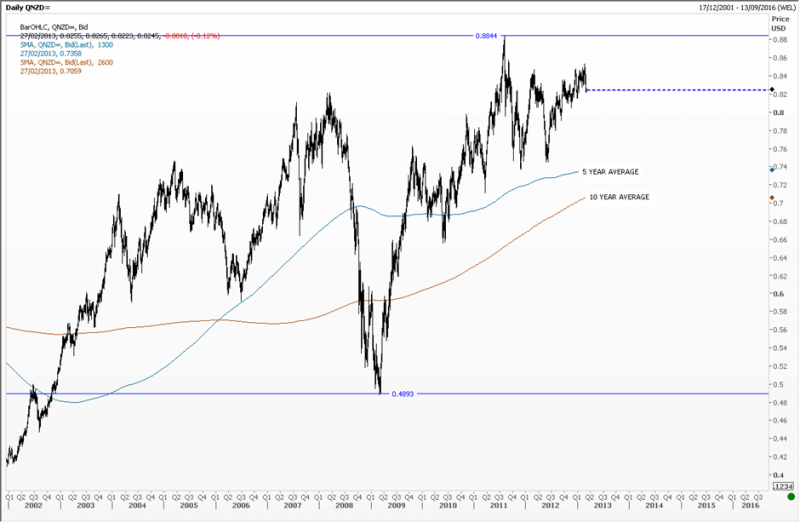
"Gold was obviously very popular through the Global Financial Crisis (GFC) and it had a massive rally to almost US$2,000 an ounce," Bell says. "It actually peaked at just over US$1,900 in August 2011. At the same time the New Zealand dollar peaked against the US, it made a post float high of about US88.40c."
"Since then the gold price is actually down almost 20%. We're hovering around US$1,500 an ounce. The New Zealand dollar is sitting around US82.50c at the moment, so still relatively high." (These gold and NZ dollar rates are as of Thursday when this interview was conducted. As discussed in the video, the Kiwi has been pushed lower recently by uncertainty caused by Italy's election and renewed fears over Euro-zone sovereign debt issues).
Bell believes the gold price is now showing that investors are changing their view both of where the US dollar is heading, and where the global economy is going.
"Previously I think the gold price was reflecting the fact that investors saw a couple of fairly negative scenarios that could have evolved. And that was either hyper inflation, because global central banks had pumped the world full of too much money, or ultimately the world was going to fall off a cliff because we had the European sovereign debt crisis and the US with its own debt issues," says Bell.
"Those things haven't come to fruition. We don't have a major inflation problem around the world and the world hasn't fallen off a cliff. The US economy is starting to gather more momentum. And whilst the New Zealand economy is still having fits and bursts of activity, we're still expected to grow at about 2.5% this year as well. So overall that to me signals that the US dollar has got a stronger tone to it overall and I think from the second-half of this year and into 2014, I think that gold price will continue to come off and the US dollar will continue to strengthen."
Back to US75c?
Asked how far the New Zealand dollar could fall against the greenback, Bell suggests back towards its long-term averages.
"If you look at the long-term averages, the five-year average for the Kiwi-US is around about US75c, the 10-year average is around about US70c. We've been in a long-term uptrend for quite some time now. If you go back actually all the way to 2001, at which time we were down under US40c, we've been in a long-term uptrend since then," says Bell.
"And then you take 2008 and the start of the US quantitative easing programme (QE), the New Zealand dollar has been extremely strong. So in a way we've got used to it but ultimately it wouldn't surprise me to see the New Zealand dollar return to those long-term averages. And US75c, I think, would be a reasonable level to expect the Kiwi-US to get to by the end of this year."
In the US, where the Federal Reserve has had its overnight bank lending rate at between zero and a quarter percentage point since December 2008, and which is now into its fifth year of QE or money printing, Bell notes a strong trend in the housing market, the sector where the GFC began. Figures out this week from the US Commerce Department showed sales of new homes reached their highest level in January since July 2008 and house prices ended 2012 with their biggest annual gain in more than six years.
Sales of single family homes rose 15.6% to a seasonally adjusted annual rate of 437,000 In January. This beat expectations of 381,000 sales. And separate data out this week showed US consumer confidence up more than expected in February.
"That to me signals that the US economy is in a much better position than they have been. We know that the housing market in New Zealand obviously drives a lot of economic momentum and I think it's similar in the US where if the price of peoples properties is going up, they're going to be a lot more willing to spend and feel a lot more confident about the prospects of the economy," says Bell.
"So that (the housing market) to me is going to be a key driver."
NZ dollar vs US dollar chart
Could the Fed's QE be nearing an end?
The Fed's monetary policy is the key driver of the New Zealand dollar against its US counterpart and for now the Fed is prepared to continue its QE programme. However, against the backdrop of an improving US economy, Bell notes rumblings from Fed voting members about exiting the central bank's QE-led stimulus programme.
"And the market is also starting to anticipate that as well," says Bell. "So that I think is going to be a key driver of the Kiwi-US cross rate over the next six to 12 months."
That said, the US still has high unemployment at 7.9%, and the Fed is targeting a reduction to 6.5%. It has pledged to keep interest rates low until unemployment falls below 6.5% and inflation tops 2.5%.
"So watching the US employment figures over the next few months is going to be quite critical in terms of understanding when the Federal Reserve will start to signal that they are going to start to remove some of the stimulus out of the system," says Bell.
The next key US employment data, non-farm payrolls, is due on March 8 and is expected to show the world's biggest economy added 151,000 jobs in February, with the unemployment rate steady at 7.8% to 7.9%.
"But watch for any surprises there," Bell says. "Because if we do start to see any meaningful improvement in that unemployment rate, the market will quickly respond and start pricing in an earlier exit by the Fed from this QE infinity programme that they've been undertaking."
Then, on March 19 and 20, the Fed's monetary policy setting body, the Federal Open Market Committee meets. This will include the release of a summary of economic projections and a press conference from Chairman Ben Bernanke.
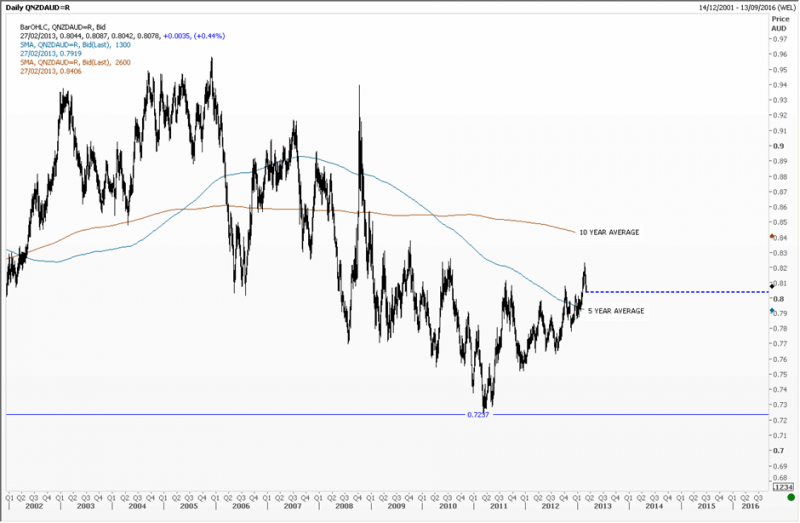
NZ dollar vs Aussie dollar chart
To subscribe to our free daily Currency Rate Sheet and News email, enter your email address here.
----------------------------------------------------------------------------
Dan Bell is the Senior Dealer at HiFX, a UK-headquartered foreign exchange dealer with significant operations in Australia and New Zealand. It has a dealing room in Auckland. See more detail here.
No chart with that title exists.
We welcome your comments below. If you are not already registered, please register to comment
Remember we welcome robust, respectful and insightful debate. We don't welcome abusive or defamatory comments and will de-register those repeatedly making such comments. Our current comment policy is here.