
So, have we gone forward? Or are we still stuck in reverse?
That's the big question ahead of the release on Thursday, June 20 of the Gross Domestic Product (GDP) figures for the March quarter.
The background is that the economy contracted in both the September 2023 and December 2023 quarters - meaning New Zealand is 'technically' in recession, albeit the contraction in December was very slight, just -0.1%.
This has all come about through the efforts of the Reserve Bank (RBNZ) to get inflation back into its targeted 1% to 3% range by squeezing up interest rates, hiking the Official Cash Rate from 0.25% in October 2021 to 5.50% currently. Inflation IS falling. After hitting 7.3% in mid 2022 the annual inflation rate was down to 4.0% as of the March quarter.
As I've stressed before, in a real sense it doesn't make much difference if our economy is, to say, grow by 0.1% in a quarter, or contracts by the same amount. Either way it means the economy is as flat as a pancake.
However, there is a power in that 'R' word. And we are definitely now getting to the point where quarterly GDP figures with minus signs in front of them are starting to drag the morale of the country down. And that's bad, because it means wallets are locked away and the fact nobody's spending money actually makes things worse - the classic vicious circle.
So, we could probably do with a bit of a pick-me-up and a positive GDP figure for the March quarter, even if it's only JUST positive. Appearances can mean a lot.
To refresh memories, this is what the previous five quarters have brought us in terms of GDP:
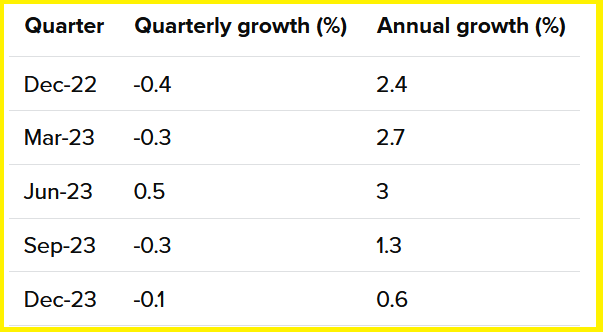
So, that's not very cheerful reading is it? And if the above sequence is all starting to look to you as though it might be quite historically significant in terms of the sheer numbers of quarters with a minus sign in front of them, well, you would be right.
In the past 40 or so years there's been a couple of comparable periods. In the 2008-09 Global Financial Crisis (GFC) time we had FIVE consecutive quarters of negative growth - and some of them were a lot bigger (IE -0.9%) than anything seen in the current run.
Going back to the 1988-90 period we had a run of six out of nine quarters that were negative - and that included a -1.1%, and an unemployment rate that ultimately (in 1991) topped 11%. I remember that period well, and it was deadly.
While the recent run of GDP figures has been nothing like as depressing as the two above examples, and unemployment, for example, is currently just 4.3%, it's kind of gradually getting there, nevertheless. These are not happy times. Much depends on where we go from here.
All we don't need now is to start getting super downbeat and not spending at all. Gloom begats gloom.
And the worst thing about all this is our recent 'headline' GDP figures don't even really tell the 'real' story. Our economy is not growing at a time when our population IS growing, a lot. According to Statistics NZ estimates our population grew by about 130,000 - or 2.5% - in the year to March. That's huge. And it means a lot more bodies driving the economy...and yet, they are producing in net, actually less.
GDP per capita decline could be worse than during the GFC
Since the third quarter of 2022 our GDP per capita has declined by nearly 4%. To give some very meaningful comparison, during the GFC our per capita GDP fell by 4.2%. And regardless of whether the March quarter 2024 GDP outcome is a plus or a minus, we can be reasonably certain that GDP per capita will have fallen yet again in the quarter.
ANZ senior economist Miles Workman is suggesting the forthcoming figures on June 20 may well see the per capita GDP decline since the third quarter (Q3), 2022 hit 4.3% - IE MORE than during the GFC.
Okay, so enough of the gloomy talk for a minute. What are the prospects for that March quarter in terms of the 'headline' GDP figure?
Well, it really looks like it could go either way based on what economists at the big banks think.
The Reserve Bank (RBNZ) is forecasting a rise of 0.2%. ANZ economists are forecasting a 0.2% rise, while ASB economists are forecasting a 0.1% gain. Westpac economists, however, see a 0.2% fall, while BNZ economists see a 0.1% fall, as do Kiwibank economists.
We can get some clues as to what the GDP may have done in the quarter by looking at the already released March quarter results from some of the key sectoral contributors to GDP - 'partial indicators' as the economists like to call them.
The results have been pretty mixed.
Retail sales volumes rose 0.5% in the March quarter, breaking a run of eight consecutive falls. However, monthly data has continued to look weak and the March 2024 quarter figures were 2.4% down on those for the same quarter in 2023.
The volume of building work put in place during the March quarter slumped 4.0%, with residential building work falling 4.8% and non-residential work down 2.8%. The total volume of building work in the quarter was the lowest in the past two years.
The volume of total manufacturing sales fell 0.4%, following a 0.7% fall in the December 2023 quarter. After falling in the December quarter, wholesale trade sales lifted on a seasonally adjusted basis by 0.8% in the March quarter, but the figures were down on those for the same quarter in 2023.
So, all that leaves plenty of room for healthy debate as to whether come the unveiling of the latest figures on June 20 we will still officially be 'in recession' or will have pulled ourselves out - barely.
At this point then I will leave you in the good hands of some of our major bank economists and their views of where things may be going.
Westpac senior economist Michael Gordon, who is picking a 0.2% contraction for the March quarter, said he's expecting most sectors to do better (or less bad) than they did in the December quarter, "but with some pronounced weakness in a few areas driving the overall result".
"Manufacturing (outside of food, which is more tied into exports than domestic demand) has been in decline for the last two years straight, and the March 2024 quarter looks to have been particularly soft, with large declines in chemicals and machinery. Construction activity was also weaker, as the pipeline of work that was consented in past years has been run down. We also saw further weakness in wholesale trade, which is something of a bellwether for the wider economy given how many other sectors it touches upon," Gordon said.
Transport and hospitality to get a boost from the rebound in tourism
"On the positive side of the ledger, agriculture and food manufacturing benefited from a lift in milk production and the recovery from the devastation of Cyclone Gabrielle last year. We expect areas such as transport and hospitality to receive a boost from the ongoing rebound in tourism (in seasonally adjusted terms, overseas visitor numbers were weaker in the December quarter, but improved in the March quarter). And log harvesting rose strongly for the quarter – though that will almost certainly unwind next time, as we’re now seeing a glut of logs on Chinese wharves that have pushed prices down sharply."
ANZ senior economist Miles Workman, who is picking a 0.2% rise in GDP for the quarter, expects services industries (around two thirds of GDP) lifted 0.4% quarter-on-quarter (and making a 0.3% pt contribution to headline growth ). He thinks the goods-producing industries contracted 1.2 % q/q (making a -0.2% pt contribution to headline growth), while primary industries will have expanded 0.3% q/q (with its contribution to headline GDP coming in flat).
"Meanwhile, the net migration cycle has turned, the labour market is loosening, consumers and businesses are downbeat, the housing market is subdued, the terms of trade is well below its peak, and global demand is sub-par," Workman said.
"Slowing inflation and gradually falling fixed mortgage rates are providing some offset, but overall we’d characterise the numerous drivers of economic momentum as becoming more synchronised to the downside than they have been in recent years.
"In big-picture terms, while we may well see the occasional upside surprise in the GDP data over the near next year or so (given typical volatility), there doesn’t appear to be a lot of scope for a sharp and sustained recovery any time soon. While growth is expected to find a floor this year, it is expected to remain sub-par for a while yet. We think this backdrop is consistent with the RBNZ cutting the OCR sooner than signalled in the May MPS. We expect cuts from February 2025."
BNZ senior economist Doug Steel, who is picking a -0.1% figure, said the economy "still looks like it is bumping along the bottom and contracting on a per-capita basis".
"The indicators remain very noisy, so we wouldn’t rule out the possibility of a small positive in the quarter. But the main message remains of the economy struggling to grow. A quarterly outcome as we see it would result in annual growth steadying to flat, from -0.3% in Q4 last year. Anything near zero annual growth overall implies clear contraction on a per person basis."
'No more recession' headlines could be cold comfort
ASB senior economist Kim Mundy, picking a positive 0.1% figure, says the March quarter figure is therefore likely to result in many "no more recession" headlines.
"And while this is arguably a nicer read, it may prove cold comfort to those facing weak demand amid New Zealand’s cost of living crisis and heightened economic uncertainty.
"More importantly, a small rise in activity in the quarter isn’t being driven by any significant structural changes to NZ’s economic outlook. Long story short, we expect the economy to continue to oscillate between small rises and falls until there is a pronounced change in the economic outlook (i.e. monetary policy starts to ease).
"With the pricing side of the economy proving more resilient than the activity side at this point, those [RBNZ] rate cuts still look to be some way away. February 2025 is our best guess at this stage.
"The general weakness will continue to be more evident in the per capita GDP numbers as headline GDP continues to be flattered by high levels of population growth. We expect GDP per capita fell 0.4% in Q1, which would mark the sixth quarterly decline," Mundy said.
"In other words, each Kiwi’s slice of the economic pie shrunk again, even if the whole pie is a tad bigger."
Kiwibank economist Sabrina Delgado, who's picking a -0.1% figure, sees things as "all pretty sombre" but notes that "the weakness we see and feel is all by RBNZ design".
"The RBNZ needs to see subdued growth in their fight against the inflation beast. And subdued growth is what they’ll see," she said.
The 'heavy hand' of the Reserve Bank is hurting
"The RBNZ’s heavy hand continues to hurt households and businesses. Restrictive monetary policy is clearly working. So long as interest rates remain elevated, growth will remain subdued. And that is the outlook for majority of this year.
"Interestingly, though we’re living in a strange era where bad news is in a way good news. Because as the economy slows down inflationary pressures are squeezed out. And the sooner we see inflation back within the RBNZ’s 1-3% target, the sooner the RBNZ can deliver rate cuts. As interest rates are relaxed, confidence among households and businesses should build. And the economy should regain momentum. Fortunately, our forecasts see inflation falling below 3% by the September (third) quarter. We’ll see that data in mid-October, and hopefully receive confirmation of inflation back within the RBNZ’s band then. And from there rate cuts could come as early as November."
Delgado says high interest rates have weakened both domestic and global demand, "suffocating growth".
"We might be okay but we’re not fine. The simple message coming through is that households and businesses need to hang on ‘til 2025. The turning point is on the horizon. 2024 is not going to be a year of much growth. But it is the year of central bank rate cutting. Offshore we’re already starting to see a number of central banks cut rates. Most notably we saw the ECB cut rates for the first time since 2019. We don’t think the RBNZ will be too far behind."
Delgado expects to see growth pick up into 2025 as rate cuts are delivered.
Economic growth
Select chart tabs
*This article was first published in our email for paying subscribers early on Friday morning. See here for more details and how to subscribe.
We welcome your comments below. If you are not already registered, please register to comment
Remember we welcome robust, respectful and insightful debate. We don't welcome abusive or defamatory comments and will de-register those repeatedly making such comments. Our current comment policy is here.