

UP...but by how much? That's the key question ahead of the release of the unemployment figures on Wednesday, August 7.
Statistics NZ's suite of labour market data, including the unemployment figures, is the last big piece of the puzzle for the Reserve Bank (RBNZ) ahead of its next Official Cash Rate (OCR) decision on August 14.
I'll have much more on the upcoming OCR review itself with a preview of it in a week or so, but, suffice it to say, the labour market figures will be a significant piece of economic 'evidence' for the central bank to peruse as part of that OCR review.
The RBNZ no longer needs to support 'maximum sustainable employment' as part of its monetary policy, with the National-led coalition having officially removed that requirement. But it doesn't mean the figures aren't important.
While it is loathe to say directly that it has been wanting jobless numbers to rise, the RBNZ has expressed a desire to see 'slack' develop in the labour market because this helps to take heat out of the economy and, by extension, inflation. However, the RBNZ would not want the unemployment rate to rise too fast or far.
Therefore, if there is a very big surprise on the high-side with the unemployment number in the coming week, this could possibly be enough to tip the RBNZ over the edge and result in a cut to the OCR at the August review.
It would have to be quite a big surprise though. In its most recent set of forecasts in the May Monetary Policy Statement (MPS) the RBNZ forecast for the June quarter the unemployment figure would be 4.6%, which would make a fairly sharp rise from the March quarter's 4.3%. It would also give us our highest rate of unemployment in over three years following a period of extremely low unemployment - as low as 3.2%. Therefore the threshold for a 'surprise' for the RBNZ from the forthcoming figures is quite a high one.
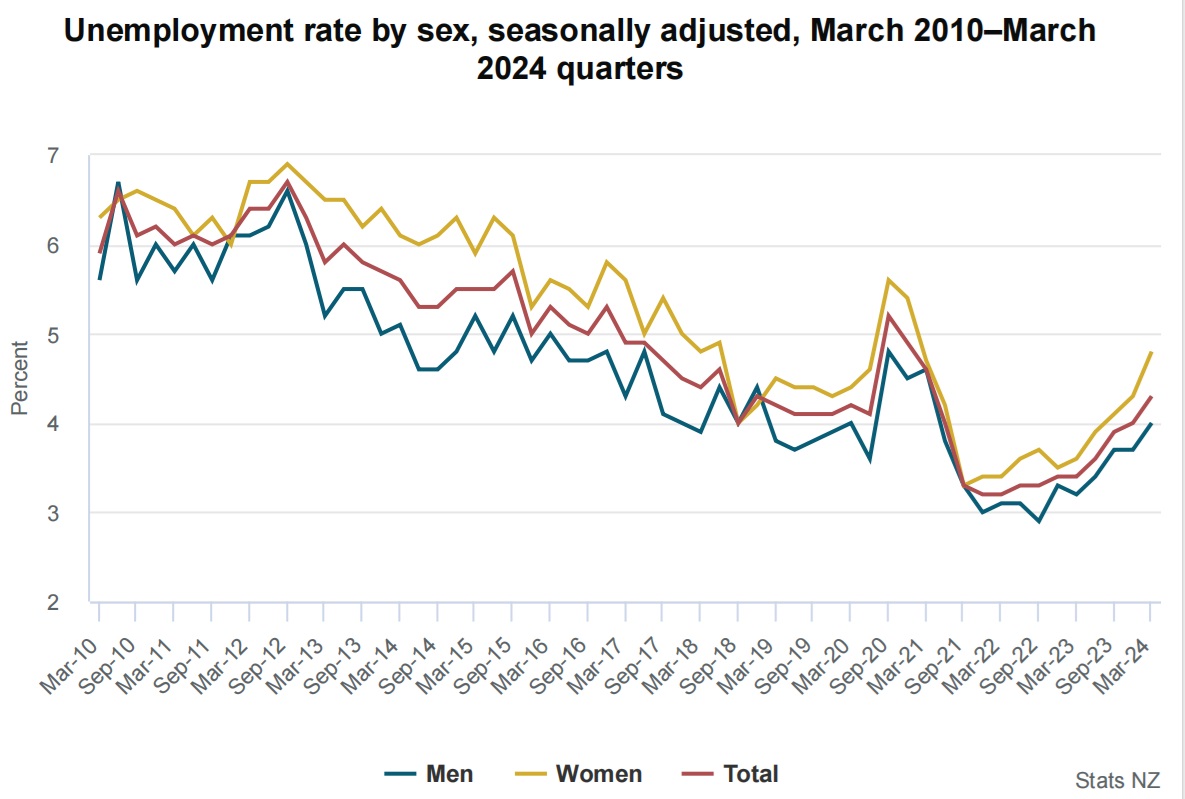
I didn't have all economists' previews of the labour market figures in front of me at the time of writing this, but the early indications from certainly the major bank economists is that expectations are settling at around 4.7%.
The RBNZ's picking a peak unemployment rate of 5.1% next year, but the bank economists reckon it's going to go a bit higher than that, with picks of 5.4% to 5.5% being bandied around.
Is there any reason to believe that the figures out in the coming week could surprise?
Well, if the high frequency data we've seen released in and around the June month is any indication, possibly yes. That's because the high frequency data really has been THAT grim.
As I said at the top of this article, it seems beyond doubt that the unemployment figure will be up. The only question is by how much.
The RBNZ has liked to portray itself as 'laser-like' in its focus on inflation and on getting it back into the 1% to 3% target range (annual inflation was 3.3% as of the June quarter down from 4.0% in March). This is why it ramped the OCR all the way up to 5.50% from just 0.25%.
The economy can't be ignored
But 'laser-like' focus or not, the RBNZ can't ultimately ignore the economy at large though - not if there's signs the RBNZ's tight monetary policy might be really starting to tank the economy in a big way. And a very sharp rise in unemployment - more than the RBNZ expects - could start to produce all sorts of unpleasant ripple effects, of which things like a rising wave of mortgagee sales are but one thing that comes to mind.
Let's consider some of that recent 'high frequency' economic data.
In just the past week we've had Stats NZ's Monthly Employment Indicators (MEI) release, which showed that the number of filled jobs in New Zealand fell in June. This was the third consecutive monthly fall - the first time there's been that many consecutive monthly falls since the aftermath of the Global Financial Crisis.
In June also, job ads took their biggest tumble in three years.
Perhaps not surprisingly, at the same time, Kiwis' confidence in getting another job has plummeted.
In terms of broader activity indicators, small businesses reported a big slump in sales in June, both service sector and manufacturing sector indicators are looking dire, and consumers have locked their wallets away.
And there's just time for an honourable mention of the latest ANZ Business Outlook, which is described as having "a bit of a 'well, can’t get any worse' vibe to it", while the earlier NZIER Quarterly Survey of Business Opinion was truly dismal.
The month of June in particular looks to have been an absolute shocker - the moment the economy started really tipping over.
Now the RBNZ's not unaware of all this. In fact the aforementioned NZIER survey might just have been the biggest factor shoving the RBNZ into its big 'dovish pivot' earlier this month, which completely reversed May's surprisingly hawkish statement.
Clearly if the unemployment figure for the June quarter does turn out to be 4.6% or close to it then the RBNZ will regard itself as being on track. But a figure higher than that might suggest that the RBNZ's inflation 'treatment' is starting to make the patient (us and the economy) very unwell.
The swoon in June
As I read the wave of unfavourable high frequency data that's come out in the past month or so, it points to an economy that went into serious swoon mode in and about June. This suggests that job losses will show up - not so much in the June quarter, but in the September quarter we are now in.
Indeed, in their preview of the labour market data, ANZ senior economist Miles Workman and economist Henry Russell (who are picking 4.7% unemployment) say that the June labour market data is expected to provide further evidence that spare economic capacity is building, and that disinflationary progress is set to continue. And they then go on to say:
"The big question on the day will be whether the second quarter data suggests this is happening at a faster pace than the RBNZ expects.
"Forward indicators suggest that could well be the case, but it is perhaps something we won’t see in the 'hard data' until the next read or even the fourth quarter data."
One of the other major points of interest the RBNZ will be focusing on in the forthcoming labour data is the wage figures. Stats NZ has a whole range of ways of measuring wage rises, but I generally keep my eye on the private sector hourly wages. As of the March quarter these hourly wages were showing an annual increase of 4.8%, but down from 6.6% as of the December quarter.
The RBNZ expects the private sector hourly wage increase to have eased further to 3.8% as of the June quarter.
Of course, if the unemployment rate is starting to push up more strongly than expected, this fact could be expected to have a pretty significant impact on wage rises as well, or lack thereof.
It all depends on the figure
So, there's much to watch out for then. If the unemployment rate is around the 4.6% the RBNZ is forecasting, then the central bank will probably be able to shrug off any perceived pressure to go early with OCR cuts, probably sticking with a start time (and this is of course is only an estimate and not based on anything the RBNZ has directly said) of November.
However, if that jobless figure is surprisingly bad then expect a growing chorus calling for a cut as early as August 14.
I leave the last words to Westpac senior economist Michael Gordon, who is picking a 4.7% unemployment figure:
"We think that for the RBNZ to begin cutting rates in August, we’d need to see a significant upside surprise on the unemployment rate next week, perhaps close to 5% (from 4.3% currently). That would be a very large one- quarter increase – outside of the temporary Covid shock, we haven’t had one of that size since the 2008 Global Financial Crisis, and before that the severe recession in 1991."
"Similarly, the RBNZ would need to see evidence that wage inflation is dissipating more quickly than they expected. While wages don’t play a big role in the RBNZ’s modelling, they are nevertheless a major source of the remaining ‘stickiness’ in non-tradables inflation."
*This article was first published in our email for paying subscribers early on Friday morning. See here for more details and how to subscribe.
We welcome your comments below. If you are not already registered, please register to comment
Remember we welcome robust, respectful and insightful debate. We don't welcome abusive or defamatory comments and will de-register those repeatedly making such comments. Our current comment policy is here.