

The great fantasy scenario in the wild world of economics is the 'soft landing'.
Trouble is, I can't ever remember too many of them being achieved. Usually you are flying along on the crest of a market boom and the next thing you on the ground, with a very sore backside, looking up at the heavens.
The latest hoped-for 'soft landing' is for New Zealand's housing market, which was last spotted heading in the general direction of Venus.
This year the events in and around our housing market have reminded me a bit of one of those nature documentaries where a group of supposedly well-wishing scientific types round up a rhinoceros and bombard it with a formidable array of tranquillising darts till the thing finally keels over and can be safely approached.
Between the reinstatement and then (from May) the strengthening of the loan-to-value ratio (LVR) limits, the Government's extension of the bright-line test to 10 years, the removal of interest deductibility on investment properties and now the probable (though note it has NOT been officially signed off by the Finance Minister yet) introduction of debt-to-income ratio limits into the Reserve Bank's 'macro-prudential toolkit', the housing market has been shot up with enough tranquillising darts to stop a herd of rhinos.
Cheerful defiance
To this point the market has appeared to do the equivalent of giving a cheery wave and a cry of: "Hi! How ya garn! D'ya want ya darts back?"
But appearances, such as the continued strength in the May housing sales figures, could be a bit deceptive. Try stopping a train quickly. It ain't easy. And our housing market is a runaway train at the moment. Too much momentum.
The expectation is that the market will slow and once it starts to slow it will do so pretty decisively.
Having said that, I do think it's clear that the reimposition of LVRs, and particularly the 40% deposit rule for investors, is not having the same sort of impact that this particular measure had when it was introduced in 2016.
The market in 2016 was very hot (though nothing compared with now, as it happens) and in May 2016 banks advanced a record $7.287 billion in mortgages. That record stood till late last year when it was shattered by several months of new records, leading up to a $10 billion-plus month earlier this year.
In July of 2016 the RBNZ lost patience with the runaway market and hit the investors with 40% deposits. Officially that measure didn't take effect till October of that year - but the banks started applying the 'spirit' of the new rule straight away. And look what happened, according to this excerpt from the RBNZ's spreadsheet of the mortgage figures:
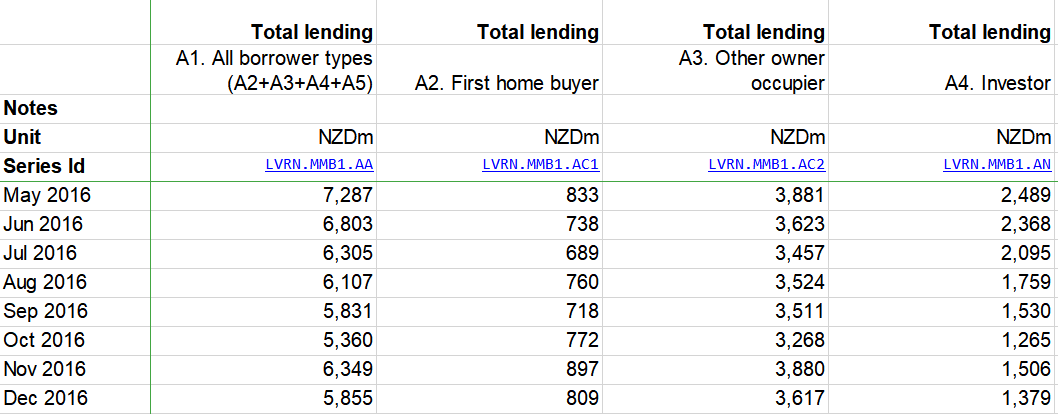
Just look how quickly the figures for the investors (far right column) fell - even before the official kick-off of the 40% deposit rule.
This time around the RBNZ signalled the reintroduction of LVRs and higher deposit rules for investors (though initially only at 30%) in November. And banks started implementing that soon after.
But look what has happened with the lending figures this time:
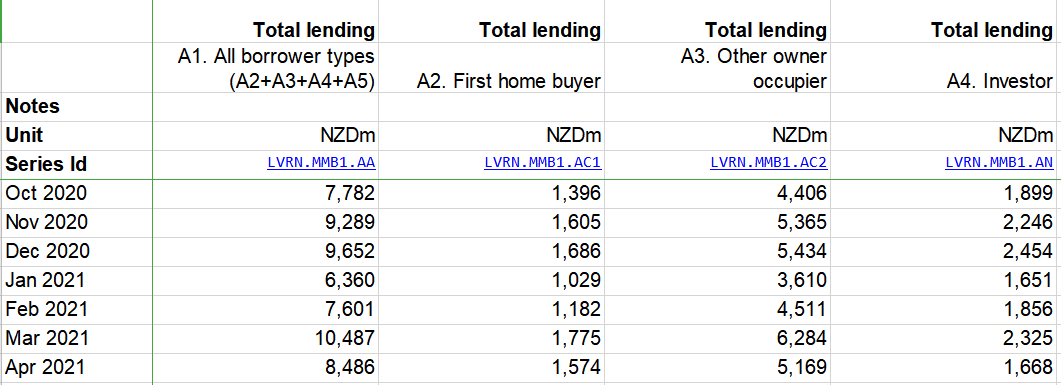
The fall-off has been a lot more gradual. The latest figures though do suggest it IS starting to happen. But those figures also suggest that the first home buyers and owner-occupiers are happily filling the gap.
The Reserve Bank is making fairly bold assumptions about what will happen to the market. Its latest Monetary Policy Statement projected annual house price inflation to be 28.5% in June of this year and then falling all the way back to just 0.4% in 12 months time. Within this, it's projecting that quarterly house price inflation will drop from an actual 7.9% in the March quarter, to an estimated 5.5% in the June quarter and then just 0.2% in the September quarter.
So, in other words the RBNZ's picking all the action (or perhaps I should say increasingly less action) to happen in the three months from the end of this month to the end of September. If the RBNZ is right then we should see some pretty sharp fall-off in activity and pressure from the July housing sales and mortgage figures onwards.
What if we don't? Already economists have been expressing surprise the market hasn't seemed to be cooling faster, particularly regarding prices.
If the market doesn't appreciably cool in the next couple of months, what then?
Plan B?
The RBNZ could of course increase those deposit limits for investor even more, to 50% or even 60%. But the interesting thing would be if FHBs and owner-occupiers appeared to be maintaining some fairly solid momentum in the market by themselves and without the input of the investors. What then?
DTIs are of course now on the horizon, but as my colleague Jenée Tibshraeny explained last week, they don't look like a priority. And the other point is, if the RBNZ has to water down the DTIs (perhaps setting them as high as debt being seven times annual income) this won't slow down the FHBs.
So, I don't really see DTIs as an issue. I think whatever happens we would be unlikely to see them for a year at least. I think the RBNZ has pushed and pushed for them because it realises they are ultimately more versatile than LVRs and our central bank did, let's face it, make a big mistake not pushing for them in 2013 when the 'macro-prudential toolkit' was established. At that time the RBNZ would unquestionably have been able to get the sign-off of then Finance Minister Bill English - but they didn't go for DTIs.
Anyway, nevertheless, I would have some concern at what might happen if the housing market doesn't appear to be slowing soon. The concern is that another hefty measure could be targeted at the market and it turns out to be the over-tranquilised dart that really deals to our runaway housing rhino. In which case, there goes the soft landing. Strap yourself in it could be bumpy.
Here's hoping not. I think the market will turn and I suspect that the RBNZ will be patient enough to wait for that. But strange things happen. Who predicted 30% annual house price inflation this time last year?
*This article was first published in our email for paying subscribers. See here for more details and how to subscribe.

We welcome your comments below. If you are not already registered, please register to comment
Remember we welcome robust, respectful and insightful debate. We don't welcome abusive or defamatory comments and will de-register those repeatedly making such comments. Our current comment policy is here.