
By Bernard Hickey
Making a movie about collateralised debt obligations and credit default swaps that is both compelling and accurate is quite some achievement. Movies don't typically do complex financial issues and spreadsheets well. Characters, plot and emotions usually beat numbers, analysis and complexity every time.
That's why I thought Michael Lewis' book on America's financial meltdown, 'The Big Short: Inside the Doomsday machine' could not be beaten as an expose of the GFC, or be turned into a cinematic experience. But somehow, the film of the book that I saw last week did it.
The Big Short movie starring Steve Carell, Christian Bale and Brad Pitt had a verve and flair that surprised and has helped it win awards and Oscar nominations. But mostly it took me back in time and stirred up all those old feelings of shock and bewilderment and wonder from 2007 and 2008 when the world's most sophisticated financial system was melting down. Sometimes it's good to be reminded of the bad old days.
The movie is actually set mostly through 2005 and 2006 when the US housing market and economy was rollicking along with the near universal belief that house prices would never fall and that all the debt owed on those houses would never go bad. The Big Short is the story about those outsiders who recognised the Emperor had no clothes and who then worked out how to bet on the failure of the most combustible debt securities linked to all those mortgage bonds under the housing market. This band of misfits took a very capitalistic approach to calling out the wrongdoing: they looked for a way to make massive profits out of what they saw as the inevitable collapse.
It is mostly a story about how hubris, laziness and 'group think' can corrupt an economy and financial markets to the point where intelligent and normally sensible people end up rationalising and defending extraordinary things. The most telling parts of the film are about the psychology of crowds and the human tendency to go with the crowd. The crowd in 2005 and 2006 were saying America's house prices were justified and sustainable. They argued the record high house price to income multiples made sense because of the permanent financial magic of very low interest rates. House prices had never fallen much and would never fall. These bonds were incredibly safe. This market was different. It was immune from the cycle or the 'downs' that often follow 'ups' in most markets. Mortgage brokers, real estate agents, bankers and even the US Federal Reserve Chairman Alan Greenspan dismissed the naysayers with a smugness and certainty that was frightening in retrospect. Right into 2007 the misfits were proved wrong as the market just kept on rising, or like Wiley Coyote, was suspended in mid-air months after the bottom had dropped out. Some of them almost gave up their 'Big Shorts'.
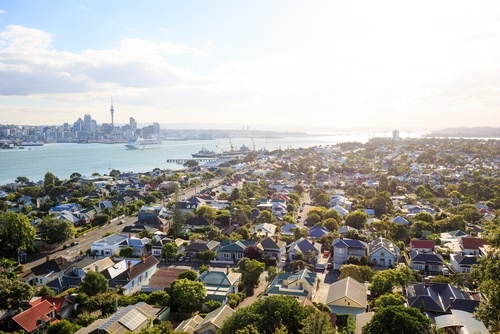
Sound familiar? I sat in the movie theatre cringing. All the language of the crowd sounded exactly the same as those who defended Auckland's housing valuations this week when Demographia called out Auckland's house prices as more expensive than London and Los Angeles when measured versus incomes. Auckland's house prices have never fallen much, they said. Auckland was an international city, just like New York and Hong Kong, which made it different this time. Auckland was a special place that people wanted desperately to live in. And this would never change.
It made me wonder how the misfits of The Big Short would try to short the Auckland housing market, and whether the crowd was actually right.
Auckland is different from America's housing markets in many ways. Home owners can't just mail their keys back to their banks and walk away debt free. The supply of new houses is not cheap and easy, as it was in many US states. The response to high prices of 'elastic' supply helped burst many of the US housing bubbles. New Zealand interest rates are expected to stay low, or even fall over the next few years, while mortgage rates were rising through 2005 and 2006 in America. The debt underpinning Auckland's housing market is much simpler and cleaner than the loans to 'NINJA' (No income, no jobs and no assets) borrowers that were carved up and mushed up with good loans in CDOs. New Zealand's banks know who they have lent money to and have much higher lending standards. They also have much more of their own money at stake and the Reserve Bank has forced them ask for higher deposits.
Yet there are plenty of similarities. The debt under America's housing bubble was only sustainable with very low interest rates forever. Anyone supremely confident about Auckland's housing market simply needs to answer the question: how would it cope with 10% mortgage rates and a 10% unemployment rate. Both are unlikely right now, but are still plausible over the longer run. There are a multitude of scenarios that would produce that combination. A financial crisis in China that froze global credit markets would do the trick and that is a non-trivial risk over the next year or so.
The Big Short is a great movie because it forces you to look at your world with fresh eyes. I'd recommend it for anyone sure that Auckland's 'Big Long' is a sure thing that will never end.
------
A version of this article first appeared in the Herald on Sunday. It is here with permission.
We welcome your comments below. If you are not already registered, please register to comment
Remember we welcome robust, respectful and insightful debate. We don't welcome abusive or defamatory comments and will de-register those repeatedly making such comments. Our current comment policy is here.