

There was much talk ahead of the Reserve Bank beginning to hike interest rates last year of the amount of 'bang for its buck' the central bank would be able to get.
When economists and commentators made such statements they were referring to the fact that most Kiwi homeowners with a mortgage had 'gone short' with their fixed interest rates at that time, taking advantage of super-low rates (according to RBNZ averages) such as 2.2% for one year and 2.55% for two years as of June.
Presumably most people thought it would last for ever. I can't find any other reason to explain why the punters weren't biting banks' hands off with the offers of five year-fixed at about 3% that were also available. The figures tell us there weren't many takers. Those few who did could be justified in feeling just a little smug and pleased with themselves.
But June 2021 proved to be the low point for interest rates and it's been a climb like the uphill bit of a roller coaster since.
As of time of writing the big banks (I use them as the example because there's quite a bit of variation among all the banks just at the moment) are offering rates in the region of 5.99% for one year and 6.19% for two years. All rates quoted here are 'specials' with loan to value ratios (LVRs) of less than 80%.
Anyway, back to last year. After interest rates began rising in July (this happened ahead of the RBNZ starting to lift the Official Cash Rate in October), much of the commentary was around the fact that about three-quarters of the total mortgage stock for the country was either fixed for a year or less or was on floating rates.
So, in terms of the 'bang for the buck' for the Reserve Bank, it meant that interest rate rises would be quickly felt by mortgage holders and therefore the desired dampening effect on household spending could be achieved pretty readily.
I think it's pretty clear at this stage, however, that things are not slowing anything like as quickly as the RBNZ and others in the marketplace might have expected. It's worth looking at...
Among the month-end suite of data released by the RBNZ this week was the crunchy stuff on how much of the mortgage stock is on fixed versus floating and how long it is till various amounts of fixed mortgage monies need to be re-fixed. The figures were updated to as far as the end of September 2022.
Okay, so going back 12 months in these figures, we can see that as of September 2021, there was a total mortgage stock of $324.433 billion. Of this $30.064 billion was floating, leaving $286.37 billion on fixed.
Right, keeping this as short as possible, at that time, 17.8% of the fixed mortgage book (nearly $51 billion), was due for refixing within just three months, while a third (($94.5 billion) was due in six months or less. Just over two thirds (nearly $194 billion) was up for refixing in 12 months or less. If you added in the floating mortgages, then at that time 71.5% of all the mortgage money was liable to see a change in interest rate in 12 months or less.
To repeat then - 17.8% of fixed mortgage money was due for refixing by the end of 2021, while over two thirds was up for a refix in a year or less.
Twelve months on then and things have certainly not stayed still.
The RBNZ figures show that as of September 2022 the mortgage stock stood at $341.534 billion with $39.282 billion floating and $302.252 fixed.
The 'headline' news here is that now just a little over half ($159 billion) of the fixed mortgages are due to be refixed in 12 months or less. That's down, remember, from over two thirds a year ago.
If we add in the floating mortgages, it means 58% of the total is up for an interest rate change within a year or less. That's down from 71.5% a year ago.
Just focusing on fixed rates again, it means that while the country's total fixed mortgage stock has increased by around $16 billion in the past year, there’s about $35 billion less of mortgage money due to be refixed within 12 months' time than there was a year ago. That's a significant shift.
What all this means is a lot of people have already seen their mortgage payments go up considerably in the course of the past year. And it means a lot fewer people have this jump to face in future.
In terms of what's ahead, there's just under $32.5 billion of fixed mortgages due to be refixed before the end of the year. That's just under 11% of the fixed mortgage total. Still pretty significant.
And looking out to early next year, within the next six months up to the end of March 2023, just under a quarter of the total fixed mortgage money (and, yes, this figure this includes those refixing within three months) is due to be refixed. That's just under $69.5 billion in total.
What sort of hikes have people faced? And what are those up for whose mortgages need refixing as of now?
Here's a couple of abridged examples from the interest.co.nz calculator. The first example is for a 30-year mortgage taken out for two years at the prevailing rate of exactly two years ago and comparing that with today's rate. The $309,000 mortgage amount is used because that was the average sized new mortgage in October 2020, according to RBNZ figures.
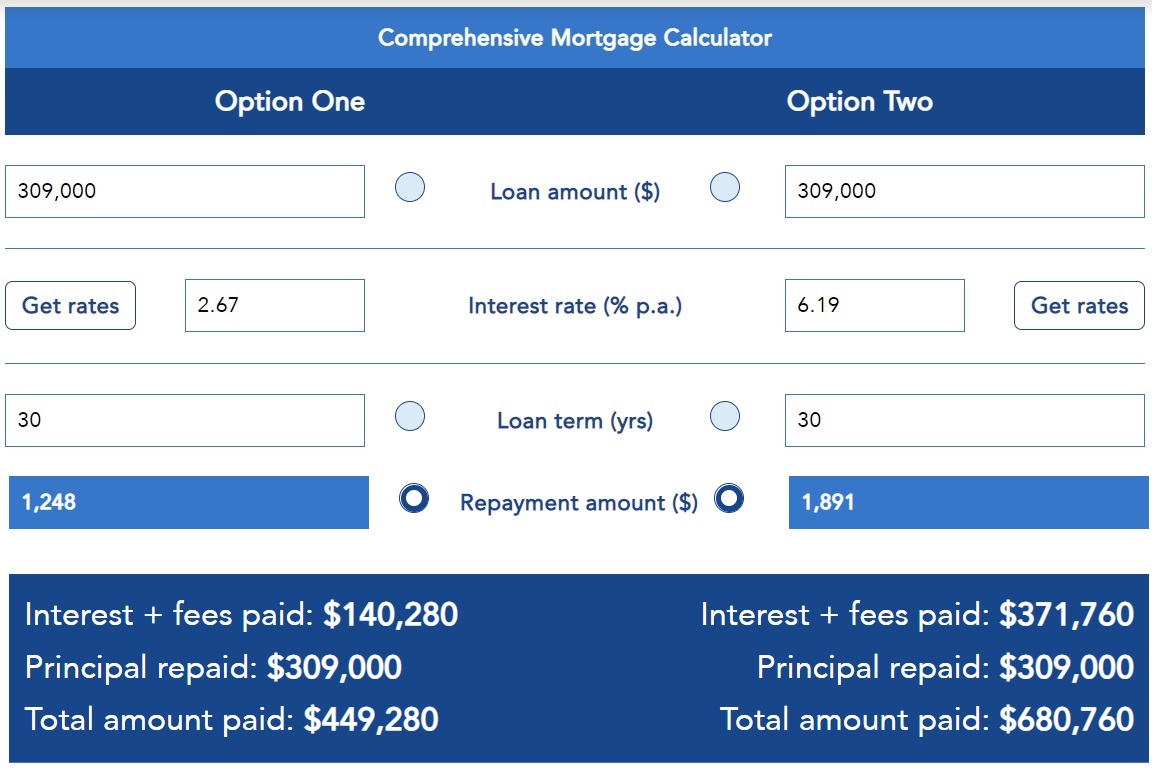
In short, with this example the payments would now be $643 more a month - a 51.5% increase on the rate of two years ago. The holder of such a mortgage would be up for more than a quarter of a million dollars MORE in interest costs over the life of the loan than would have been the case two years ago.
The second example is comparing a $369,000 mortgage (average size as of October 2021) taken out for 30 years with one year fixed, and what the payments would be on such a mortgage now.
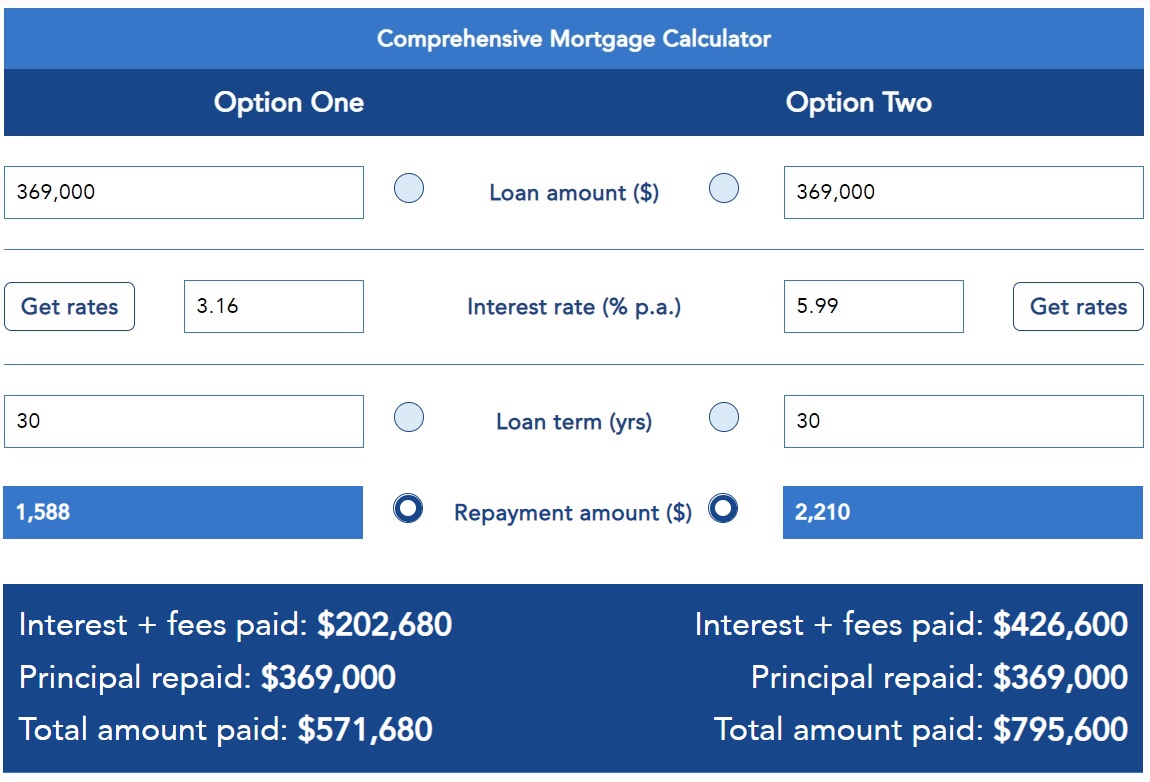
With this example the mortgage holder would now pay $622 (39%) more a month and would face interest costs across the life of the loan just under a quarter of a million dollars more than with the interest rate of a year ago.
Okay, so, with eye-popping figures like these, why isn't the country falling over?
Well, interest rates WERE historically low till last year. We know that a lot of people got ahead on their payments.
Not everybody climbed in to the super-sized mortgage environment of 2020-21.
Not everybody has a mortgage. A lot of people don't.
Is the RBNZ over-estimating its ability to affect people and their spending patterns with higher interest rates?
The counter argument of course is that people might be suffering quietly. People who got ahead in repayments or saved money during the Covid lockdown periods might be slowly eroding their comfort margins.
And a lot of people, as seen above in this article, are still yet to face the music with higher rates - even though a substantial number already have.
For me, I think the worst case scenario here would be if there are sufficient numbers of people in the community, either who don't have mortgages or are earning lots, who will be impervious to whatever the RBNZ throws out at them.
Why this would be bad is that the more the RBNZ is tempted to push rates higher because it's not apparently getting the traction it wanted, the more there is the risk that those in a precarious position may fall over.
We could see a very uneven situation develop where the haves keep on having and the have-nots suffer.
This needs watching very closely.
The weather's bucking up and getting warmer. Fabulous. People are looking forward to summer. They ARE out spending. Things are looking up.
But, people, things might not be what they seem.
*This article was first published in our email for paying subscribers. See here for more details and how to subscribe.
We welcome your comments below. If you are not already registered, please register to comment
Remember we welcome robust, respectful and insightful debate. We don't welcome abusive or defamatory comments and will de-register those repeatedly making such comments. Our current comment policy is here.