

Property information and analytics company CoreLogic - whose information is widely used by the Reserve Bank - is predicting that the RBNZ will further relax the loan to valuation ratio (LVR) rules in November.
And interestingly, CoreLogic suggests the RBNZ may reduce the deposit limits required by owner-occupiers - effectively changing the current definition of a 'high' LVR.
This prediction is one of 10 made for the rest of the year in CoreLogic's latest Weekly Market Pulse publication.
With the steam having come out of the housing market in recent times, the RBNZ has already twice loosened the LVR rules, the last of these applying from January of this year.
At the moment owner-occupiers have to either find 20% deposits or hope they can fit inside the 'speed limit' that the banks have for loans in excess of 80% of the value of the property. This 'speed limit' restricts the banks to advancing no more than 20% of their new mortgage money for such 'high' LVR loans.
Investors on the other hand have to find 30% deposits, or hope they can squeeze into the very small 'speed limit' for this restriction of just 5% of new bank lending available at 'high' LVRs for investors.
The next time the RBNZ will likely look at the LVR rules is in its next Financial Stability Report in November.
CoreLogic senior property economist Kelvin Davidson believes there will be a relaxation of the LVRs in November "reflecting our expectation of steady market conditions" in the housing market.
"Possible options include lowering the owner-occupier deposit requirement from 20% to 15% and/or raising the investor speed limit for high LVR lending from 5% to 10%."
Such an approach, if taken by the RBNZ, would be a departure, given that from the introduction of the LVR rules in 2013 the so-called 'speed limits' have applied based on deposits of 20%, so reducing the deposit threshold would effectively change the definition of a 'high LVR' loan.
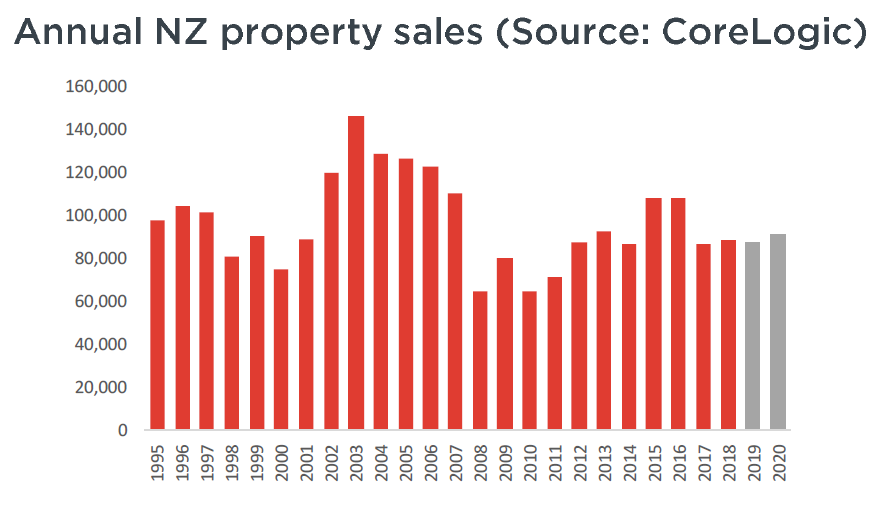
CoreLogic's predicting that house sales volumes will stay pretty flat for the rest of the year, with average property values still rising "but in a restrained fashion".
Davidson said CoreLogic's sales model points to an annual total in the range of 85,000-90,000 for 2019 as a whole, about in line with the average for the past decade.
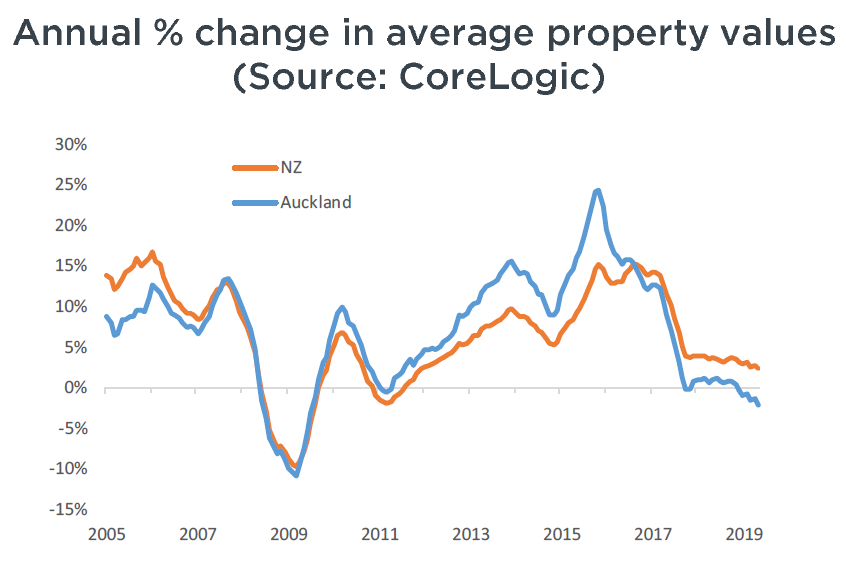
In terms of prices the more affordable towns and cities in ‘regional NZ’ likely to record the largest increases.
"By contrast, it wouldn’t be a surprise to see further weakness in Auckland – as buyers bide their time."
This is the 10 predictions CoreLogic have made:
1. Sales volumes to stay pretty flat
2. Average property values still rising but in a restrained fashion
3. Further loosening of the LVR rules in November
4. Imposition of extra capital requirements on the banks
5. Banking sector competition to remain intense and ‘rate wars’ to be a recurring theme
6. Foreign Buyer Ban to remain a contributing factor to softness
7. More homeowners potentially ‘trading up’
8. Rental yields to continue to rise
9. Residential building consents to flatten off
10. Buildings insurance to come into starker focus
In terms of the prediction of more homeowners potentially ‘trading up’, Davidson believes they may take advantage of the subdued market, especially in Auckland, to get a bigger or newer property, or in a better location.
"This will of course depend on not already being at the limit of their borrowing capacity."
And in terms of building insurance becoming a bigger issue, Davidson says this will "come into starker focus", especially given the issues already seen in Wellington with changes to pricing methods and big increases in premiums.
"This will have implications for property values, especially apartments, and needs to watched closely – not just in Wellington either."
We welcome your comments below. If you are not already registered, please register to comment
Remember we welcome robust, respectful and insightful debate. We don't welcome abusive or defamatory comments and will de-register those repeatedly making such comments. Our current comment policy is here.