

A chorus of criticism about the effect Credit Contracts and Consumer Finance Act (CCCFA) changes are having on first home buyers may be premature.
Since changes to the CCCFA took effect on December 1 last year, when the Responsible Lending Code was also updated, there've been no shortage of horror stories blaming the new legislation for preventing potential first home buyers from getting into their own home.
Unfortunately most of the evidence offered to support those claims was anecdotal, while the Reserve Bank's lending data up until the end of last year suggests first home buyers more than held their own in the home loan market in the first month in which the CCCFA changes were in force.
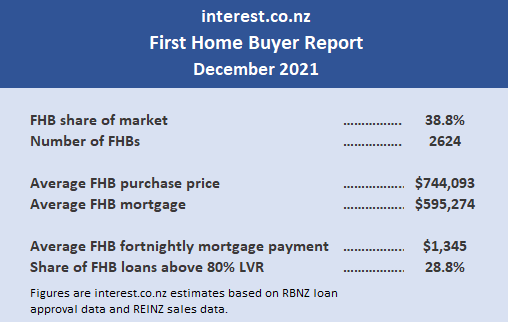
The figures show banks approved 2624 mortgages to first home buyers in December last year, which was down 21% from the 3338 approved for first home buyers in December 2020.
Because the CCCFA changes took effect on December 1 it would be easy to conclude this was responsible for that downturn in lending to first home buyers. But that probably wasn't the case.
Firstly, there was a significant downturn in overall real estate activity in December last year, with the Real Estate Institute of New Zealand recording 6755 residential sales in December 2021, down 29% compared to December 2020.
Secondly, although mortgage approvals to first home buyers were down 21% in December year-on-year, mortgage approvals to non-first home buyers declined 31% over the same period.
To put that into context, the number of mortgages approved for first home buyers in December last year declined 714 compared to December 2020, while approvals to non-first home buyers declined by 7817 over the same period.
At the same time, the number of mortgages approved to first home buyers expressed as a percentage of residential sales was 38.8% in December 2021, up from 34.4% in November last year and 35.0% in December 2020.
What that means is that first home buyers more than held their own in December, both in terms of their share of new mortgage approvals and as a percentage of buyers in the market.
Where there has been a significant decline in lending to first home buyers was in low equity loans - that is loans where the borrower has less than a 20% deposit. The Reserve Bank reduced the amount of lending banks can do to low equity buyers from November 1 last year.
In December last year low equity loans made up 28.8% of mortgage approvals to first home buyers, down from 33.9% in November and 34.7% in December 2020.
So the downturn in mortgage approvals to first home buyers that has occurred, has been at the riskier end of the market, which is probably not such a bad thing, because the average amount being borrowed by first home buyers and their subsequent mortgage payments is continuing to rise.
In December 2020, the average size of mortgages approved to first home buyers was $505,093 and by December 2021 that had increased to $595,274, up by $90,181 in 12 months.
That, combined with recent rises in mortgage interest rates, has pushed the estimated amount of mortgage payments paid by first home buyers on new mortgages, assuming a 20% deposit and a 30-year term, from around $1141 a fortnight in December 2020 to $1345 a fortnight in December 2021. That's an increase of just over $100 a week.
So while affordability is undoubtedly an issue for many potential first home buyers, the causes are much more likely to be high house prices and rising interest rates rather than the CCCFA.
However it's still early days in terms of the available data.
The lending figures for January, due out in a couple of weeks, will throw some more light on the subject and February's figures, which will be based on more robust levels of market activity, will be even more informative.
In the meantime, we need to maintain a degree of scepticism about some of the claims being made about the effects the CCCFA is having on the market and first home buyers in particular.
The comment stream on this story is now closed.
We welcome your comments below. If you are not already registered, please register to comment
Remember we welcome robust, respectful and insightful debate. We don't welcome abusive or defamatory comments and will de-register those repeatedly making such comments. Our current comment policy is here.