
ANZ chief economist Cameron Bagrie is questioning whether New Zealand's current migration policy settings have got the 'mix' right.
"There are numerous questions within the story (composition of visa approvals, skills of applicants etc) that suggest the migration framework, and the application of the rules, could be in need of adjustment," Bagrie said.
In the ANZ's latest monthly Property Focus, Bagrie said New Zealand's economic and political credentials currently looked "pretty good", so the ANZ economists didn't believe net migrant inflows, (which are currently running at around 69,000 a year),were going to cool aggressively any time soon, in the absence of policy intervention.
"Skill shortages will worsen as the population ages, so New Zealand needs to import labour.
"However, it is questionable whether current policy settings have got the ‘mix’ right and are achieving the desired outcomes."
Bagrie said GDP per capita growth was "lacklustre". In the March quarter, annual per capita real GDP growth was just 0.7%.
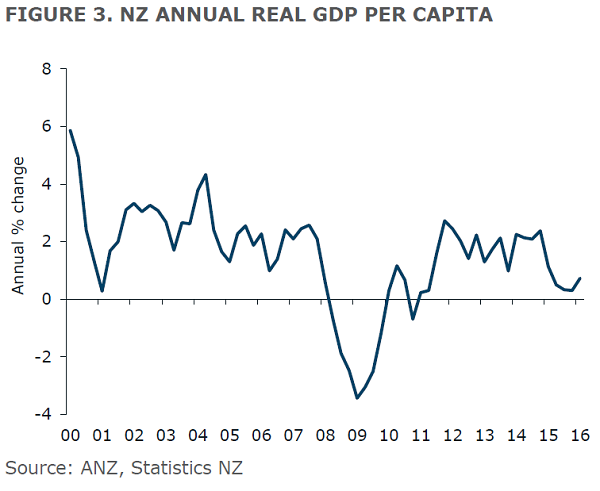
"Timing and measurement issues might be at play, but clearly this is a less-than-desirable rate of growth for what is ultimately the most widely followed measure of living standards. So we’re not seeing “value creation” right now from this population boom," he said.
"Sub-par GDP per capita growth is telling, as is the mismatch between reported skill shortages and the skill sets of arrivals. It is also odd that more foreign students are heading into Private Training Institutes as opposed to Universities.
"In short, there are aspects that suggest the migration framework, and the application of the rules, could be in need of adjustment," he said.
Bagrie said the "rhetoric" was that migrants are needed to fill skill shortages.
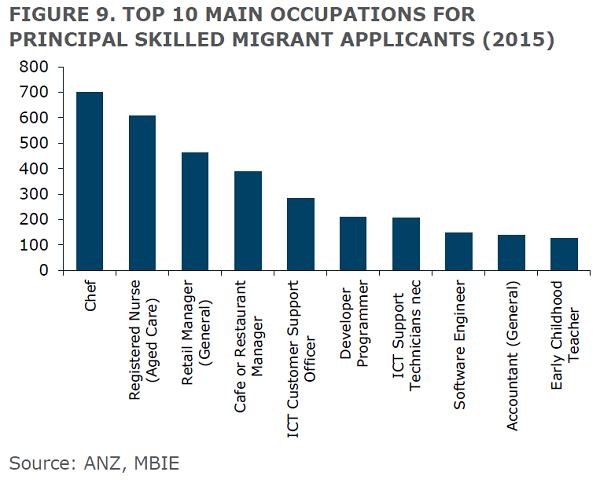
"We certainly concur. But that is not necessarily backed up by what skills end up coming through the system. While we know that the tourism sector is doing well, and long may that continue, three of the top four occupations of principal skilled migrants approved for residency are chefs, retail managers and café/restaurant managers.
"Retail spending on food and beverage services is up 10% on a year ago, which is clearly strong growth, so perhaps it is little wonder we are seeing strong demand for these types of workers as a result.
"But the dominance in approvals for chefs is still eye-watering (699 in 2014/2015) and it is certainly a surprise that it is the top occupation."
Bagrie said it was a "broadly similar story" when looking at temporary visa approvals. There seemed to be a mismatch between the skills of those coming in and what is actually needed.
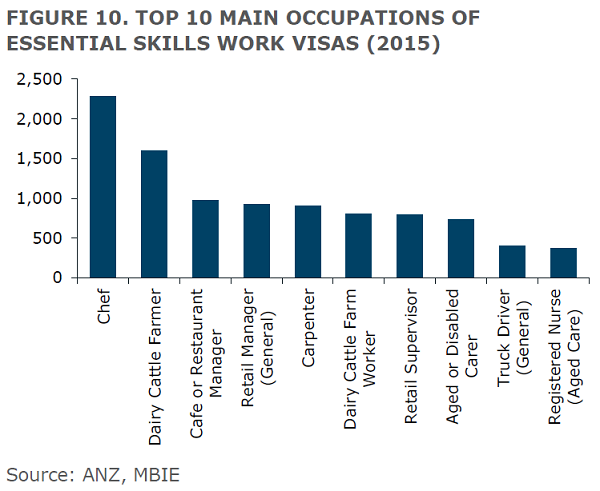
"Some sectors appear fully clothed (food services); some don’t (construction). Most of the people with essential skills work visas are going into cafés, restaurants, dairy and retail.
"Some make more sense than others – dairy has had definite staff shortages (although there are anecdotes of staff redundancies now), while retailing generally remains a tough industry
"Most of the occupations of those coming in on essential skills (temporary) and the principal skilled migrant category (permanent) are very similar. Either that’s consistency at work or we are being hoodwinked on both levels."
And looking at the education figures, Bagrie said the number of international student visas granted increased 17% from 2010 to 2015. Education exports were up 21% over the same period (28% to June 2016).
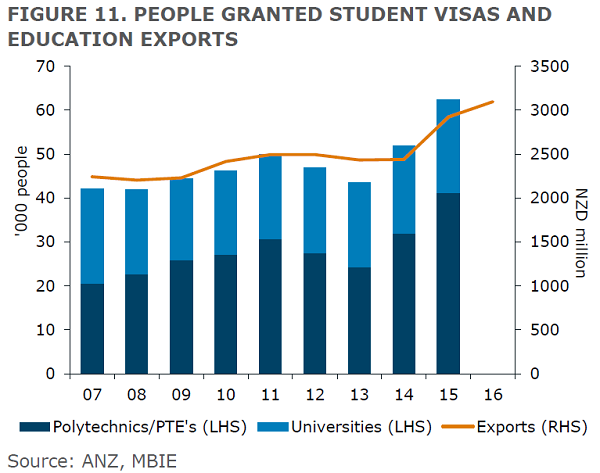
"However, we are seeing a massive surge in students heading to polytechnics and private training institutes (52%) without the same growth in those going to universities (10%). Is that the right mix?
"Around half of these international students are from China and India. Most of the Chinese students are attending university while well over half of the Indian students are attending private training establishments. That looks a little odd, and we can’t think of good reasons why this should be the case."
We welcome your comments below. If you are not already registered, please register to comment
Remember we welcome robust, respectful and insightful debate. We don't welcome abusive or defamatory comments and will de-register those repeatedly making such comments. Our current comment policy is here.