

The prospect of a "reasonable correction" in Auckland house prices "grows by the day", according to BNZ economists.
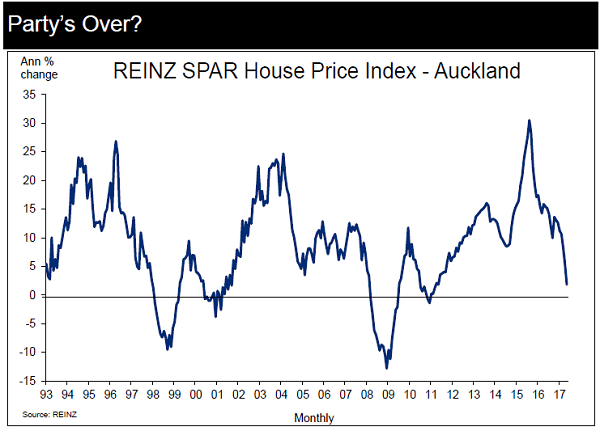
In BNZ's latest weekly Markets Outlook publication, BNZ senior economist Craig Ebert says recent housing market trends show prices, generally, to be going sideways in Christchurch, modestly down in Auckland and up almost everywhere else.
"We expect the [forthcoming] REINZ June data to show more of the same.
"But with Auckland’s large weighting, nationwide house price inflation is expected to fall further."
Ebert said that, importantly, the recent decline in Auckland house prices was now getting significant media coverage.
"This can be self-fulfilling to the extent that folk fearful that a market might correct are more likely to withdraw from it (buyers that is) and sellers will either delist their properties, simply not sell or, if under pressure, accept lower prices than might otherwise be the case.
"Certainly, there is already anecdotal evidence of speculators looking to exit the market for fear of getting burnt.
"All of this can lead to a sentiment-driven price correction over and above what market fundamentals might dictate.
"We still think genuine excess demand will underwrite the Auckland housing market but, equally, the prospect of a reasonable correction in prices grows by the day," Ebert said.
"From a Reserve Bank perspective, housing market developments will certainly play into its 'lower-for-longer' rates strategy."
ASB economists say in their Economic Weekly publication that the market is coming in for a soft landing, "one that is well under way in Auckland".
"Auckland house sales turnover has fallen 30% over the past year.
"Yet over that period the trickle of new listings on to the market has been pretty steady.
"These two factors together mean that the number of outstanding listings on the market are up 66% over the past year, according to realestate.co.nz figures."
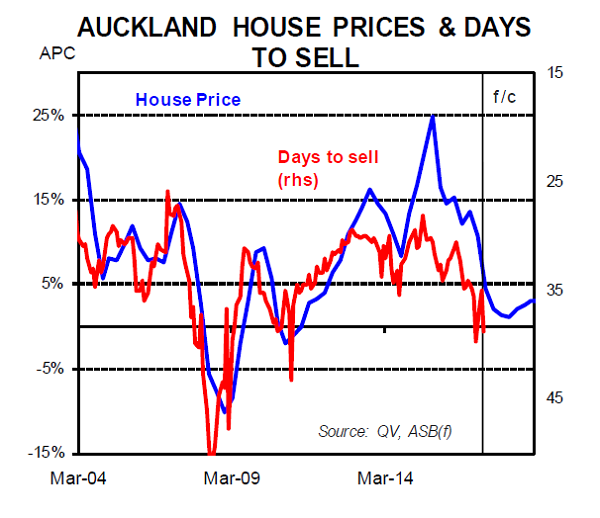
The ASB economists say buyer demand has tempered in Auckland, for a variety of reasons. Some key ones are: the added Loan-to-Value Ratio restrictions; lifts in mortgage rates, and affordability challenges.
"On top of that is psychology: the more it appears that prices are no longer soaring, the more the Fear of Missing Out evaporates.
"As a market of would-be buyers and sellers, housing is going through adjustments in behaviour. Buyers are being cautious and can afford to take their time.
"Increasingly, we will see the sell side adjust. Some of the people with their homes on the market who don’t need to sell will pull out of the market. Others will become more realistic about the price their home will sell for and move to meet the market. Still other would-be sellers will refrain from listing for the time being.
"We are likely to see a combination of developments in Auckland over coming months. Prices will remain flat or edge down slightly, the number of new listings coming onto the market will eventually slow, and the total number of homes for sale will start to stabilise."
The ASB economists say that due to house price measurement issues (such as Barfoot & Thompson's prices being impacted by compositional changes) they have tended to focus on QV’s quarterly House Price Index.
"The most recent figures released last week for Q1 show Auckland house prices up 0.8% qoq (ASB seasonal-adjustment) and 10.6% higher over year.
"However, as recent data have suggested, the slowdown in price growth appears to have accelerated in Q2.
"As a result, this week’s release of the REINZ’s house sales and price figures for June will be particularly timely.
"Specifically, the REINZ’s new House Price Index (launched April 2017) should reduce even more the impact on figures of month-to-month shifts in sales composition. And given the delay of Core Logic data, the measure is the most up-to-date read on house prices, as it is based off unconditional sales over the one month. In 2017 to date, this index had shown a marginal fall in Auckland house prices and a 0.8% increase for NZ overall.
"On this measure, it is conceivable that Auckland house price growth turns negative in the year to June 2017."
We welcome your comments below. If you are not already registered, please register to comment
Remember we welcome robust, respectful and insightful debate. We don't welcome abusive or defamatory comments and will de-register those repeatedly making such comments. Our current comment policy is here.