

By David Hargreaves
The Government's announced how it will divide up the spoils from its $1 billion Housing Infrastructure Fund.
It's named five councils - mostly in the top half of the North Island, with the lion's share of the money going to Auckland, Waikato and Tauranga.
The Labour Party says the Government's just trying to "pull a fast one" and has accused it of offering up "a list of ghost houses".
"This is loans for water infrastructure and bridges; National cannot point to a single plot of land and guarantee a house will be built there as a result," Labour's housing spokesperson Phil Twyford said.
"Even if [Building and Construction Minister Nick] Smith’s promises come true for once, they amount to less than 20,000 houses in five years, and just 2,200 in Auckland."
The fund, announced in high-profile fashion at the National Party's annual conference last year by then Prime Minister John Key, is to pay for water and roading infrastructure in high growth areas to accelerate house building. (See here for more details on the Fund)
On Tuesday, Prime Minister Bill English said the allocation of the $1 billion fund was "another milestone in the Government’s plan to increase housing supply for a growing New Zealand".
"The infrastructure projects announced today will speed up the delivery of 60,000 houses across our fastest growing population centres over the next ten years."
Auckland Mayor Phil Goff said accelerating housing delivery in Auckland was a priority.
"...While $300 million in new infrastructure investment will help Auckland address housing shortages in the city, it will continue to need billions of dollars of extra investment to keep pace with the city’s unprecedented growth.
"Auckland has received most of what it sought from the HIF. In the coming weeks there will be a further important announcement from Government on new funding options for Auckland that take into account the balance sheet constraints the city faces. We have worked constructively with Government to find innovative solutions to meet Auckland’s needs.
"The HIF package will help significantly, but with ongoing growth and the pressing need for matching infrastructure, we will need to continue to work together to increase and bring forward investment to tackle Auckland’s housing shortage and growing congestion, Goff said.
Finance Minister Steven Joyce confirmed that Auckland had additional housing infrastructure projects it was seeking help with outside of the Housing Infrastructure Fund "as it doesn’t have further debt capacity on its balance sheet".
"Discussion on those options are continuing and the Government will have further to say on those matters in the weeks ahead."
The Government says the councils that were successful in getting infrastructure funding will now work through Detailed Business Cases for the projects alongside government agencies, with the first funding agreement from the Housing Infrastructure Fund expected to be signed in the coming months.
A document produced by the Government, outlined in detail where the money was going and the expected outcomes. Included in the document was this detailed breakdown:
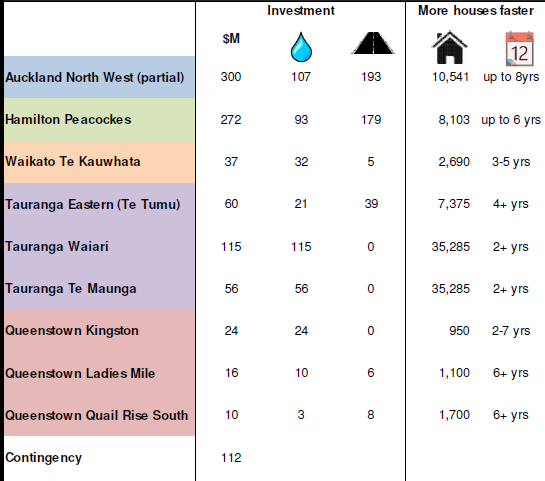
This is the Government statement released on Tuesday:
Five of New Zealand’s fastest growing Councils will have infrastructure projects funded through the Government’s $1 billion Housing Infrastructure Fund, Finance Minister Steven Joyce and Building and Construction Minister Dr Nick Smith say.
“These funding decisions will help provide another big step forward in housing supply,” Minister Joyce says. “The funding will be used to provide network roading and water infrastructure for 60,000 houses across nine projects in these five fast-growing urban areas.”
“The funding of this infrastructure is bringing forward the ability to build these homes in some cases up to eight years earlier than otherwise,” Dr Smith says.
“Adding these big new subdivisions will help lift the supply of residential sections and bring greater consumer choice into the housing market.”
The successful proposals are in critical high growth areas including:
· Auckland Council – $300 million – 10,500 houses
Greenfield development (North-west) at Whenuapai and Redhills.
· Hamilton City Council – $272 million – 8,100 houses
Greenfield development (Peacockes) on southern edge of Hamilton.
· Waikato District Council – $37 million – 2,600 houses
Te Kauwhata (new development on the shore of Lake Waikare).
· Tauranga City Council – $230 million – 35,000 houses
Greenfield development at Te Tumu (eastern end of Papamoa) as well as a capacity upgrade to the Te Maunga Wastewater Treatment Plant and a new (Waiari) water treatment plant (at Te Puke).
· Queenstown Lakes District Council – $50 million – 3,200 houses
Two new greenfield sites (Quail Rise South and Ladies Mile) on the Frankton Flats and an extension of the Kingston township.
Proposals were assessed by independent experts and an independent evaluation panel recommended the agreed package to Ministers.
“The infrastructure to be funded includes a new bridge over the Waikato River, a State Highway interchange, arterial roads, water and waste treatments plants, pump stations and reticulation and collection networks, and storm water drainage”, Mr Joyce says.
“This infrastructure initiative is the logical next step in our housing programme. We have freed up planning constraints on new subdivisions through Special Housing Areas and reforms to the Resource Management Act but the areas zoned for residences cannot be built on without infrastructure. We will be working closely with the Councils and developers to ensure these projects are progressed at pace,” Dr Smith says.
“The next step is for the Councils to complete with the Government the detailed funding agreements which we expect to be concluded in the next few months. There is also a huge amount of work required on resource consenting and construction of the works. The first earthworks will be under way this coming summer, the first homes consented early in 2018 and homes completed by late 2018.”
The Government expects to make statements on further new funding options and tools for housing infrastructure in the coming weeks.
This is the statement released by Labour's housing spokesperson Phil Twyford:
The Government’s housing infrastructure announcement is another Nick Smith special – over-promising with no detail on delivery, says Labour’s Housing spokesperson Phil Twyford.
“Like the Special Housing Areas, this is a just a list of ghost houses from a Government that has made an art form out of promising houses but never building them.
“Bill English and Nick Smith are attempting to pull a fast one. They’re claiming specific numbers of houses will be built, but they’re not actually providing funding for a single house.
“This is loans for water infrastructure and bridges; National cannot point to a single plot of land and guarantee a house will be built there as a result. Even if Smith’s promises come true for once, they amount to less than 20,000 houses in five years, and just 2,200 in Auckland.
“Only Labour’s KiwiBuild policy will actually build houses that Kiwi families can afford to buy and sell them to first home buyers at cost.
“There’s no doubt a huge infrastructure deficit has built up in New Zealand after nine years of National. Labour will change the way infrastructure is financed, tapping international bond finance and packaging it for new developments, with the debt serviced through a targeted rate on the properties in a new development.
“It will be fairer, more cost efficient, and it will turn on the tap allowing investment to flow into the infrastructure our cities need for growth.
“National’s so-called Housing Infrastructure Fund is simply a line of credit for councils who are already up against their debt limits. This policy was dreamed up by political staff and rushed out without proper advice from departmental officials after National was criticised for not addressing housing and infrastructure in their 2016 Budget.
“National is good at promising its latest half-baked idea will solve the housing crisis but, after nine years, Kiwis are left with a lot of ghost houses and not a lot else,” says Phil Twyford.

We welcome your comments below. If you are not already registered, please register to comment
Remember we welcome robust, respectful and insightful debate. We don't welcome abusive or defamatory comments and will de-register those repeatedly making such comments. Our current comment policy is here.