
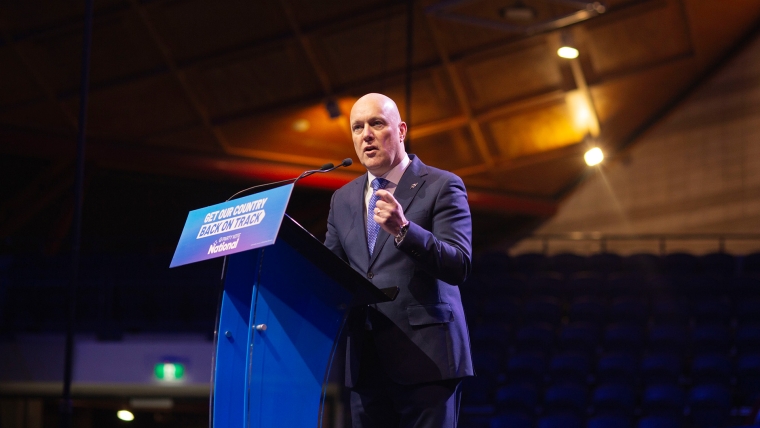
National Party leader Christopher Luxon has promised to deliver an alternative fiscal plan before advance voting starts in two weeks time, with all its policies funded.
It comes after the Treasury's pre-election update showed future governments would have very limited scope for new spending, if they wants to return to surplus in the foreseeable future.
Forecasts show the Crown accounts returning to surplus in 2027, after seven consecutive deficits, but only if the next government limits its annual operating allowance to $3 billion.
By comparison, Labour included $4.8 billion of new spending in Budget 2023. The forecasts released Tuesday suggested that could be the biggest budget NZ sees for years to come.
When Finance Minister Grant Robertson searched for savings to bake into the pre-election forecasts, he reduced the size of allowances set for new spending in future budgets.
This helped the forecasts return to surplus, but also set a very difficult mission for future Finance Ministers who would have to deliver these tight budgets.
Stephen Toplis, head of research at BNZ, said the election put “serious doubt” on the surplus forecast, as it didn’t factor in any campaign promises from either party.
“You’d have to say that, whatever the election outcome, policy settings will probably end up more relaxed than is currently the case, whether that be higher levels of spending or tax cuts that are not fully offset,” he wrote in a note.
Michael Reddell, an economic commentator, said the surplus was only forecast based on the numbers the Government told the Treasury to use.
“Anyone can plonk down a number. Delivering it is a different thing,” he wrote in a blog.
Financial headache
Current polling suggests that these ultra-tight budgets will likely be a problem for a future National government and its coalition partner, the Act Party.
On Tuesday, Act said it would have to revise its tax proposal after seeing the forecasts, while National recommitted to its plan — despite growing doubts over whether it was funded.
Finance spokesperson, Nicola Willis said the tax cuts were designed to be deliverable without cutting frontline public services and were funded by reallocated spending and new taxes.
Party leader Christopher Luxon said National would take a few days, or weeks, to digest the new forecasts and formulate a fiscal plan that allowed it to deliver on its campaign promises.
However, both declined to comment on specifics, such as whether the party would favour borrowing more, cutting public spending further, or dropping policies.
Treasury wrote in its report that the allowance for future spending was sufficient to meet cost pressures but not much more. Population growth and other unforeseen factors could also add to cost pressures and test the limits of these allowances.
Reddell suggested this was Treasury’s coded way of saying it was unlikely that future governments would be able, or willing, to keep to these tight limits.
Treasury went on to say that governments in “recent times” had regularly added new spending over and above the allowances they had signalled previously.
“If this trend was to continue and there was no corresponding offset from either an increase in revenue or a reduction in expenses, there would be an adverse impact on the fiscal outlook”.
‘The cupboards are bare’
Treasury said the forecasts were for “flat-to-falling” government consumption, with real spending ending the four year period slightly lower than it was in 2023.
“This represents a significant departure from the recent upwards trends,” Treasury said. Real spending had increased about 4% per year over the past decade.
Willis, said Robertson wouldn’t actually follow through on his forecast to clamp down on spending.
“It's important to remember today that this update is Grant Robertson's best case scenario. It assumes that, after years of spraying the money hose around, suddenly he's going to show some restraint,” she told reporters.
Labour had exceeded its operating allowance in the past three budgets and Treasury had consequently included a higher spending forecast as a risk scenario, she claimed.
However, Willis batted away questions about how she would cope with cost pressures as a future finance minister.
Independent economist Cameron Bagrie said the parties weren’t able to form full fiscal plans without the pre-election document to benchmark against.
“Both [National and Labour] have done about as much of that as they could possibly do without it,” he said.
But now it was time to add up all their promises and plug them into the fiscal forecasts.
It would be “immensely difficult” for any finance minister to make their party’s election promises stack up with those operating allowances, Bagrie said.
Too much of the election campaign had been driven by “populist policy” without enough attention being paid to the fact that roughly $2.8 billion would be needed “just to keep the lights on”.
Labour looked likely to have more challenges than National, but both would struggle to stay within the limited allowances, he said.
Debt offers flexibility
BNZ’s Stephen Toplis said this set of accounts could impose a major constraint on policy promises going into the election — at least in theory.
On the other hand, net debt was well below the self-imposed cap and the fiscal outlook wasn’t bad in global terms.
“While the deterioration is bothersome, it should not be overlooked that the fiscal balances (especially the net debt position) look fairly good by international comparison.”
“On this basis parties may yet adopt greater flexibility than some might expect,” he said.
Treasury forecast net debt would peak at 22.8% in June 2025 and fall to 21% two years later. Even under a higher spending scenario, debt would only reach 25% in the medium-term.
Toplis said fiscal targeting was “just one leg of the stool”, ensuring that spending doesn’t drive up inflation was just as important as balancing the budget.
Prior to the pre-election update, S&P Global Ratings confirmed NZ's AAA local-currency sovereign credit rating, most relevant to government borrowing given almost all is in the NZ dollar, and its AA+ foreign currency sovereign credit rating. The outlook on both is stable.
"We expect New Zealand's fiscal deficit to narrow over the next three years as Covid-19-related temporary spending measures come to an end. Net general government debt will stabilize at a level that is modest compared with that of most highly rated sovereign peers," S&P said.
“New Zealand's economy has entered a technical recession on the back of aggressive monetary tightening. New spending by the government and a slowdown in tax collections will delay, but not derail, the path of gradual fiscal deficit reduction”.
36 Comments
NZ First looks more attractive every day
I reckon! Do you think he’ll actually release a plan or another ~32 page brochure like the tax policy?
Winston got us into this mess.
Yes..and all because he had a snitch against someone in the Nats for some (in Peters head) perceived wrong doing against him. He's a man who hold's grudges .Do we really want him in Govt. again ?
Vote left then I guess.
Yep let's keep out those who hold petty grudges.
https://www.nzherald.co.nz/nz/say-sorry-act-stonewalls-unified-message-…
Coming from Seymour,that's a bit rich,he is the king of 'smart arse' comments...
Everyone knows people who gain popularity 'telling it like it is' make the best leaders.
Right?
Is that a statement or a question?
Seymour certainly didn't like journo's asking him about his candidate issues...he wasn't so candid about "telling it like it is" with regards to those issues.
We need an energy budget, a resource budget, and a 'remaining sink capacities' budget.
The rest is hot air - from ALL Parties.
Dan - and Mr Reddell - should read this:
https://surplusenergyeconomics.wordpress.com/2023/08/16/260-known-known…
Then start asking the real questions. I am reminded of Jonathan Kronstadt's excellent comment - P12, current issue of the Listener.
The article you link states there is a hard solar cell efficiency limit. Problem is that limit has already been broken in real world conditions.
In defence, not likely to make much material difference, and the practical problems with the record cell are likely huge but an example of hand waving psuedo intellectual waffle hiding factual errors and incorrect assumptions.
The point remains interesting however.
As soon as you see 'wordpress' in a URL about science and technology, you have to turn your skepticism dial up to 11.
No - facts either are, or aren't. The fact that mainstream culture sidelines inconvenient facts, shouldn't pre-prejudice your appraisal of same.
Unless you have a pre-held need to be convinced, of course...
I see one party is promising a future generations commissioner, would have thought that would be a step in the right direction...
A quick look suggests that New Zealand public service employs about 18.7% while Australia is about 16.4%. OECD average is 17.9%. Overall pretty similar.
Similarly regarding taxation we're slightly under the OECD average:
https://www.compareyourcountry.org/tax-revenues
We are mid-pack for the OECD countries in terms of deficit:
https://data.oecd.org/chart/7bjq
Regarding debt we are mid-pack:
https://data.oecd.org/chart/7bjt
I would be hesitant to say we should slash spending and start firing, just that we should make sure we do not become an outlier. We just need very careful budget management over the next decade.
It's not a competition. We shouldn't base our policy on trying to match the other oecd countries, few of which have done well in the last decade.
"its not a competition "
No but it is a valid comparison - that does shed light on some of the murky claims made by the opposition.
No OECD country is living within its resource means. All are overconsuming.
Why bother to compare? You already know that...
Singapore isn't in the OECD echo chamber
It's the kiwi korporate way.
Look over there. There's a half dozen organisations doing worse than us. Middle management.....relax.
Is there a public breakdown comparison between the countries?
Easy to overload on bureaucrats, pen pushers, comms staff and middle management in the offices in Wellington that offer little value.
Squishy,
But if you look closely at the Debt/GDP figures, you see that almost without exception, the ratio is falling while NZ's is rising. Australia's is falling particularly quickly.
If he open up the door to foreign buyers it will just push house prices out of reach for most of the population who don’t already own a property as it is my children have very little chance of being a house owner in New Zealand.
NZ property is also a lot cheaper now for overseas buyers due to NZs weak dollar. 2 million is not very much to many overseas buyers where they also earn more, and the land is freehold. Queenstown properties have a lot of overseas owners already, and suburbs in Auckland could be out of reach of NZ buyers if this plan goes ahead. National obviously expect there to be a lot of buyers as they are expecting a lot of tax from it.
Instead of selling government assets to overseas investors(where they have nearly run out of assets to sell), National are essentially taking a cut from private owners selling assets to overseas buyers.
Selling to foreign buyers is selling the land beneath your feet. I don't know why we do it at all. We should be more like the Cook Islands, leasehold to foreigners only.
Are you sure? 2 million is a lot for new no citizen migrants just arrived New Zealand. Of course, very a few over sea millionaires or billionaires can afford them. But why would they invest in property in New Zealand where they can get better properties with cheaper prices and better yield elsewhere?
New spending should be increasing if they are using migration as a tool for economic recovery. Overwise spending per capita is decreasing and we are sharing the same resources across an ever increasing population. But the mainstream media don't seem to take the politicians to task on this. To be honest some of what WP says makes a lot of sense and is why he is gaining votes.
It's the two faced media.
Media - To prove we're not a racist country we need to bring in more immigrants
Also Media - We need to decrease our carbon footprint to save the earth.
Can't do both.
Interest.co.nz is really the only NZ media outlet I read now. Media in NZ in the last 10 years has become so unreadable.
ACT and NZ First are the only parties I'm considering voting for this year. ACT is what National was 20 years ago.
Stephen Toplis, head of research at BNZ, said the election put “serious doubt” on the surplus forecast.
This sums it up. Labour has spent all the money.
I haven’t seen any media report which states that that when Labour won in 2017, Net Core Crown Debt was $59.5 billion. After 6 years of government it has increased it to $155.3 billion.
There is so much fat in the system it is an absolute joke. The system is clearly not sustainable.
The country needs much better leadership to cut most of what Labour has introduced. It’s an absolute shambles.
There is an optimum level of tax that can be collected. If you tax too hard, companies and wealthy individuals will shift their tax base overseas to lower tax paying countries.
This will lead to increasing unemployment, less money to go round and benefits increasingly being slashed.
If Labour gets in, rents are going to increase at a much greater rate than otherwise would have been the case, as the 85% of landlords that provide private rentals start exiting the market at a faster rate. They will sell or head offshore because the costs & legislation imposed on landlords make their businesses unprofitable.
Message to renters, if you vote for Labour to be elected is expect far more rent pain to come than would otherwise be the case if they lose.
Is this you Mike Hosking? Whoever you are you have been living under a rock.
Events that have affected govt finances since 2017:
- Global pandemic - rent & wage subsidies paid to keep economy alive
- Death of tourism industry - see cause above
- Lockdowns & supply chain disruptions - inflationary
- Record low interest rates - a boon for landlords & property speculators, inflationary
- Weak milk powder prices due to selling low value product, weak global demand, low productivity - see above
- Low NZD & higher fuel prices, closure of Marsden Point by private owners - inflationary
- No new income taxes since 2008 except 39% at top end, tax bands unchanged (now a problem actually)
- Biggest drain on public finances is superannuatants - healthcare & pensions, will get worse before it gets better
- Decades of neglect in water infrastructure, public health, transport infrastructure, defence, higher education.
Many countries face the same issues, especially inflation and public debt. It sure is miraculous how Ardern/Hipkins/Robertson have also influenced economic conditions in places like South Korea, UK, Germany & the US.
But you know all that don’t you?
If we are talking “fat in the system” I suggest we start with the juiciest piece - welfare for landlords and welfare for oldies.
I am going to vote left just to piss Mike Hosking off.
He is the biggest cheerleader for the left.
Who would ever want his outlook on life very unbalanced.
he is so much a one eyed national supporter i am surprised he passes the eye test for his drivers license, he never holds any national member to account
even ACT do not get much of a go on his show and if they talk against national he shoots them down and as for TOP he most likely has never heard of them even though he is from christchurch. I am not sure why labour or the greens even bother going on his show and surprise surprise when was the last time he had WP on, he still does not forgive him for not putting national in
Are they gonna pack the houses up and take them in a rucksack across the ditch?
Luxon has promised to deliver an alternative fiscal plan
I'd rather he deliver a population plan before anything else.
At present it seems to be in the hands of the 70,000 accredited employers The Front Page: How a simple visa change became an immigration nightmare (msn.com).
Imagine those accredited employers had a personal incentive of say 20k per visa issued how many from the 3rd world would want to come gain residence here...
we are going to go from a BAD finance minster to an even worse one, how can that even happen? i feel for the young in NZ they are getting sold down the river by own two main parties
We welcome your comments below. If you are not already registered, please register to comment
Remember we welcome robust, respectful and insightful debate. We don't welcome abusive or defamatory comments and will de-register those repeatedly making such comments. Our current comment policy is here.