

It has been revealed Treasury advised Finance Minister Grant Robertson to suggest the Reserve Bank (RBNZ) attaches conditions to its $28 billion Funding for Lending Programme (FLP) to direct newly-created money to productive parts of the economy.
Robertson on Thursday confirmed he had “discussions” with the RBNZ over putting conditions on the FLP, but noted the FLP’s design ultimately rested with the RBNZ.
The RBNZ in December started offering banks cheap loans to help them lower their interest rates to stimulate the economy. While these loans are secured, banks can do what they want with the funding.
Robertson in late-August publicly signalled his preference for the RBNZ to put conditions on the FLP, recognising the concern funding could flow straight into the housing market.
National’s shadow treasurer Andrew Bayly in November also openly called for the RBNZ to put conditions on the FLP.
Prime Minister Jacinda Ardern criticised Bayly at the time for suggesting the Government interferes with the RBNZ’s independence, comparing him to former Prime Minister Robert Muldoon.
But as it turned out, Bayly was joined by not only Robertson, but also Treasury in thinking there should be some conditions tied to FLP funding.
Treasury’s advice
A document released to interest.co.nz under the Official Information Act shows Treasury on August 6 told Robertson: “You may also wish to signal your support for the Bank considering additional incentives for SME and business lending.
“Such incentives would complement broader Government objectives to support firms, particularly SMEs, in the economic recovery over the medium term…
“The Bank has options to design the FLP in a way that helps ensure that: lenders’ lower funding costs are passed on to their customers; new lending is allocated to productive parts of the economy; and financial stability risks are managed.”
Treasury also noted: “[A] lack of competition in the banking sector could mean banks use reduced funding costs to boost profits instead of passing it through to retail rates.”
Treasury’s advice came a week before the RBNZ said a FLP was a tool it could potentially use, and seven weeks before the RBNZ confirmed it would get ready to deploy such a programme by the end of 2020.
The RBNZ’s position
The RBNZ last year explained putting conditions on the FLP could constrain its uptake. If banks don’t take the opportunity to borrow cheap money (at the Official Cash Rate, which is currently 0.25%), they might not lower interest rates.
While the FLP supports liquidity, it is being deployed to boost inflation and employment in line with the RBNZ’s monetary policy mandate.
The RBNZ has stressed the monetary policy tools at its disposal are blunt, and its job is to support the economy as a whole, not direct credit to certain sectors.
Speaking to interest.co.nz in November, RBNZ Deputy Governor Geoff Bascand put the onus back on the Government.
“If you want to direct lending, that's really a government policy decision or initiative,” he said.
The piece of Treasury advice interest.co.nz has didn’t go down the path of exploring whether the Government could do anything to ensure FLP funding got to productive parts of the economy.
It didn’t specifically raise concerns around the provision of cheap funding and lower interest rates setting the housing market on fire. Both the RBNZ and Government were throwing a lot at keeping the economy afloat in the face of dire economic forecasts at the time.
FLP likely to become more effective later in the recovery
It’s worth noting that unlike the RBNZ’s Large-Scale Asset Purchase Programme, the FLP didn’t need to be indemnified by the Government.
However, the RBNZ wanted Robertson’s “endorsement” prior to publicly consulting on the design of the FLP. Treasury suggested Robertson provided this endorsement.
It believed the FLP would “likely make existing lending cheaper and, at the margin, may incentivise new lending”.
“FLP is unlikely to have a transformational effect on willingness to borrow or credit standards applied to borrowing,” Treasury said.
“To the extent that FLP transmits by easing funding costs, it will be most effective in supporting real activity where funding costs are suppressing bank lending.
“Right now, these seem like marginal constraints as uncertainty seems to be a larger drag on businesses’ and banks’ willingness to borrow and lend.
“However, FLP is likely to be more effective later in the recovery, as uncertainty recedes and credit demand increases.”
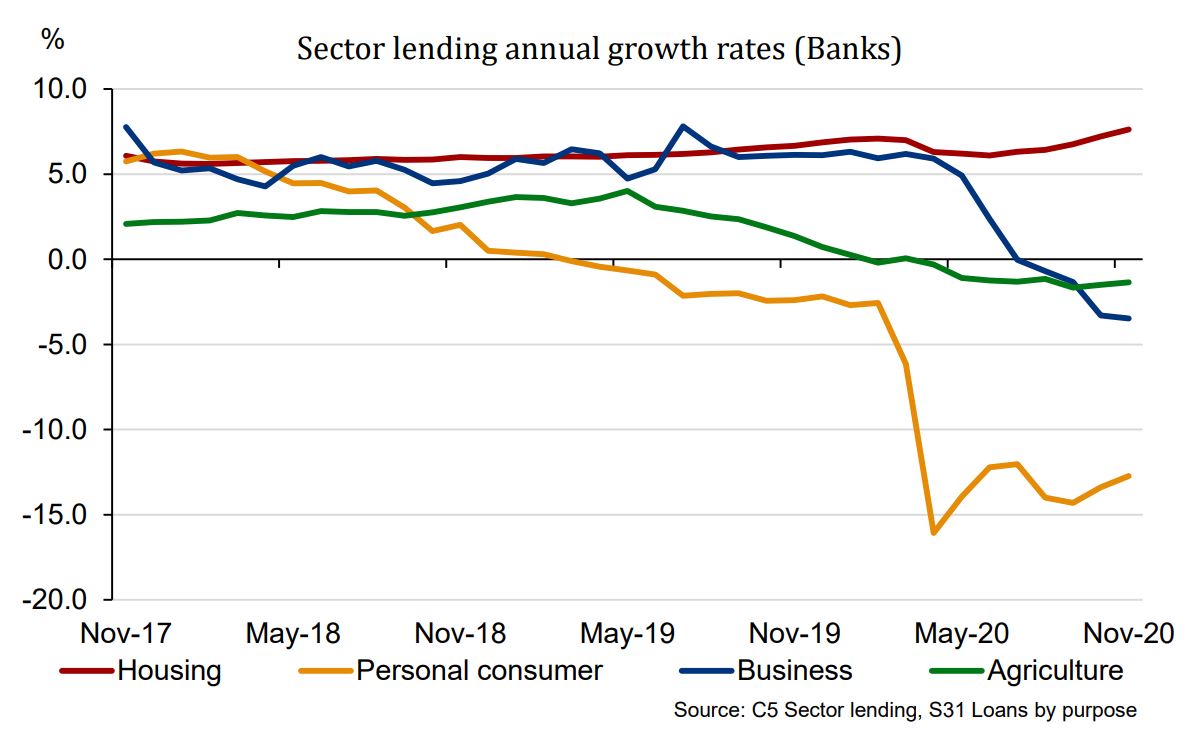
Indeed, bank lending to businesses fell off a cliff in 2020, while lending for housing shot up.
It's too early to see the impact of the FLP. There have been three drawdowns from the FLP, totalling $1.14 billion, since its December launch.
*This article was first published in our email for paying subscribers. See here for more details and how to subscribe.
We welcome your comments below. If you are not already registered, please register to comment
Remember we welcome robust, respectful and insightful debate. We don't welcome abusive or defamatory comments and will de-register those repeatedly making such comments. Our current comment policy is here.