

By Jenée Tibshraeny
The Reserve Bank (RBNZ) has been making headlines, as the actions it’s taking to lower interest rates are contributing to soaring house prices.
The situation has prompted National’s Andrew Bayly to make his first splash as Shadow Treasurer by calling for the Government to “rein in” the RBNZ.
Specifically, Bayly wants Finance Minister Grant Robertson to get the RBNZ to put conditions on its Funding for Lending Programme (FLP) due to launch in December.
Bayly says banks that draw down on the $28 billion being made available to them by the RBNZ, should have to use this funding to lend to those investing in “productive” parts of the economy, not just housing.
Robertson has responded: "In the end it is the retail banks who will ultimately decide if this money is used and where it is allocated.
"I encourage them, if they take part in the programme, to focus their lending to support investment in the productive economy including in supporting our small businesses."
The politics
Bayly's suggestion has cornered Prime Minister Jacinda Ardern politically.
The “left” has for some time been coming at Ardern for not doing enough to address rising inequality stemming from asset price inflation.
The Green Party last week renewed its call for the introduction of a capital gains or wealth tax. It also supported pleas by 40 welfare and poverty organisations for the Government to increase income support payments.
Meanwhile the “right” - namely ACT’s David Seymour - has been calling for the Government to add asset price inflation to the RBNZ’s monetary policy mandate. This would be an impediment to the RBNZ slashing interest rates - something Seymour wants to coincide with heavily reduced government spending.
Now, Bayly is leading a call from the “centre-right” for Ardern to address inequality by getting the RBNZ to direct more of its newly-printed money towards businesses and less towards the housing market.
Ardern hasn’t caved to pressure. Rather, she on Monday and Tuesday resorted to defending the independence of the RBNZ, likening the interference Bayly is calling for to that of former Prime Minister Robert Muldoon.
Monetary policy is finally on the radars of politicians and the mainstream media. This is great in terms of creating necessary (hopefully high-quality) policy debate.
But it’ll prove a headache for the RBNZ, which will have to work harder to maintain its social and political licence.
Key questions
National speaking out on monetary policy raises two questions:
- At a high level - how closely can and should the government work with the RBNZ?
- At an operational level - would putting conditions on the RBNZ’s FLP reduce its potency?
Robertson suggested conditions be put on the FLP
To deal with the first question, Ardern’s comments are overblown and hypocritical.
While she said Bayly’s call represented a “significance departure” from "long-term consensus" around government/RBNZ separation, she failed to recognise Robertson made similar comments a couple of months ago.
Speaking to media on August 26, Robertson said: “One of the issues we want to work through with the Bank is how it [the FLP] would work; what kind of conditions they might place on that lending.
“That’s a discussion that we’re still having and the concern you’re raising [the prospect of that funding flowing straight into housing] will be one of the issues that I’ll talk to the Bank about.”
Asked what kind of conditions he wanted to see the RBNZ put on the scheme, Robertson said: “What we want to do is ensure that it supports productive growth in the economy - that’s what we always want to see; that it makes sure that the financial system remains liquid and that our banks are stable and able to lend and help boost the economy...
“My understanding from the Reserve Bank is they understand this shouldn’t be a carte blanche scheme; that it should be one that is dedicated to those sorts of goals.”
Put to him that the RBNZ had in fact talked about having few conditions on the scheme, Robertson said: “That’s the discussion we’ve got to have. For me it’s early days, it’s a proposal."
Asked on Tuesday what input, if any, he had in the creation of the FLP, Robertson said: "The RBNZ consulted with my office as it formulated the FLP, as is standard practice.
"Decisions on the implementation of the programme are taken solely by the bank itself."
But as per the above, Robertson "encouraged" banks to "focus their lending to support investment in the productive economy".
Even traditional former central bankers support more communication
Blogger, Michael Reddell, who used to hold a number of senior positions at the RBNZ, believed the Bank would’ve “guarded jealously” its power to conduct monetary policy independently (the FLP is a monetary policy tool).
Because FLP loans have to be secured against high-quality collateral, Reddell believed the Crown’s balance sheet wouldn’t be exposed. Therefore, the Finance Minister wouldn’t need to provide an indemnity as it has for the RBNZ’s quantitative easing programme.
The RBNZ subsequently confirmed this, saying: "We did share our assessment of the fiscal and balance sheet risks of the FLP with the Treasury after the decision by the MPC was announced on 11 November, as requested [by the Finance Minister]."
Consultant Geof Mortlock, who like Reddell spent a number of years at the RBNZ, said it would’ve been “entirely proper” for Robertson to sit down with the RBNZ - not to interfere with its operational independence - but to voice any concern over the impact monetary policy is having on asset price inflation.
Mortlock said Robertson and Treasury should be meeting with all members of the Monetary Policy Committee. He said Robertson needed to provide the RBNZ with clear expectations.
Indeed, Bayly wants Robertson to give the RBNZ a "letter of expectations".
“It has been a raucous cacophony of silence from them [Monetary Policy Committee members]. They should be more transparent,” Mortlock said.
Government technically has the power to intervene
He also pointed out there’s a provision in the Reserve Bank Act that enables the Governor-General, by Order in Council, on the advice of the Finance Minister, to direct the Monetary Policy Committee to target different economic objectives.
Under Section 12, the Minister can direct the Committee to only target one of its two objectives - inflation and employment - or an objective in addition to, or instead of, either of these objectives.
The Order can last for up to a year.
Mortlock said this provision has never been used, and wasn’t suggesting it be used now, but noted the narrative around complete RBNZ independence was technically untrue.
Where Bayly and the RBNZ would clash
Now to the second question Bayly’s comments raises - would putting conditions on the RBNZ’s FLP reduce its potency?
The RBNZ would argue yes.
By lowering the cost of bank funding, the RBNZ hopes banks will be able to lower their lending rates. If they can rely less on competing for funding from term deposits, this will give them even greater scope to make rate cuts across the board.
The idea is that even if banks don’t take up all $28 billion on offer, knowing cheap funding (at the rate of the Official Cash Rate: 0.25%) is there, will give them confidence to lower rates.
Ultimately the goal is for this to encourage more borrowing, investment and spending to boost inflation and employment.
The RBNZ has avoided putting conditions on the FLP, because it doesn’t want to inhibit its take-up.
It is at this point that Bayly’s call for the FLP to be directed towards productive parts of the economy, particularly business lending, clashes with the RBNZ’s position.
What if businesses, which haven’t shown a great appetite to increase their borrowing since the onset of Covid-19, continue to remain cautious? Would the FLP be a flop?
Bayly said it was understandable for, say, a business under pressure to be cautious about using their house as security for a new loan. But he maintained the view there was little demand by businesses for credit was a “heroic assumption”.
Asked whether he believed there would be a problem if the FLP wasn't as stimulatory as it might’ve been without conditions, Bayly said: “The big thing is making sure there’s enough liquidity in the banking sector. That’s what the RBNZ’s role is… The issue of interest rates will be a natural consequence of it."
Once again, the RBNZ would have a different view. It has already made other moves to support liquidity - of which there is ample. The primary purpose of the FLP is to lower interest rates to boost inflation and employment.
Demand for credit by businesses could be picking up
Coming back to this notion of whether businesses want to borrow - the jury is out.
The total value of outstanding bank loans to businesses has been declining from the onset of Covid-19 until September (the latest available RBNZ figures) to $110 billion.
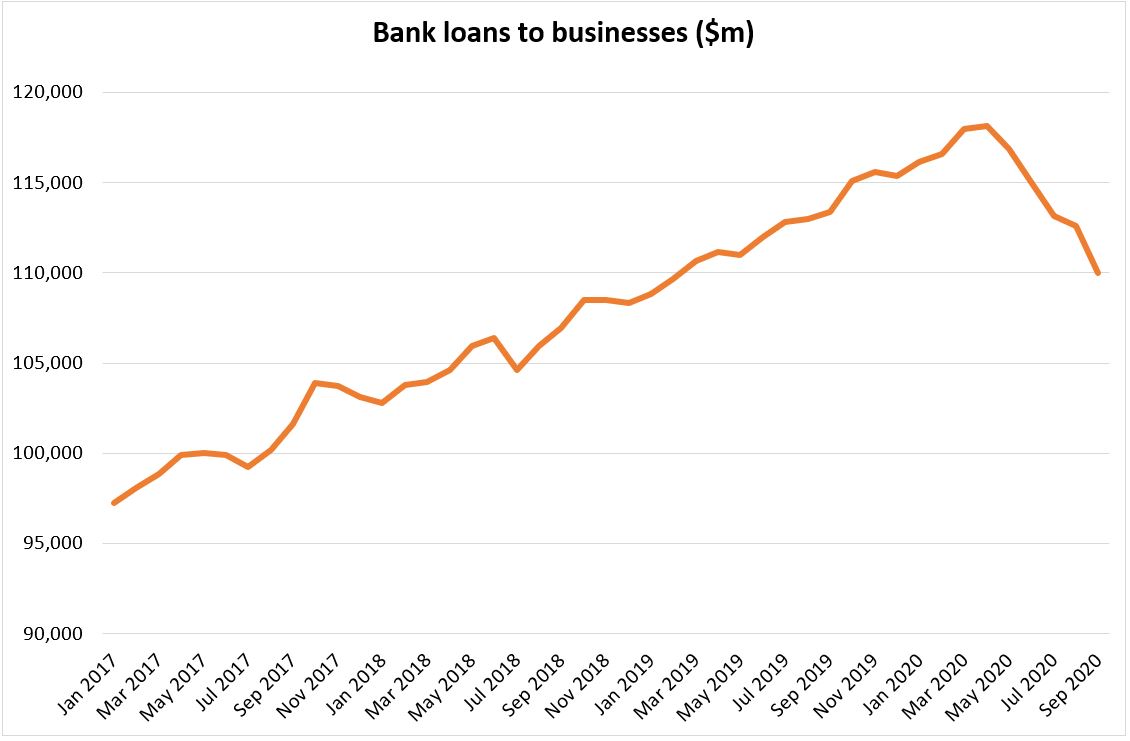
The bright spot in the business lending category is investment property and commercial property development. Everything else is down, even lending for residential property development. Agricultural loans are also down, largely due to banks continuing to reduce their exposures to dairy. Lending for horticulture and sheep, beef cattle and grain farming are up.
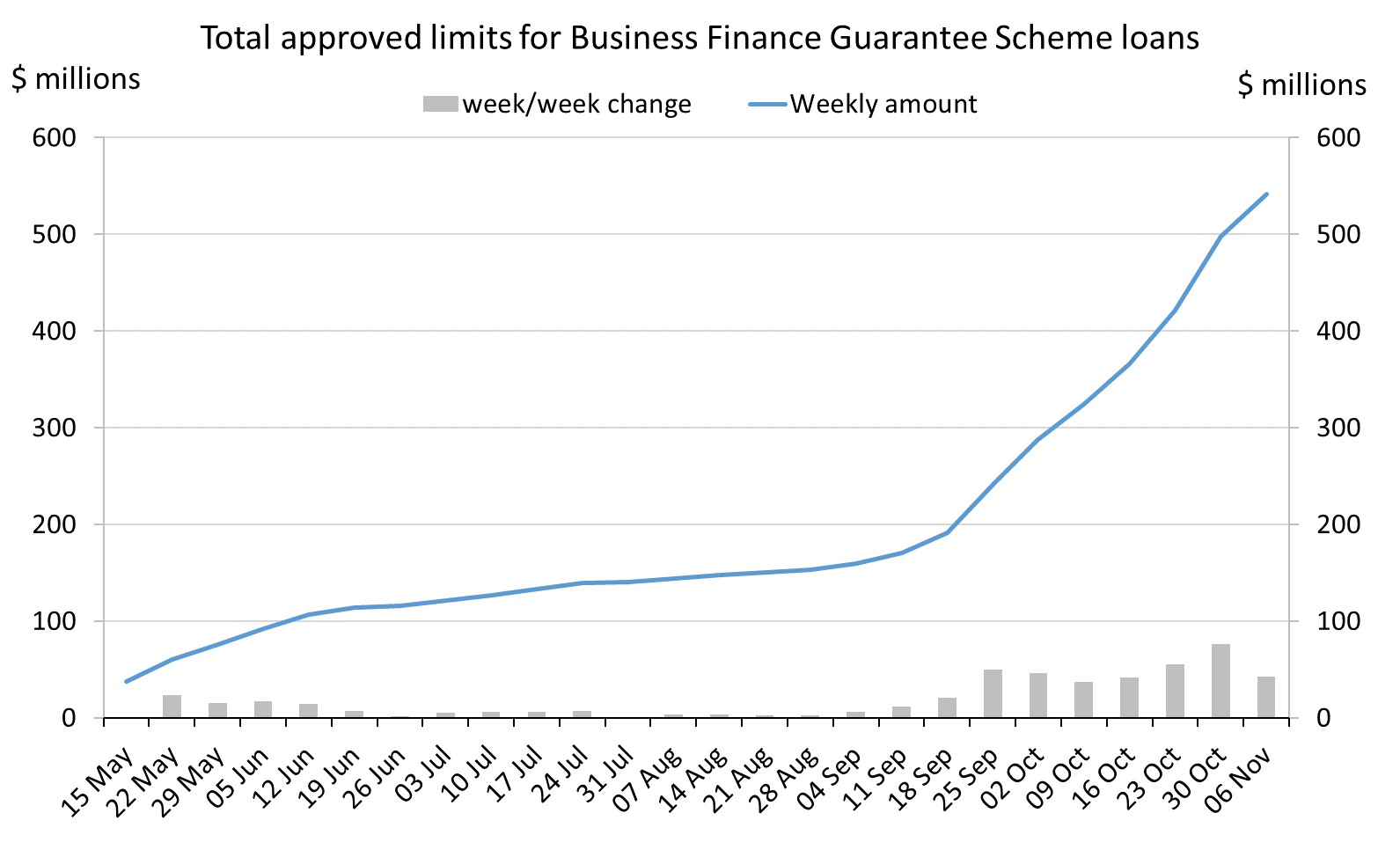
However, there's been an uptick since September in the amount lent under the Government’s Business Finance Guarantee Scheme. This scheme, which has been broadened a number of times, sees the Crown underwrite 80% of eligible bank loans to businesses.
Furthermore, there's been high uptake of the Government’s Small Business Cashflow Loan Scheme, through which businesses can get small interest-free loans directly from the Government. Around $1.6 billion has been lent through this IRD-administered scheme to date.
The RBNZ’s chief economist, Yuong Ha, last month noted that while property buyers are borrowing now, businesses might have a greater propensity to borrow once economic growth picks up.
We welcome your comments below. If you are not already registered, please register to comment
Remember we welcome robust, respectful and insightful debate. We don't welcome abusive or defamatory comments and will de-register those repeatedly making such comments. Our current comment policy is here.