
Summary of key points: -
Global bond market mayhem has implications for New Zealand
RBNZ ignore exchange rate depreciation at their peril
The RBA is set to hike interest rates again
Absolute mayhem in global bond markets has dominated the headlines over this last week. The benchmark US 10-year Treasury Bond yield continuing to increase from 4.92 % to a high of 5.22% over the course of the week (back to 5.17% at the market Friday close). Everyman and his dog is struggling to explain why the sellers are dominating the buyers in this market, sending the price of US bonds lower and the market yield up.
Fear and expectations about the future might accurately summarise the drivers in the current market environment.
The future direction of US 10-year Treasury Bond yields is important for both investors and corporates in the New Zealand economy. For fixing/hedging local interest rates via the swap market, our term fixed rate swap interest rates beyond two years are almost solely determined by US swap/bond interest rates.
In theory, high US 10-year Treasury Bond yields attract funds into the US dollar and the currency appreciates. However, over recent months that correlational relationship has broken down somewhat. The US dollar has strengthened in global FX markets over recent weeks from 98.22 on the 8th of September to 100.75 today (reaching a high of 101.00 on 24th September). The stronger US dollar pushing the NZD/USD exchange rate to 18-month lows at 0.5660. The USD-related Kiwi dollar selling coming on top of the independent NZD selling caused by the RBNZ “go slow” message on local interest rate increases on 2nd September.
In no particular order, the following forces are at work t0 push US Treasury Bond yields to levels above 5.00% not seen since 2006: -
- Global bond investors reducing their weighting/risk exposure to US Government Bonds in general as they finally conclude that Government debt levels are only going to increase further (bond supply increases) under the Trump regime that has lost control of its annual fiscal deficit.
- Hedge fund speculators aggressively (using leverage) selling bond futures at the same time they sell oil futures. They are betting the Iran/US war continues for some time, keeping oil prices elevated and pushing US inflation higher for much longer.
- US domestic bond investors vying away from Government bonds, preferring to invest in the high yielding corporate bonds being issued by the hyperscalers, the AI/data centre companies requiring astronomical amounts of debt as well as equity capital to fund their builds.
- Fears that the US Federal Reserve will suffer political interference from Trump and not raise US short-term interest rates to control inflation. However, the decisive action of Kevin Warsh to increase the Fed Funds interest rate at the last meeting may have allayed some of those fears surrounding the Fed’s credibility.
- The world’s security, trade and investment order completely breaking down under Trump’s agenda of the rich/powerful nations dictating terms to the poorer/weaker nations. The end result is chokepoints, as we are seeing in the Middle East, leading to supply shortages/shipping disruptions and permanently high inflation.
US Treasury Secretary, Scott Bessant and Fed Chair, Kevin Warsh both confidently claim that stronger US GDP growth will solve the US fiscal deficit and debt problem. They may well by right with higher oil prices and lower costs through AI efficiencies driving increased profitability and investment in some parts of the US economy. The US Government Debt to GDP ratio is currently 122%, still lower than Japan (230%) and Italy (135%). Unlike the US, Japan does not rely on foreign investors to fund its debt, it is all domestic investors.
There is, off course, a risk that the AI revolution does not deliver the GDP growth the US authorities are so convinced about. The stack of cards could crumble which would be highly negative for US economic growth. Perhaps the bond markets are reflecting the risk that GDP growth will not solve their debt problem, and the credit rating agencies may be close to knocking on the door with negative watch and downgrade decisions.
A nearer-term risk is that the US agrees to Iran’s terms on ending the shipping blockade to allow an immediate re-opening of the Strait of Hormuz. Trump has reportedly rejected the proposal. Under this scenario (albeit a low probability at this point in time), oil prices would tumble from US$92.00/barrel (WTI) to US$70.00/barrel. The worries that the Fed members have about second and third round inflation increases from the prolonged elevation of oil prices would dissipate overnight. Should this scenario eventuate into reality, the USD would weaken as the US interest rate markets would instantaneously unwind the pricing-in of further hikes. Such a scenario cannot be ruled out as Trump needs to pull a few rabbits out of a hat (plummeting gasoline pump prices) for the Republicans to win the mid-term elections In November. On the other side, an egocentric Trump probably does not even care about his party retaining the House and the Senate, as long as he can build his vanity edifices (ballroom and arch) and punt AI stocks, he will be happy!
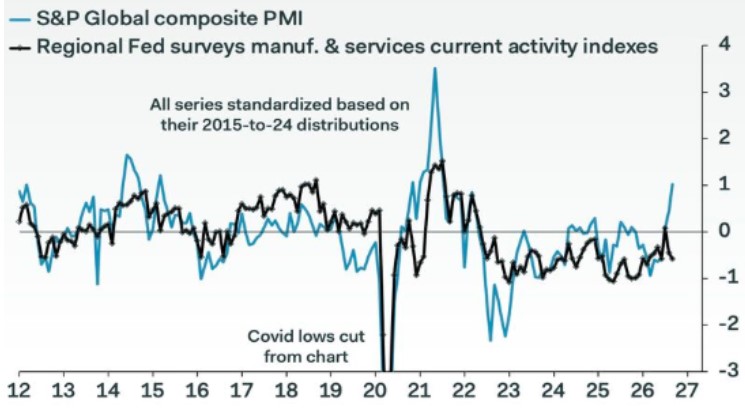
The much stronger than expected S&P Manufacturing and Services PMI survey results for September in the US last week caused a massive reaction by the FX and bond markets (USD and yields higher). However, do not be surprised that the spike higher in the composite index (services + manufacturing) from 55.2 to 58.4 is a rogue number and an inaccurate representation of activity levels in the US economy. The various regional Fed surveys of services and manufacturing (Dallas, New York, Richmond, Philadelphia and Kansas) are not recording a spike higher in September (refer to the chart below where the S&P measure has temporarily spiked higher and lower in the past).
Whether US bond yields (and the US dollar currency value) can extend to higher levels, or reverse downwards, may well depend on a stack of US economic data releases coming this week: -
- CB Consumer Confidence Index for September (currently 89.4).
- PCE Inflation Price Index for August – a core PCE increase of +0.30% is forecast, reducing the annual rate from 3.40% to 3.30%. A lower increase will send bond yields and the USD lower (and vice-versa).
- ISM Manufacturing PMI Index for September (currently 54.6).
- Non-Farm Payrolls jobs data for September – an increase of 90,000 to 100,000 jobs is forecast, following the stronger +162,000 jobs in the month of August.
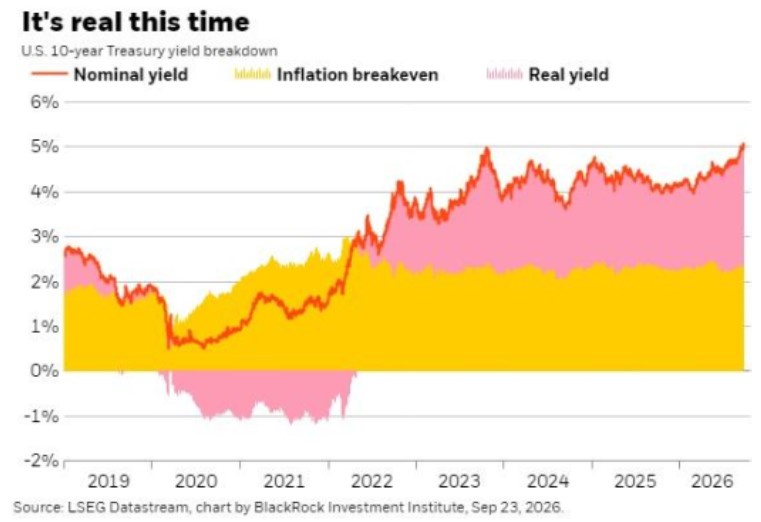
The unanswered question in the bond market rout, is when will investors be enticed to come back into the market and buy bonds? (forcing yields back downwards). The chart below confirms that “real” bond yields (nominal yields above inflation) are at their highest level for many years.
RBNZ ignore exchange rate depreciation at their peril
In their regular Monetary Policy Statements the RBNZ always reference NZ dollar currency movements as being solely caused by international developments, normally related to US interest rate changes and the US dollar. The never mention the fact that their own actions/decisions influence the NZD/USD exchange rate. However, one of the essentials arts of central banking is that they should know in advance how their actions and words will impact on foreign exchange and interest rate markets.
Twelve months ago, the RBNZ were aggressively slashing the OCR interest rate, not because inflation was in danger of falling below 1.00%, but the interim Governor at the time was worried about the economy falling into another mini recession. It was a worrying misread of what was actually happening in the economy at the time, as GDP growth in the September 2025 quarter was a robust +0.90% and the December 2025 quarter another 0.50% expansion on top of that. The RBNZ were the sole cause of the NZ dollar depreciating in late 2025 when other major currencies were stronger against a weaker USD.
In their 2nd September 2026 Monetary Policy Statement, for some unknown reason, the RBNZ changed their previous signalled rate of increase in the OCR interest rate to a slower pace (removing the 28th October OCR increase). The NZ dollar depreciated on its own account from 0.5960 to 0.5820 and has subsequently depreciated further to 0.5660 as the interest rate differential widens due to recent increases in US interest rates. It is now clear that the RBNZ will need to backtrack on the “pause” decision for 28th October and implement another 0.25% OCR increase to 3.00%.
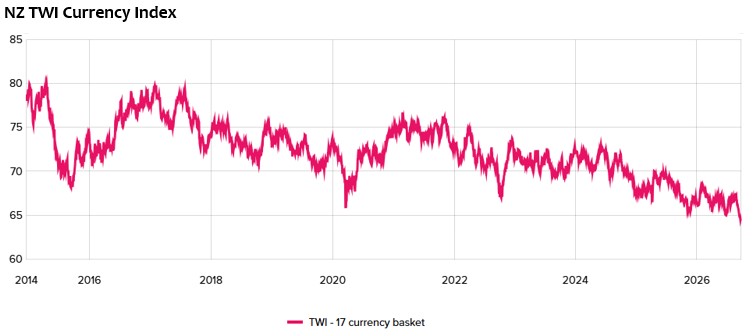
As we have stated previously, making decisions that depreciate the NZ dollar when the RBNZ need a stronger NZ dollar to reduce tradable inflation and bring overall inflation back within the 1.00% to 3.00% target band makes no sense whatsoever. The RBNZ always base their GDP growth and inflation forecasts on a stable TWI exchange rate index going forward. When the TWI index depreciates significantly below their assumed stable level, they need to accordingly adjust their inflation forecasts higher. The TWI Index is currently at 64.35, down 3.50% from 66.70 over the last 12 months and down 9.70% from 71.26 over the last 24 months. Whilst the TWI depreciation has been very helpful to the export-led economic recovery over the last two years, the flipside is that the lower currency value has kept tradable inflation elevated and overall inflation above 3.00%. The substantial depreciation in the TWI Index in late 2025 and again over recent weeks is evident in the chart below.
It is not credible to cause a depreciation in the NZ dollar, then assume a stable exchange rate environment to always achieve a forecast 2.00% to 2.60% pa inflation outcome.
Over the last 18 months, in their last six Monetary Policy Statements, the RBNZ have kept their 18-month ahead inflation forecast stable between 2.00% and 2.60% pa. In each forecast they assume a stable TWI Index going forward. However, due to their own decisions on interest rates the TWI Index has not remained stable, it has depreciated 6.70% over the last 18 months from 69.00 to 64.34. The actual annual inflation rate is consequently well above RBNZ forecasts due to imported inflation.
The RBNZ would be a lot closer to achieving their 2.00% to 2.60% inflation forecasts over the last 18 months had they not slashed the OCR to 2.25% in late 2025 and caused the material NZ dollar depreciation.
The good news for local USD importers is that the RBNZ will soon realise that they need to be increasing NZ interest rates to above those of the US over the next six to nine months to reverse the currency slide and have a chance of returning inflation to below 3.00%. The RBNZ also need to know that the majority of our exporters (outside of the lamb and beef firms) are highly hedged forward for multiple years against NZD appreciation, therefore a much stronger NZD value will not impede GDP growth from the export sector.
The RBA is set to hike interest rates again
The Reserve Bank of Australian (“RBA”) will be announcing another 0.25% increase in their OCR interest rate this Tuesday, taking the rate up from 4.35% to 4.60%. Whilst that lift is already fully priced-in to interest rate and FX markets in advance, the Aussie dollar is still expected to appreciate as the accompanying commentary from the RBA will be that their fight against a stubborn high inflation is not over and even further interest rate increases are likely to be needed.
Australian inflation data for the month of August is released the following day on Wednesday 30th September. The “trimmed mean” measure of the annual inflation rate that the RBA prefer to monitor is forecast to increase from 3.60% to 3.70%, justifying a decidedly hawkish RBA stance.
Depending on Iran/US war outcomes and the future direction of the oil price, there is a very good chance that the RBA tighten monetary policy too far over coming months, sending the Australian economy into a very rare recession. Australian mortgage borrowers are all floating/variable rate and medium to smaller business firms in Australia do not hedge their interest rate risk through the swaps market like the equivalent borrowers do in New Zealand. The end result is that interest rate hikes In Australia have a much more immediate negative impact on the economy than what the case is in New Zealand where 90% of mortgage borrowers fix and business borrowers also fix their interest rates. The RBNZ will also be hiking interest rate substantially over coming months, however the negative impact on the economy will be muted/delayed by the better awareness of financial risk management on this side of the Tasman.
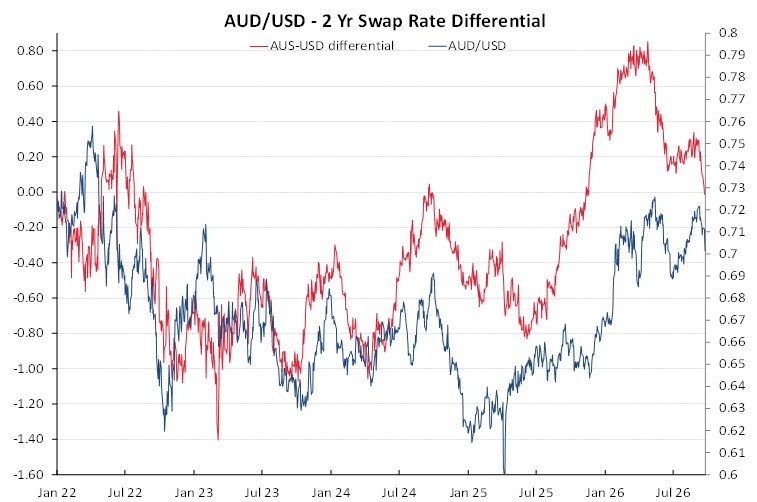
For these reasons the NZ economy is set to significantly outperform Australia over the next 12 to 24 months. Currency traders are starting to understand these differences; therefore, the NZD/USD exchange rate is likely to follow the AUD/USD exchange rate higher as the RBA hike rates. Australian interest rates remain just above those in the US, even though US rates have increased substantially of late. The Aussie dollar still has some legs in it yet to appreciate to 0.73000/0.7400 over coming months; however, it is set to underperform the NZ dollar later next year when the RBA may well be cutting interest rates whilst the RBNZ are still hiking/holding.
Daily exchange rates
Select chart tabs
*Roger J Kerr is Executive Chairman of Barrington Treasury Services NZ Limited. He has written commentaries on the NZ dollar since 1981.
We welcome your comments below. If you are not already registered, please register to comment
Remember we welcome robust, respectful and insightful debate. We don't welcome abusive or defamatory comments and will de-register those repeatedly making such comments. Our current comment policy is here.