
Summary of key points:
- Debt markets are always the first to reflect financial risk and stress
- Usual culprits remain behind stubborn elevated inflation in New Zealand
- Are there more interest rate hikes to come in Australia?
It has become abundantly evident over recent weeks that the investors into debt securities issued by the data centra builders are starting to vote with their feet and reduce their credit exposures. All around the world the pricing of corporate type bonds issued by the hyperscalers has blown out as the investors sell out. In the classic “canary in the coalmine” risk signal, the growing financial stress in the debt/credit markets means that it cannot be too long before there is a more significant downward correction in the AI/data centre/tech stocks on equity markets.
You always see the risk fractures in debt markets first.
Everyone is anticipating a correction back in equities at some time, given the speed and extent of the rally higher, however the timing of just when that happens is the difficult bit.
What started out as a predominantly cash-funded expansion into AI infrastructure, has rapidly transformed into a reliance on debt to raise the required capital.
Now there are serious questions as to whether all these new data centres will generate sufficient income to service and repay the debt. Credit default spreads for neocloud company CoreWeave have blown out to 12% (1,200 basis points), reflecting massive doubts as to the company’s creditworthiness.
The chart below from JP Morgan confirms the level of repricing of debt for the riskier AI borrowers.
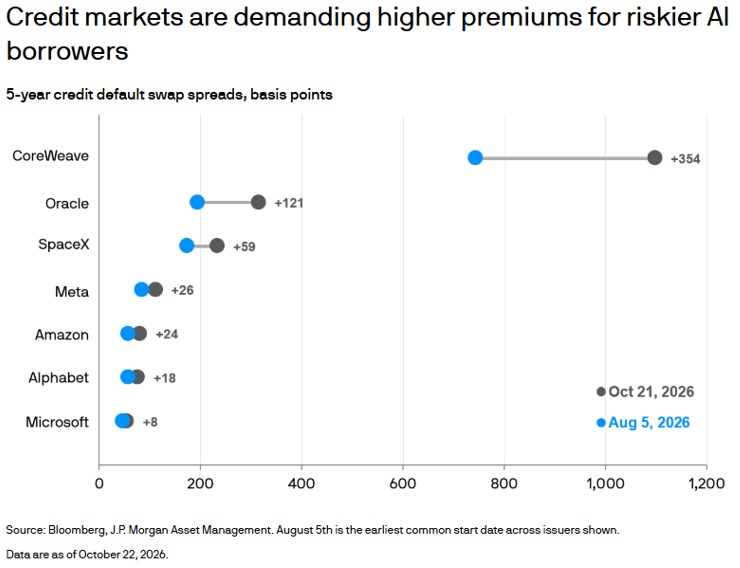
Currently in the US, SpaceX’s proposed US$40 billion Ai related off-balance sheet debt deal to finance the purchase of chips has hit obstacles as credit spreads blow out. The deal is being re-priced as credit conditions deteriorate. The warning signs are certainly starting to flash red!
Whilst the computing demand associated with AI boom continues to grow, the infrastructure providers of the capacity supply side should be able to contain their financial risks. However, a demand shock would see financial stress increase.
The direct implications for the currency markets from a potential AI debt related shock or risk event are not altogether clear. Should the US equity markets start to slide, we could well see a reversal of foreign capital inflows into the US that have been attracted in by the AI boom over recent years. The general overall stability of the US dollar since 2024 has been attributed to foreign inflows into US-listed AI stocks offsetting foreign investor outflows from selling out of US Treasury Bonds. A more one-way flow of foreign investors returning their money home would be negative for the USD currency value. Should there be an AI driven share market correction, the epicentre would be tightly concentrated inside the US share market, therefore that would weigh downward on the USD. A significant US stock market sell-off would also reduce demand in the US economy, slow growth and lead to the Fed cutting interest rates, which is also negative for the US dollar.
The Kiwi dollar with its reputation as a risk/commodity currency has tended to depreciate when there is an investor “risk-off” sentiment on Wall Street. However, in recent years the fact that New Zealand’s interest rates have remained below those of the US has been the dominant negative for the Kiwi dollar holding it down. We have witnessed in the past that when there is a debt crisis somewhere in the world (e.g. Greece/Europe in 2013), the Kiwi dollar is often seen as an alternative safe haven destination far away from the risk and trouble.
Usual culprits remain behind stubborn elevated inflation in New Zealand
There are three very good reasons why the RBNZ should ignore their own OCR track assumptions in their 2nd September Monetary Policy Statement, which confirmed skipping a 0.25% increase in October, with their OCR review this week on Wednesday 28th of October. The local interest rate markets have arrived at the same conclusion as they now price an 85% change of an OCR hike to 3.00%: -
- Oil prices have returned to their highs at US$103.40/barrel (WTI) as President Trump vows to restart the missiles on Iran after the US mid-term elections in nine days’ time on 3rd November. Whilst the theory is that central banks should “look through” oil price shocks they cannot control, after eight months of Middle East hostilities the longer-term and second round impacts on local inflation cannot be ignored.
- The overall value of the Kiwi dollar exchange rate as measured by the Trade Weighted Index (“TWI”) is significantly lower today at 64.51 compared to the 66.90 assumption level at the time of their 2nd September RBNZ statement. The TWI Index hit a low of 63.59 on 13th October (5.00% below the 66.90 RBNZ assumption), so there has been some recovery over recent days. In their economic forecasts, the RBNZ always assume the TWI exchange rate will be stable over the forecast period. Because the exchange rate has been consistently lower (partly due to their own decision to pause with OCR increases this month), the RBNZ are forced to increase their tradable inflation forecasts as import costs rise. If the RBNZ are serious about returning the inflation rate to within the 1.00% to 3.00% required band, they need a higher exchange rate, not a lower one.
- Whilst there was relief in some quarters that the September quarter CPI inflation rate was not above the prior consensus forecasts of a 0.70% quarterly increase, there is absolutely no room for the RBNZ to be complacent. Forecasts for the December quarter are already picking the annual inflation rate to return to well above 4.00% from the 3.70% annual rate to the end of September. The worrying aspect of the September results was that the usual culprits of continuing price hikes, local government rates and electricity prices, showed no signs of abating. To be fair, local government rates were only up 6.20% over the year, which is lower than the 8.00% to 12.00% repeating annual increases over the last 15 years. Why it has taken the central government so long to address this inflation problem, with rates caps and amalgamations, is a failure of financial management. The RBNZ are also at fault here as well for never pointing out the root causes of inflation in our economy. They are the guardians of our purchasing power, unfortunately they act at the bottom of the cliff, not in a preventative way at the top.
The new Government we elect in on 7th November also needs to address constant electricity price increases. Self-congratulatory claims that we have the most renewable energy sources in the world does not help struggling households and businesses paying some of the highest electricity prices in the world (we are marginally lower than the US and Europe, but higher than Asia, South America and Africa). Dry year alternative sources are critical for our hydro reliance, as well as adjusting the protected/regulated profits of the energy distribution network companies.
The RBNZ’s own calculated “sectoral factor model of core inflation” was revised up to 2.80% in the September quarter, with their “factor model” at 3.20%. Similar to the Kevin Warsh’s Federal Reserve impatience with US inflation being above the target for far too long, the RBNZ should be expressing similar concerns with inflation in New Zealand. The OCR review statement this Wednesday needs to be more hawkish in tone than what the markets are expecting, as the RBNZ has a responsibility to push the exchange rate higher on its own account to have a chance of bringing inflation back within the target band. They need to provide clear forward guidance that OCR hikes are needed this week and again in December, followed by likely further increases in 2027.
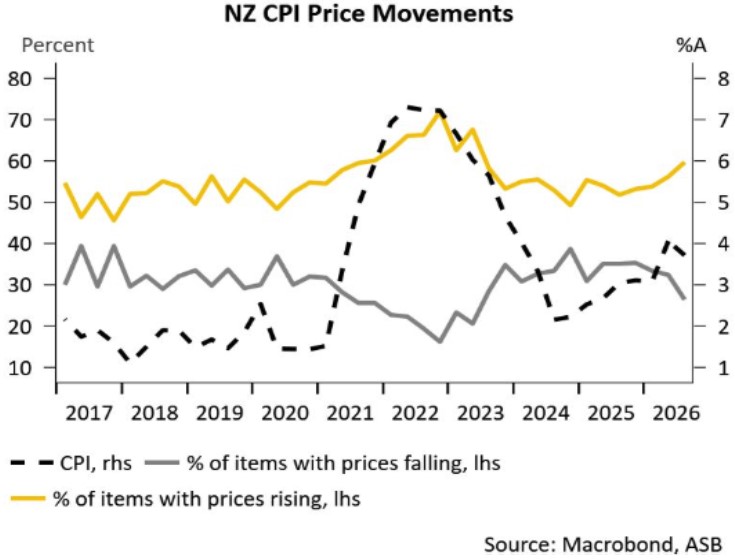
The chart below from ASB on the percentage of prices increasing and the percentage of prices falling should make for sobering reading at the RBNZ. New Zealand’s inflation problem is not about excessive demand, it is always about the supply side, uncompetitive industry sectors and “administered” prices. Demand in the economy will not be adversely affected by the OCR interest rate increasing from 2.75% to 3.75% as 70% of mortgage borrowers have fixed interest rates in place, as do most SME and corporate borrowers. Critics of OCR increases completely ignore the fact that most Kiwi borrowers are pretty savvy at managing their interest rate risk. The local media, in particular, need some education in this respect.
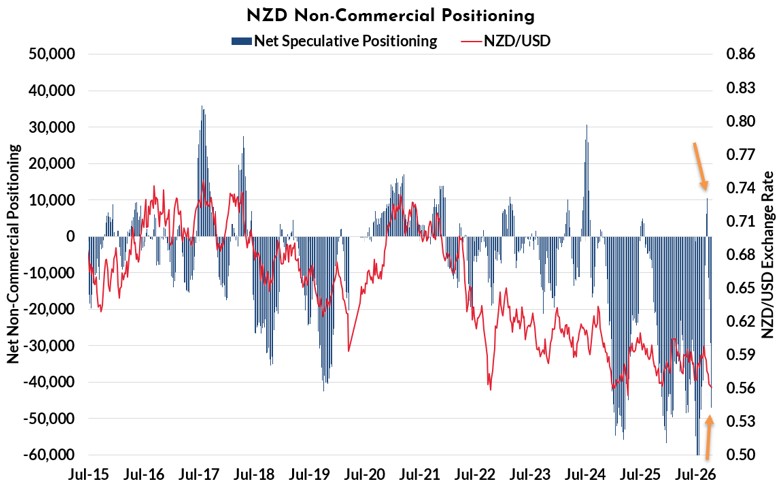
Speculative positioning on the NZD/USD exchange rate in US futures markets has changed dramatically over the last eight weeks since the 2nd September RBNZ Monetary Policy Statement. As the top orange arrow on the chart below shows, the currency punters went “long-NZD” expecting further NZD appreciation in late August (positive blue bar on the chart). After the RBNZ September statement, they rapidly reversed their view on the Kiwi dollar outlook, switching to “sold-NZD” positions expecting NZD depreciation. The lower orange arrow shows that the speculative positions are now 45,000 open futures contract short-sold the Kiwi dollar. A reversal of the RBNZ’s September position this Wednesday, should see the Kiwi dollar appreciate on its own, as the FX markets are going into the statement heavily short-sold. They have to buy the NZD to unwind.
Are there more interest rate hikes to come in Australia?
The constantly rotating “on again” and “off-again” views and market pricing on whether the Reserve Bank of Australia (“RBA”) need to increase their OCR interest rates further from the current 4.60% level, or not, is becoming very hard to follow!
The pendulum has decisively swung back in favour of another 0.25% OCR hike to 4.85%, following RBA Deputy Governor, Andrew Hauser’s warning shot in a speech at the Citi conference in Sydney last week. The hawkish comments from Mr Hauser included remarks that the RBA had “hard choices” ahead as inflation in Australia looked “materially worse” than the RBA’s own August projections. The market responses were to push the AUD higher against the USD and lift interest rates to a 64% probability that the RBA will increase the OCR to 4.85% at their 3rd November (Melbourne Cup Day) meeting. Before Mr Hauser took the stage for his speech, the market pricing was only a 27% chance of an interest rate hike.
The RBNZ should be noting Andrew Hauser’s conclusion on the need to revise inflation forecasts higher!
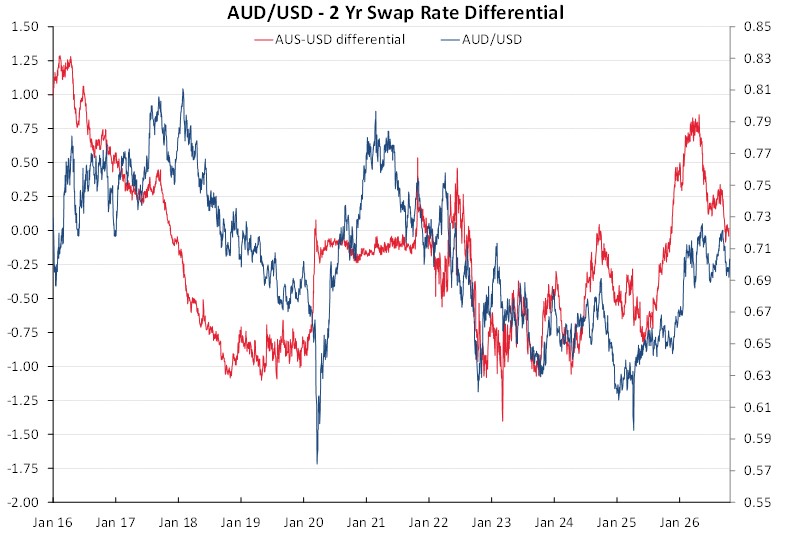
The AUD/USD exchange rate has lifted from 0.6945 a week ago to 0.7035 at the Friday New York market close. Further gains for the Aussie dollar seem likely as they increase interest rates again on 3rd November, whilst the Federal Reserve in the US will most likely be holding pat with interest rate adjustments at their meeting on Wednesday 28th October (6am Thursday morning NZT). The interest rate differential between Australia and the US seems set to widen out in Australia’s favour again as US market interest increases over recent months closed the gap up to zero (red differential line, left-hand axis in the chart below). Over coming weeks/months, we would expect to see the Australian two-year swap interest rate increase from its current 4.82% level to above 5.00%. However, on the other hand, US two-year swap interest rates (also currently sitting at 4.82%) could be expected to be pulled down by longer-term bond yields in the US continuing to correct downwards from their recent peak. US 10-year Treasury Bond yields closed last week at 4.98% after peaking at 5.35% on 7th October. We anticipate that US 10-year Treasury Bond yields will continue to decline over coming weeks as bond investors seek a “safe haven flight to quality” from the carnage starting to develop in the AI-related debt arena.
The Kiwi dollar will follow the AUD exchange rate higher and not lag behind, as the FX markets look further forward into 2027 and conclude that the RBNZ will still be hiking interest rates to return New Zealand’s monetary policy settings to “neutral”, whereas the RBA in Australia will be contemplating interest rate cuts by mid-2027 as their economy is hit hard from the now “tight” monetary policy conditions.
Daily exchange rates
Select chart tabs
*Roger J Kerr is Executive Chairman of Barrington Treasury Services NZ Limited. He has written commentaries on the NZ dollar since 1981.
We welcome your comments below. If you are not already registered, please register to comment
Remember we welcome robust, respectful and insightful debate. We don't welcome abusive or defamatory comments and will de-register those repeatedly making such comments. Our current comment policy is here.