
Summary of key points:
- Kiwi dollar caught in the backwash of a perfect storm!
- Uncertain political result not positive for the Kiwi dollar
- US dollar lower then higher on mid-terms election result and jobs report
A combination of a weaker Australian dollar, stronger US dollar and election/political uncertainties at home conspired together to force the Kiwi dollar lower late last week - a perfect storm of events propelling the Kiwi lower with no respite in sight.
The NZD/USD exchange rate has been forced down to a low of 0.5530, a level not seen since the GFC in 2009. It seems the Kiwi dollar cannot turn a trick in the current environment, depreciating in tandem with the AUD/USD rate as that currency was rapidly sold off from 0.7020 last Thursday to close the week at 0.6865.
The Australian dollar is meeting a wall of sellers as the FX markets price-in the fact that the Australian economy will be performing very poorly next year and the Reserve Bank of Australia’s (“RBA”) next change with interest rates will be cuts, potentially as early as June/July 2027. It is ironic that the NZD/USD exchange rate did not fully follow the Aussie dollar 12 months ago when it appreciated eight cents from 0.6450 against the USD to 0.7250 by May 2026. The Kiwi dollar appreciating just four cents over that period from 0.5600 to 0.6000. However, when the AUD was aggressively sold last week, the NZD/USD rate duly followed.
If the RBNZ had increased interest rates on 28th October, the Kiwi dollar may have found more support in the forex markets as the difference between New Zealand increasing interest rates and the Aussies coming to an end of their monetary tightening cycle would have been starker.
As it has transpired, the Kiwi dollar has been caught in the Aussie dollar downdraft and the overall value of the NZ dollar on the TWI Index dropping to a new 24-year low of 63.66 (the last time the TWI was this low was December 2002).
The RBNZ need to take some accountability and responsibility for the currency weakness with their last two decisions on interest rates in early September and late October both causing independent NZ dollar selling. Unless oil prices plummet over coming months, New Zealand’s inflation rate looks set to remain firmly above 3.00% as the currency depreciation forces higher import costs.
The very low level of the NZ dollar on the TWI Index is completely at odds with New Zealand’s strong economic fundamentals at this time with export prices continuing at record highs, GDP growth at 2.6% pa and the Government’s finances in a much better space than many countries. The fact is that the RBNZ have, as a deliberate policy, maintained our interest rates well below those of the US for two years now. The consequences of that monetary policy stance are now plain to see, an historically low exchange rate that is increasing tradable inflation on top of the sticky domestic/non-tradable inflation.
Whichever way you may wish to look at the NZ dollar value plummeting to 24-year lows, it is coming to the point that RBNZ may have to step in with direct intervention in the FX markets to give themselves a chance of reducing inflation next year and achieving their remit of 1.00% to 3.00% annual inflation. Their mandate states that they must contain inflation between the limits without causing undue volatility on productive output/GDP growth, interest rates and the exchange rate. They are currently not meeting the last requirement on the exchange rate volatility; therefore, they should be considering what action to take.
There are five prerequisites to be met under the rules of engagement before the RBNZ can intervene on the NZ dollar value under the category of monetary policy/cycle smoothing. The five official prerequisites and conditions are as follows: -
- Exceptional level: The current 24-year low in the TWI Index would meet this test of “exceptionally low”
- Unjustified by economic fundamentals: On any measurement score of our economy the exceptionally low exchange rate would have to be seen as unjustified.
- Consistent with policy goals: Intervention in the FX markets to halt the depreciation would currently be consistent with the 1.00% to 3.00% inflation goal as higher import costs will be increasing inflation well above 3.00% in 2027.
- Opportune and likely to succeed: A much more subjective test on FX market liquidity and conditions. Would a surprise intervention cause immediate NZ dollar gains on its own account at this time? There would be a strong case of concluding “yes” to that question.
- No long-term trend manipulation: Another very subjective prerequisite. Any intervention action by the RBNZ must not attempt to alter or defy the long-term trend of the exchange rate. A difficult test to substantiate, however at 0.5550 the NZD/USD exchange rate is a long way below the long-term fair equilibrium value of the NZ dollar. According to World Bank and OECD long-term purchasing power parity models the NZD/USD fair value is 0.6700. The Federal Bank of St Louis calculates the purchasing power parity over GDP rate for New Zealand at 0.6900.
The first three prerequisites appear to me meet, the last two are open to interpretation. We are not stating that the RBNZ will intervene. However, given the current unique set of circumstances of all the uncertainty surrounding the election outcome causing potential further NZ dollar depreciation, the RBNZ Governor should be contemplating explicit “jawboning” action around monetary conditions. A verbal intervention stating that the recent NZ dollar depreciation is inconsistent with returning monetary policy settings to “neutral” would seem appropriate and required. Two weeks ago, Governor Anna Breman fobbed off the NZD depreciation as “normal short-term volatility” that does not mean much in terms of inflation levels. That stance is no longer defensible, and the Governor would be well advised to step up to the plate.
Uncertain political result not positive for the Kiwi dollar
New Zealand’s politics and New Zealand’s government are now in a state of limbo until the 400,000 special votes are counted and released on 27th November. The final outcomes of who wins a seat in five knife-edge electorates will determine the shape of the next collation government (Mt Roskill, Wellington Bays, Wairarapa, Hamilton East and Te Tai Tokerau). The right-bloc parties currently have a two-seat majority in an expanded 131-seat parliament and look more likely to hold that majority when the special votes come in. Given that likely outcome, it would make sense for National/Act/NZ First to negotiate a loose confidence-and-supply agreement with the protest-vote Opportunity Party as an insurance policy for stability.
To outsides, New Zealand’s political/voting system appears convoluted, complex and something of a weird mess, however no more so than many European nations with multi-party parliaments. Coalition formations require compromise, however there are no big economic policy issues that could be compromised away to rock the boat for our stronger economic growth next year.
Foreign exchange markets hate uncertainty and unknowns. The “no clear result” outcome cannot be positive for the Kiwi dollar and further short-term depreciation would appear likely. However, a right-bloc collation confirmation on 27th November would be seen by the world as much more positive for the NZ currency value. The appointment of Act Party leader, David Seymour as the new Minister of Finance in the new Government would also be seen as a major positive for the Kiwi dollar.
Should coalition negotiations drag on until Christmas, the delay in forming a New Government would also be a drag on the Kiwi dollar’s value. Potential voting recounts, challenges and petitions after the 27th of November will confuse the picture further.
In contrast to our indomitable spirit, us Kiwis have a clear talent of making life hard for ourselves!
US dollar lower then higher on mid-term election result and October jobs report
Global foreign exchange markets were preparing for a weaker US dollar in response to the Democrats doing well in the US mid-term elections and gaining a majority in both houses, the House of Representatives and the Senate. The spectacular turn around in US political sentiment within the space of two years since Trump was elected President for a second time in 2024, was unprecedented and has delivered the Democrats large majorities in both houses to get stuff done. Trump may champion his right to veto, however that can only go so far as he knows that his Republican Party will be decimated again at the next elections in 2028 if he behaves like an aging despot leader in denial. He may not care about that; however, what we do know is that Trump needs a significant victory to go out on a high of having achieved something. An ending of the Middle East conflict and resultant tumbling oil prices would allow Trump some vindication in this respect.
Initial lower oil prices and plummeting US share markets following the Democrats blue wave trouncing of the Republicans saw the US dollar depreciate mid last week. The USD Dixy Index depreciated from 101.80 at the start of last week to a low of 101.09 by 5th November. However, the US dollar selling proved to be short-lived as a much stronger than expected Non-Farm Payroll’s employment report for October on Friday 6th November turned the market to USD buying. The USD Index lifting to 102.18 on the higher probability of a Fed interest rate hike in December. The number of new jobs added in the US economy in the month of October was 165,000, substantially above prior market consensus forecasts of a 65,000 increase. The unemployment rate reducing from 4.20% to 4.10%. On the surface, the strong result increases the probability of the Federal Reserve lifting interest rates again at their next meeting on 9th December. However, a closer examination of the composition of the increase in jobs reveals that 70,000 of the 165,000 increase was in the “professional and business services “ sector, an industry sector than averages +/-15,000 monthly changes historically. It looks very odd! Maybe the large increase in this particular sector reflects all the architects, engineers and planners involved in the massive data centre build-out.
Two further interesting aspects of the current US labour market that have implications for inflation, interest rates and the US dollar currency value were as follows: -
- There is no evidence of wages being pushed up by seemingly stronger labour market. Average hourly earnings in the US have only increased by 3.10% over the last 12 months, down consistently from 3.90% 12 months ago. Annuals wage increases are at the lowest level since the post-Covid impact in May 2021. The Fed do not have fresh evidence that the labour market has the potential to push up inflation. In anything, it is the opposite, with lower wage increases pulling services inflation lower.
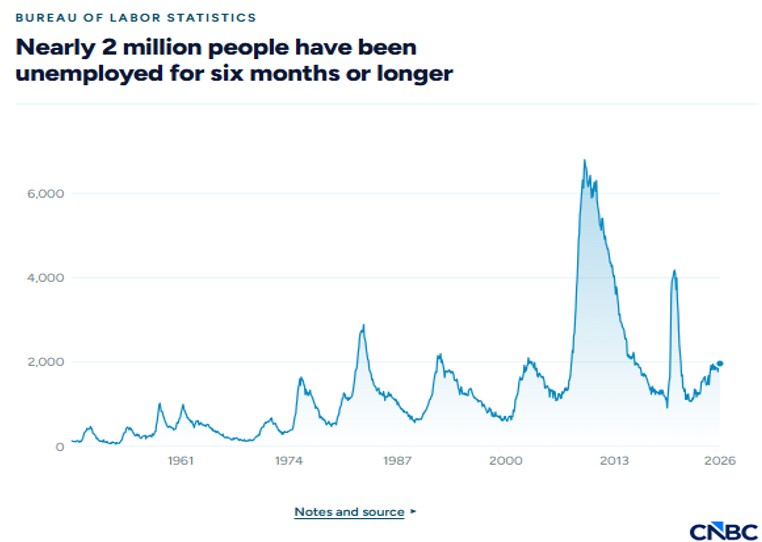
- The average duration of unemployment increased to 27.1 weeks in October, the highest level (outside of the Covid period) in a decade. Two million people in the US have been unemployed for at least 27 weeks, accounting for 27.60% of all unemployed workers. These unemployed workers are suffering from the “low-hire, low fire” job market in the US and is a jarring reminder that all is not that well in the US labour market. Large employers such as Disney and American Express are axing thousands of jobs this year, perhaps the first evidence AI computing power replacing workers.
Fed Chair, Kevin Warsh intimated at the last Fed meeting that there was a stack of economic data being released this month that would go some way to determine whether they need to hike interest rates further. The most important will be the CPI inflation figures for October on 10th November and then the Fed-preferred PCE inflation result for October on Wednesday 25th November. A continuation in the fall of crude oil prices to well below US$90.00/barrel over the intervening period would also remove some of the pressure for higher Fed interest rates.
US market interest rates have continued to decline over this last week from their peak levels in early October. The US 10-year Treasury Bond yield is sharply lower from a high of 5.35% on 5th October to 4.85% at Friday’s market close. The hedge fund punters who short-sold bonds a month ago are now all busy unwinding their positions. Continuing lower US bond yields based on US inflation not actually increasing when everyone thought it would, leads to a weaker US dollar on global currency markets.
Daily exchange rates
Select chart tabs
*Roger J Kerr is Executive Chairman of Barrington Treasury Services NZ Limited. He has written commentaries on the NZ dollar since 1981.
We welcome your comments below. If you are not already registered, please register to comment
Remember we welcome robust, respectful and insightful debate. We don't welcome abusive or defamatory comments and will de-register those repeatedly making such comments. Our current comment policy is here.