
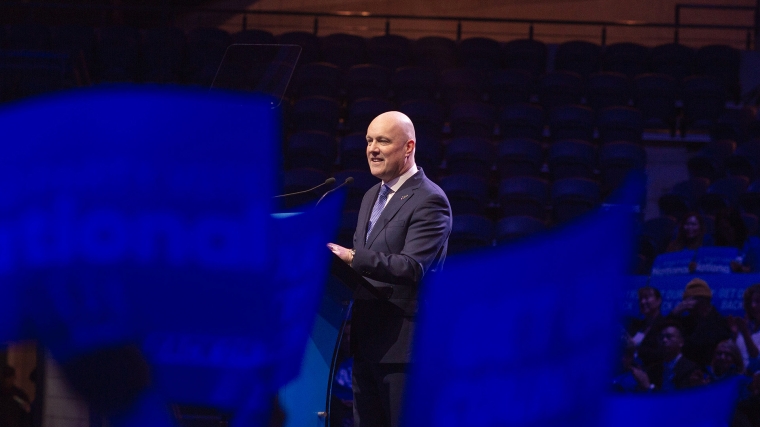
National and Labour are campaigning on very similar macroeconomic policy platforms but differences in specific sectors could lead to some noticeable outcomes in the next three years.
Economists think the policies proposed by National could drive house prices higher, reduce food prices, and have a minimal impact on interest rates.
Whoever forms the next Government will have to operate within tight constraints and stay in line with fiscal responsibility rules that were baked into law by the 1989 Public Finances Act.
The pre-election update set out an extremely tight set of budget forecasts that many economists think neither party will be able to actually stick to.
“Despite the campaign rhetoric, the policy positions of the major parties are not substantively different, and we don’t expect transformative change,” ASB economists said in a note.
There has been inter-party support for funding core public services, including health, education and policing, just with differing positions on the details.
Labour and the Greens tend to lean more heavily on greater regulation and centralised control, while National and ACT favour a lighter touch regulatory regime and devolving services to the regions, they said.
Where there are differences between the two political wings, they are completely overshadowed by much bigger forces that are impacting the New Zealand economy.
For example, most of the world is grappling with high inflation and the sudden increase in interest rates which has eroded asset prices.
“The global outlook is tenuous with concerns over the Chinese outlook impacting broader risk appetite. Rising geopolitical tensions in the Middle East point to a more unsettled global environment going forward,” ASB said.
ASB economists said these dynamics would have longer-lasting impacts than policy tweaks put forward by either party during this election.
Pro-property policy
For example, National’s housing tax policies could encourage some investors to buy existing residential property, but rental yields will stay well below debt servicing costs.
Still, most economists agree that restoring tax deductibility of mortgage interest on investment property and bringing the Brightline Test back to two years from 10 will boost prices.
Kelly Eckhold, Westpac NZ’s chief economist, said these measures will “make investment in housing more attractive” and backed up his forecast that house prices will rise 7.7% next year.
Analysts from UBS agreed, saying the “clearest implication” of a National and Act coalition forming was a boost for the housing market.
Westpac NZ and Goldman Sachs have both said the National Party’s total tax package was likely to have a slightly expansionary, meaning inflationary, impact on the economy.
“Our view is that while this package might be fiscally neutral, it will still likely have a modest expansionary impact on the economy; perhaps to the tune of 0.2% to 0.3% of GDP,” Eckhold said.
Goldman Sachs went even further and suggested the cuts could lead to further increases in the Official Cash Rate (OCR), a claim which National has disputed.
ASB economists cast doubt on whether the policy would make it through coalition negotiations, with both Act and New Zealand First, in its current form.
“Tax relief will likely be scaled back, some proposed new taxes shelved, with more focus on government expenditure restraint. Such a scenario would help cement the Reserve Bank’s on-hold stance for the OCR,” they wrote.
Specifically, National’s controversial foreign home buyer tax could be shelved and decisions to raise the retirement age could be left for a future government, if NZ First holds the balance of power.
A wealth of taxes
If Labour did surprise pollsters and secure a third term, with the help of its left leaning allies, it would have to overcome a substantial disagreement over implementing a wealth tax.
The party considered putting one in place at Budget 2023 but backed out at the last minute.
Te Pāti Māori and the Green Party still support the policy and have insisted they will fight for it during coalition negotiations.
Treasury gave advice prior to the budget which said a wealth tax could help generate revenue and make the tax system more progressive.
However, it could discourage saving and investing, it would come with high compliance costs, and could be tough on people who hold valuable assets but have limited cash flow.
It could also cause some of the wealthiest New Zealanders to move their assets offshore.
Eckhold said this policy would likely discourage investment in rental housing and other low-yield assets.
“Such assets may generate limited cash flows relative to their purchase prices, but potentially sizable capital gains. The introduction of a wealth tax would therefore be likely to result in lower house price inflation,” he said.
National has also pledged to get rid of the Auckland Regional Fuel Tax, but Westpac believes any household savings would be offset by an increase in local rates and a higher carbon price.
Tread lightly on farmland
National and Act’s policies to reduce regulation of the agricultural sector could put climate goals at risk but should lead to lower food prices.
This could be a vote winner, with food prices up 8% in the past year and almost 30% in the past six years, even though regulations are not the main cause of this increase.
Eckhold said the proposed “lighter touch” climate and immigration regulations demonstrated a “clear distinction” between the left and right political blocs.
Looser immigration policies would allow for more employment at a lower cost, while less regulation and compliance could drive down production costs even further.
“When combined, these policies would also likely result in an increase in (food) output and thus lower food prices,” he said.
However, there was also a risk this lighter touch could mean New Zealand failed to meet its climate obligations and got hit with trade barriers or less demand from overseas buyers.
Lawyers at Chapman Tripp said the architecture created by the Zero Carbon Act and the Paris Agreement commitments should ensure all parties travel towards carbon neutrality by 2050.
This should be the case with either a National or Labour led Government, “notwithstanding ACT’s commitment to require the repeal of the Act as a bottom line in coalition negotiations”.
Meaningless mandate moves
Almost all economists think National and Act’s plan to remove employment objectives from the Reserve Bank’s mandates will have little-to-no effect on monetary policy.
“[It] could mean tighter policy settings in the near term given current high NZ inflation, but in practice this would not significantly change how the RBNZ operates,” ASB said.
The central bank’s policy response could change during a large supply shock, when inflation and unemployment were both increasing, but generally they travel in opposite directions.
Stephen Toplis, BNZ’s head of research, said he’d found “a number of investors” were nervous about the proposal to drop maximum sustainable employment as an objective.
“We think any such nervousness is unwarranted. We will not be making any major change to our view on monetary settings this cycle in the event the remit is adjusted,” he said in a note.
“We have long held the view that the secret to getting inflation to acceptable levels this time around is to get the heat out of the labour market. We will hold to that view.”
Only UBS seems to disagree with that view. It said the proposed change was “hawkish and implies a higher-for-longer OCR”.
104 Comments
Jacinda / Helen Clark may even contact Winston post election and seal the deal for labour with Grant Robertson as PM. Anything is Possible.
for winston to go with Labour, he would be P.M .
El Presidenté
El patron
El viejo loco.
I could be less polite but…..
malparido a todos es el
Perhaps election night will be Winston ringing up potential coalition partners, offering them DPM plus a few ministers?
The National lead government re-starting the Ponzi will push housing price higher guaranteed.
This courses the main problem we have in this country at the moment peoples debt levels are way,way,way to high
on the back of the last Ponzi and now greed from the banking Cartel.
Take me back to 2010 $500k for a 4 bedroom home in forest hill Auckland now $2m $1.5m extra debt.
That is your dead kiwis in the water guys.Please don't let this happen again
A good solution would be for the Red Team & the Blue Team Leaders to stand up and and say we have both destroyed NZ over the last 20 years so we need to fix it and form a government together.Now that's leadership. Ha,Ha,Ha
Take control away from the minor partys.
Personal I am dead in the Middle now best solution $1 each way split my vote one to the left one to the right.
If the best the politicians can come up with is a re-start of the Ponzi we are in deep, deep trouble.
Please leave the house market alone and go and invest in business.
Big test of leadership for whoever gets in, do they go with their vested interest and donor buddies, or do they show some fortitude and do what is right for the long term prosperity of all. Tick tock
how can National and labour's govt spending be similar , when National is planning to cut 6 % more ?Or am I reading it wrong .
Motorways? All of them.
Roads of National Donor Significance?
National's only planning to cut back office functions, which is a relatively small amount of total government spending. No changes to spending on NZ super, the single biggest item in the government budget, over the near future as the move to 67 will come in many years time.
The total spending in nominal dollars would be lower under National, but the fiscal stance (or the balance between spending and revenue) would be roughly the same because of the tax cuts.
So, the two fiscal policies are very, very similar but the two parties do slightly different things with the money. National goes for tax cuts, while Labour opts for subsidies... the net effect is the same.
The greens wealth tax would kill small business in NZ. The threshold is far too low. Anybody with any sense will shift their business to Australia immediately.
Small business employs most of the people employed.
And once they kill small businesses, they will go after the larger ones.
Not to mention if they kill small business then we will end up with more oligopolies and duopolies.
Do Australians not have businesses? I doubt it’s so easy to up sticks and leave. Machinery, leases, workers, kids etc
If the Greens wealth tax concerns you I suppose you are happy with the Te Pāti Māori's one?
(I don't think you quite grasp the Green's proposal)
I don't think you quite grasp the meaning of theft.
Taking from young working Kiwis to give to older folk and property speculators?
Any financially literate person grasps the lunacy of the Green's proposal.
Scratch just a little bit and you can see that under the surface their Green turns quickly into a deep Red.
Scratch our supposed right-wing parties just a little and you'll see the same - but the beneficiaries are primarily their older voters and property speculators. Welfarism deeply entrenched though.
back of the envelope calculations might imply moving to Aussie would probably take more of that business owner's money in tax than the wealth tax if they were generating income out of their business that puts them in that 45% tax bracket. The plan is to tax people's wealth, not businesses, so for someone to be offended by the wealth tax they'd have to be taking quite a sum of millions out of their business over time?
Most wealthy people in Australia put their business assets into their self managed super fund where they pay 15% income tax and 10% capital gains. Read the shareholder lists of listed companies, they all have XYZ Family Super Fund as significant shareholders. Either that or the assets are held in family trusts. Or they could move to Singapore where there is no capital gains or wealth taxes - being wealthy means you can get residency in any country you like.
The idea that any NZ govt has house prices on a string is a bit of a cop out in my opinion. I think there's too many 'unknown unknowns' now compared to the past.
At what point was the future more certai than right now?
Still, most economists agree that restoring tax deductibility of mortgage interest on investment property and bringing the Brightline Test back to two years from 10 will boost prices.
A housing specuvestor is being put in charge of policy choices for housing. And he is not forced to sell his housing investments?
How the hell is this different from the Transport Minister not being forced to sell his Auckland Airport shares?
Is Specuvestor a new word you have invented? What does it even mean? Is any investment other than Term Deposit specuvesting?
The first page of a quick google search reveals its use at least as far back as 2006 to describe housing speculators-ahem-investors. it may have been around long before then, perhaps even in print. Somewhat surprised the dictionaries haven't picked it up, given the random acronyms and internet slang they add every year.
TD's aren't really an investment. It's just storage of unneeded money, much like banks were once a storage facility for gold. Most "investment" is a form of speculating/gambling. Unlike a casino though where most people accept it's a game of chance, much more is done to keep the investment industry afloat.
An investment into say, a business, is clearly done so that company has capital to expand, create more products or services, tap new markets etc etc. These are investments, they have risks and often don't work out. They require work, particularly if you are a big part of the business, to grow and develop said business. After some time the investor in such businesses hope the business returns income on their investment, i.e. the asset generates an income for them. The intention here is that you use money to purchase part of a business so they can grow revenue to generate income in the future. There is lots of social good that happens when investing is done right, innovation, increased competition, bringing to market better goods/services, higher rates of monetary circulation, more jobs for economies etc.
"Investing" in housing is done purely for capital gain for the last about 15 years as it almost never made sense during that time to do it for the income that asset generates. And this has been done in the hope that Central Banks will ease monetary settings a little bit more so that it pushes up the perceived value of their asset more. That's speculation and hopium, likely corruption as we see the leaders of the system benefitting from the rules they have imposed or at least supported from the sidelines. Now at the same time they have participated in locking up those assets into higher and higher prices, causing a long list of social harms evidenced all around you. At the same time this activity has locked capital away from being invested in businesses and meant we struggle to fund businesses. At the same time the capital is given to banks who charge it out and return money to their own wealthy (almost all overseas) shareholders.
I could have called specuvestors something worse, rentier leeches maybe, but specuvestor is being kind.
Very Very well written and all very true well done.
One thing I would add is the Banking cartel in NZ BNZ ANZ, WESTPAC, ASB are the controller of this Ponzi and the only thing they have been interested in sense the GFC is housing .No interest at all in business.
Vote very very carefully NZ we could have a tuff 3 years ahead of us.
Overlaps of politicians and banks are a bad sign.
Yes
Look at John Key
Very well written.
Are these stats legit? If so they should be hung up on every national poster
Is this Author being balanced ?
He is completely remiss in not pointing out the unsustainable borrowing being conducted under this current government
He's tried to be, but no.
And the reason is simple; glaring; obvious: He's interviewed economists.
If you get sense out of them, it's en passant. That is the bit where they mention global factors, albeit through a financial lens.
And it wasn't just this current Government, it's been every one since about Kirk - with the possibly-excused Muldoon attempts to address the Limits to Growth issues. Those were more discussed then, than they are now; we're dumber in our debate now than we were in 1980. Thus Motonui
https://www.engineeringnz.org/programmes/heritage/heritage-records/motu…
It was ahead of its time; look at our vulnerability now!
Whichever grouping is elected, they will attempt to do BAU, plus or minus a tiny fraction. They will borrow, because they think tomorrow can repay. But it increasingly won't. And that will likely snowball - read a human account of living in Weimar Germany, for a taste of how it staggers. This time it's global, intermeshed - the US can't live without imported things, neither can any other nation.
Fixating on some 'others' your peer-group don't like (I'm guessing) misses seeing the bigger predicament. Debt will either be defaulted on, jubilee'd, or wiped out in a collapse. The real question is: What did they buy with it, and is it future-applicable?
The real question is: What did they buy with it, and is it future-applicable?
A very astute question.
Hard to have any sort of economy without money and much of it is created by the government through its spending and issued as its debt. Our only other money is created by the banks and that is created as private debt, all money is someones debt. https://democracyjournal.org/arguments/the-truth-about-government-debt/
New Zealand doesn't currently have unsustainable borrowing. Our debt is higher than prior to the pandemic but is still perfectly manageable.
Here's S&P Global Ratings opinion:
The May 2023 annual budget was expansionary. It revealed new spending in areas such as health, early childhood education, and a "National Resilience Plan" to address infrastructure shortfalls...Despite this higher spending, we expect New Zealand's public debt to stabilize at a level that compares favorably to that of most highly rated peers. By fiscal 2025, net general government debt should reach about 34% of GDP, while interest expenses will account for about 5.7% of general government revenue.
The mid term economic impacts of a National-led govt aren’t likely to be much different to Liebour.
I am more interested in the short term impacts of a messy coalition with Winston.
I don't think a govt that involves NZ First will be "messy".
I think that NZ First will provide a pragmatic handbrake on the radical right wing social and economic policies of Act and the predominantly right-leaning bloc of National.
Remember - ALL politicians who were in Parliament voted in favour of making it possible for men to change the sex designation recorded on their birth certificate merely by filling out an online form and paying a token admin fee. Not one single solitary politician opposed it. As a result you cannot trust the details printed on birth certificates to be an accurate reflection of reality nor as proof of identity (and that nowadays is even printed on the certificate itself).
What NZ desperately needs is a government grounded in economic and fiscal reality, and guided by pragmatism, not ideology. Winston Peters was right to cite the example of Lee Kuan Yew who completely transformed his country into a modern technology-driven economy; and lifted millions of people out of poverty.
Lee turned a poor, chaotic, and malaria-ridden harbor in Southeast Asia into a clean, healthy, gleaming, prosperous city state where the per capita GDP exceeds that of the USA, and where there are 5 official languages, and everyone can read and speak English.
Extremists on the left and the right will hate it.
Moderates will breathe a huge sigh of relief.
Businesses will thrive.
And ordinary NZers will prosper.
Lee got there by forcing good race relations through strict media censorship, caning or executing people for smoking pot and fining people for chewing gum.
And using Indian immigrants to do all the manual labour so the favoured races can live the good life in their shiny buildings.
I appreciate the outcomes look good, but that kind of govt wouldn't stand a chance here.
"Laws in Singapore permit the death penalty for people convicted of trafficking more than 15 grams of heroin, 30 grams of cocaine, 250 grams of meth, or 500 grams of cannabis."
Death to pushers, not users.
+1 on Singapore
I've done a small bit of family history research, a tough enough job at the best of times but a lot of diligent clerical care was taken over recent centuries in NZ, Oz, UK records. Mistakes happen, just not deliberately until now: law should have retained the original sex & name record & recorded any subsequent change/s separately.
Were you earlier offended by name changes in isolation? I don't remember anyone rallying against that.
Nah you're probably just a bigot...
Hey David,
I'm guessing you aren't friends with anyone transgender.
For whatever reason, this group of people feel mis-aligned with their birth gender. They can't change, much like you can't change your personality and tendencies.
Letting them identify as the other gender helps them towards solving a lot of their challenges.
It does no harm to anyone directly or indirectly.
Why would you do anything but support?
Facts don’t care about your feelings
When was a birth certificate ever a proof of identity? It simply verifys that a person with that name was born in NZ. Holding the document only proves you have a copy of it.
Do you ask new people you meet if you can view their genitals to check their birth gender? That is the only real way you can get these particular 'facts' straight in your day to day life.
Cool story bro, you got any actual counter argument?
Let me see, lower food prices or climate targets... Given that we already net sequest carbon, perhaps it should be the former?
We do not, repeat not, repeat not, net sequester carbon.
We import and burn 60% of our energy needs, and there isn't the acreage to go even close. Plus which, seedlings start VERY small (yet another way we steal from the future; they have to leave OUR seedling in THEIR ground).
https://www.stats.govt.nz/indicators/new-zealands-greenhouse-gas-emissi…
and MfE - so what are you referring to? Some vested-interest rabbit-hole?
If tree's don't sequester carbon, what's the ETS all about?
What's the ETS about? Collecting money for team admin of course. But seriously, all trees start as tiny little seedlings. It'll be ten years before those accredited offsets you don't purchase on the holiday to Fiji store any significant carbon, assuming a goat doesn't eat them first, turning them into methane emissions.
We have plenty of acres to sequester carbon. That is why we are a carbon negative as a country. Sea shells alone take care of it.
NZ continental shelf 6 million km2
CaCO3 deposited per annum 120 million tonnes = 53 million tonnes CO2-e.
New Zealand's net emissions in 2020 were 55.5 Mt CO2-e.
https://environment.govt.nz/publications/new-zealands-greenhouse-gas-in…
https://agupubs.onlinelibrary.wiley.com/doi/10.1029/2021PA004294
"Results from Beata Bukosa's research from @niwa_nz confirm New Zealand as a carbon sink. Interesting and encouraging preliminary results of inverse modeling and new measurements in New Zealand #CarbonWatchNZ #ICOS2020SC"
Lol.
- Between 1990 and 2020, gross emissions increased by 21 per cent (13.6 Mt CO2-e). This is mostly due to increased methane from growth in the dairy cattle population and carbon dioxide from road transport.
- Between 1990 and 2020, net emissions increased by 26 per cent (11.5 Mt CO2-e), due to the underlying increase in gross emissions
As for shells... that report literally says they're guessing.
Plenty of information suggests that the ocean isn't meant to be a carbon sink. It requires balance like the rest of the ecosystem. Earth evolved over millions of years to give us this balance, to sustain all Life, not just humans. CO2 is balanced between the atmosphere, biomass and soil. Upset any one and we have problems. It's an interdependent design and an intelligence that we fail to perceive through our ignorance, arrogance and hubris.
You really should try reading the report before commenting. You state "Plenty of information suggests that the ocean isn't meant to be a carbon sink" yet the paper states "The ocean is a global carbon sink, because some organisms form shells by combining calcium with carbon dioxide dissolved in seawater. Once dead, their calcium carbonate shells sink to the seabed. Over millions of years, the southwest Pacific accumulated huge deposits. We used geophysical surveying and drilling to measure this history of deposition"
Note geophysical survey and drilling is not "guessing" as you put it.
NZ is simply exporting carbon to the seabed at a rate that matches our net CO2e. You have been offset.
"Biogenic particles settling in the ocean and exporting carbon toward the seabed play a key role in long-term modulation of atmospheric carbon dioxide (Boyd et al., 2019)"
I did read it, and I read the part where they say they're guessing until they have computer models to fit their observations.
Just because they want it to be a carbon sink doesn't mean it's meant to be. I also looked at many other reports that suggest the same. There's plenty to suggest adverse effects long before shells take up the slack. Common sense and joining the dots would also suggest this.
I've also come to realise that we humans are very limited in our perspective and the more a narrative is promoted, the more science is distorted to fit certain agendas. We are not the most intelligent species.
There is not "want" or or "meant" or guessing about it - NZ is a carbon sink. This particular sink has varied a lot, long before insignificant humans, like our good selves, came along. This sink along dwarfs any vain glorious climate change policy.
We shouldn't be using good arable land land to grow trees. We should be using that land to raise livestock and grow crops, and we should add value to those before selling those products for a premium price overseas.
Exporting whole logs is such a waste of resources.
But the clear goal of the Green party is to reduce livestock. How could you possibly suggest more livestock?
Their goal is to reduce the impact of farming on the environment, especially waterways, and methane emissions. Reducing the number of livestock may be a consequence of that, but it's not the goal.
And it wouldn't be wise to be too vocal on the best use of arable land to feed the world. Livestock are not the most efficient way to do that, and the world wouldn't starve if NZ disappeared altogether.
Is good arable land being used to grow trees somewhere? You'll love Nat policy of putting the very highest quality land under urban sprawl then?
The purpose of housing is so that people can have a home of their own, not to be a means to make a profit.
Therefore, the 10 year brightline is fair and reasonable. So too also is keeping mortgage interest non tax-deductible on domestic housing.
When you understand the purpose of a given sector of the NZ economy then you can understand the controls and levers that should be applied to that sector.
Housing and wages are significantly misaligned and there needs to be a market correction of one or the other, or both.
The ten year brightline existed even before the term was introduced. If you look at IRD taxation rules from years ago, if you sold a house within 10 years of purchase, then the IRD can investigate to assess if the purchase was to provide a rental income versus speculation to make a profit. Apparently a few people were caught out on this one. In some ways it's better to have a clear "brightline" number eg 7 or 10 years so it is clear to everyone from the beginning. Most investors keep their properties for many years anyway. The speculators (who tend to be a different breed) are the ones who were flicking on a property after 6 months or so, and the IRD would probably have "caught" them.
No. The brightline rule was only introduced October 2015.
What existed before then was an intention rule. If you bought with the intention to sell at a profit it would be taxable so everyone just said they were holding long term, even if they always intended to sell after 5, 10, 15 or 20 years. Too hard to enforce or investigate unless one showed a history of buying and selling.
It's why there should be a rewrite of tax law instead of ineffective tweaks. A comprehensive tax on all income would level the playing field.
Doesn't the intention rule still exist, and still trumps the bright line test?
It most likely still exists but I think the brightline test overrules it unless you can prove otherwise.
It still exists but the trick has always been to not be honest about having bought for capital gains.
Too simplistic. Brightline is a really stupid way to run a CGT. People otherwise happy to pay a CGT wouldn't because brightline is at marginal rates and therefore a massive tax compared to a typical CGT, so instead they wait it out, causing all sorts of inefficiencies along the way.
If you look at how the deductibility rules are meant to trigger investors to sell and build new houses for instance, brightline is an active disincentive to doing that while the tax to switch is higher than the lost deductibility. The setup is just a trap to punish investors rather than trying to fix a housing crisis.
Actually think there may have been some kind of tax credit thing that can be applied when you buy a new build after selling an older house which negates the bright line tax. Not 100 percent sure but did hear of some people talking about that at some point who were selling a house in Taupo and buying a new build elsewhere as an investment property.
In the same way that Income Tax is a trap to punish the productive members of NZ society, in that light.
Somebody has to stop Jessica Mutch McKay from moderating any more debates ffs.
The obsession with what they would do if they lose was dumb, what does it matter,it's of no use to voters to know.
They had to drag a beneficiary who looked like they didn’t want to improve there lot from employing they own initiative and hard work….
question to both networks… where are the business men, exporters, farmers and entrepreneurs asking questions in the debate!
Regardless , i don't think the single persons view is fair , whichever way it goes. I was glad they went to the reporters report of the pub voters , rather than interviewing a couple of them,
And surely they could come up with better commentators than 2 of the worst high ranking MP's from the recent past.
I actually want to give Cunliffe credit there I thought his analysis was quite good and unbiased. Especially his point around this fundamentally being a campaign between centralisation and localisation which I thought was quite insightful.
I actually don’t mind Paula usually but she seemed blatantly partisan here and didn’t have much of value to add.
Was it just my imagination , it appeared to me the tvnz female reporter was ready to rip her mullet off?
Yes Cunliffe tried to be bipartisan , his music analogy was off , but i kept thinking back to his p.m campaign , and thought , you can talk , mate.
He made a good point about Labour failing to have a CGT as a policy resulted in Labour losing 5% of their vote to the Greens. Also that both National and Labor are losing support due to their policies and their track record.
Jack was there, so why didn't he do it? Or John Campbell. Some of the questions she asked were also very poor, and quick fire questions are a complete waste of time. It was almost like she was trying to trap Luxon with some of his answers. Such as the one about whether he will stand in 3 years it he wins. I don't think he understood what she was going on about, she really mucked it up. Hipkins was the only one that made sense of it all. I though Luxon was really weak, and again failed to answer questions, which people don't like. But the Bedleg statement was really the winner of the debate, and that backfired on National because they never release the report, so they never put that to bed.
Shame Luxon didn't come back with "None of my ministers has been chased down by a police dog".
And that minister is gone, which was Hopkins point. Undies is still there.
Calm down solardb, one action was by a kid at school, the other was by a minister under Hipkins leadership.
Yes, what is happening to the world when people don't respect the privilege of being a wealthy white kid insulated from consequences?!? It is horrid!
No need to bring race into it buddy.
Winner if you like the despicable.
nonsense. Labour Greens have no economic plan.
They do. It's just you don't like it. That's not the same as "no plan".
May as well be no plan. At the least, it's 'no clue'
I guess socialist reform counts as a plan
They have already been given the chance to have a plan, and failed miserably at implementation. The country has realised they aren't getting what they voted for with Labour last election and will hopefully vote elsewhere for another party or parties to have a better go at actually following through on election promises, and improving core aspects of NZ society such as education and healthcare, instead of watching the number of meth-heads wandering the streets increase, numbers of homeless increase by a good margin, the healthcare system in disarray form poorly timed execution of large scale reform, decreased social cohesion nationwide, and loss off staff from foolish mandates that now are seen to have been wasteful and in some cases harmful.
People essentially voted for failure last election, they won't be fooled again for the large part. Those that forget history are doomed to repeat it.
“Almost all economists think National and Act’s plan to remove employment objectives from the Reserve Bank’s mandates will have little-to-no effect on monetary policy.”
If this statement is true, what was the point of including employment objectives in the first place?
Who are the economists that agree or disagree with this statement?
Arthur Grimes doesn’t agree with this statement. I think there will be quite a few others as well.
https://www.interest.co.nz/news/111369/inflation-targeting-architect-ar…
Grimes also reiterated his opposition to the Labour-led Government in 2018 requiring the RBNZ to target “maximum sustainable employment” as well as inflation.
He is adamant this requirement prompted the RBNZ to do more to lower interest rates than it should have.
Grimes said the Treasury was “utterly incompetent” when it advised the Government on making the change.
“Now we’re seeing the result of that,” he said.
it should be removed, they should focus on monetary issues, ie money supply in the system, exchange rate, banks, lending and deposit totals and conditions and most importantly INFLATION
Apologies, I was too definitive saying "almost all" when I meant "most quoted in this story". There are quite a few who oppose the employment mandate including UBS in the story.
Interesting thoughts - a few things missing...
National look like they are going to tighten up the ETS, which will send the price of carbon right up, and lead directly to higher prices at the pump. If global oil prices remain at $80+ then we will see big increases in diesel and petrol prices. We know that higher fuel prices pass through quickly to other prices - including domestic food production.
National are going to load Councils up with huge (and expensive) debt using off-balance sheet CCOs to build roads, new water infrastructure etc. This goldrush will put upward pressure on construction costs (and wages) and lead to much higher Council rates for a very, very long time. But, don't worry, the hedge funds / banks will get rich off the premium rate debt.
As mortgage rates stabilise and NACT policy juices the housing market, house prices will soon be back to 7% - 10% per annum increases. If we continue to see record inward migration, we will see higher rents too. Auckland rents rose over 9% in the year to September 2023 - the highest leap since 1996.
The net impact of the above will be higher CPI - it's basic maths. But, whether we get sustained inflation will be decided globally. The price we pay for food is almost entirely determined by our food export and import prices, imported fuel costs will still hold more sway than ETS costs, we import all of our tech etc.
At the macro level, the flow of new money through Council CCOs plus a pick-up in mortgages might just be high enough to sustain reasonable levels of employment. But, if NACT slash the public service we could easily slip into a deepening recession (Winnie is right about that!)
At the macro level, the flow of new money through Council CCOs plus a pick-up in mortgages might just be high enough to sustain reasonable levels of employment. But, if NACT slash the public service we could easily slip into a deepening recession (Winnie is right about that!)
I get the feeling we are simply following the law of diminishing returns here. GFC = QE to get us out, 2020: QE and borrowing. We are flailing about to do everything to keep high employment even though it has already been said that we need a certain level of unemployment to hit our inflation targets. Perhaps the RBNZ are simply trying to keep at the soft landing headline to prevent nationwide panic and the level of irrationality that comes with it, deepening the recession that is overdue in the economic cycle. Either way we can't simply keep borrowing our way out of every crisis that comes about. One can't keep adding money supply and borrowing to fix all, just as one can't keep getting new credit cards to pay off the last, the debt keeps rising and will eventually come due. Lesser and lesser effect is being seen until it will no longer be possible due to the level of debt in the system. Feels as if the govt and RBNZ have hit 6am on the second day of a bender. They managed to stave off a hangover yesterday by keeping on the beers, it kept them going and they are now finding the last remaining ones stashed around the house to try and stave it off even further. But the hangover is coming, the beer supply is dwindling as nobody will give them any more and all of the previous actions will make certain it is a painful one.
Fair points. All economies rely on a steady flow of new money from net Govt spending (increasing Govt debt) and net lending by commercial banks (increasing private sector debt).
This steady flow of new money has to broadly keep up with inflation and satisfy the savings desires of domestic savers and overseas investors who take dollars out of circulation and stick them in savings accounts / term deposits (or swap them for Govt bonds).
NZ's challenge is that we run a large current account deficit, which means we have significant overseas savers ($100 billion of dollars / bonds), and our high level of inequality / rent extraction mean that money doesn't circulate for long before it is stuffed into a term deposit.
My basic point here is that our economy is geared so that newly created money quickly gets hoarded - meaning we rely on new money being injected into the economy from higher and higher debts (Govt and private). The solution here is to stop all of that new money getting hoarded - to keep it circulating around the economy, and use taxation to redistribute money from hoarders to spenders. Our tax system in the 40s and 50s was designed to do this - so a typical family had a single working parent who paid no tax at all, whereas someone leaving their kids a large estate paid a crap tonne of tax!
My basic point here is that our economy is geared so that newly created money quickly gets hoarded
The wealthy argue that it is theft and something is being stolen form them, while the egalitarians argue that it is for the benefit of all and not the few. The wealthy argue of they have to pay more tax they will leave or provide less jobs, but the rational historian would argue that the top tax rate was 66% less than a generation ago when benefits to all were seen in more abundance, and still many flocked to STEM education and roles to be of core benefit to their communities and others. Those same ones that flocked to higher paying jobs have benefited from the lowering of taxes and the property advantages the last 30 years have brought, quite possibly both, and are likely the beneficiaries of both 1./ the pension 2./ the public healthcare system paid by all. It seems only fit for purpose that given the economic climate, the tax system needs well overdue reform to better allocate funding to where it is needed and disincentivise investment towards non-productive assets allowing said wealth to be hoarded.
One things for sure, 3 more years of Labour and no one will be able to afford to eat.
We welcome your comments below. If you are not already registered, please register to comment
Remember we welcome robust, respectful and insightful debate. We don't welcome abusive or defamatory comments and will de-register those repeatedly making such comments. Our current comment policy is here.