
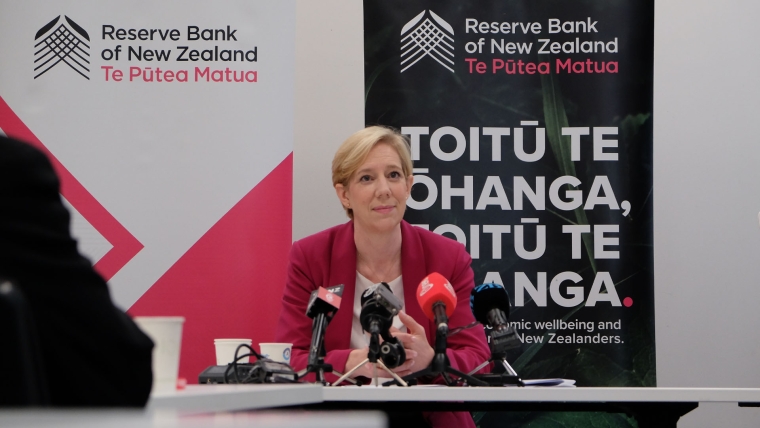
Reserve Bank (RBNZ) Governor Anna Breman says New Zealand having a 2% midpoint target for inflation is appropriate.
Her comment comes after she was asked by TVNZ Q+A host Jack Tame whether the RBNZ's target was still appropriate given supply shocks look increasingly common.
“There will be some who say that globalisation is no longer the dependable deflationary force for a country like New Zealand that it once might have been,” Tame said in Sunday's interview.
The RBNZ is charged with maintaining inflation between 1% and 3% based on Statistics NZ's Consumers Price Index, specifically targeting 2%. New Zealand was the first country to formally adopt inflation targeting.
“The reason why the inflation target is so important is that compared to the 1970s and ‘80s, we had large supply shocks to oil, and then we didn’t have an inflation target," Breman said.
“Then inflation became embedded in the economy. So even though households were getting relatively high wage increases, the high inflation took that away in terms of purchasing power.”
The December quarter CPI showed 3.1% annual inflation. March quarter CPI is out on April 21.
Breman said the RBNZ was focused on getting inflation back to the 2% target midpoint “because we know if we get low and stable inflation, that means that over time, wages have the opportunity to grow more than inflation”.
“And then households get their purchasing power, then demand is a bit better and with better demand, you get better growth, you get better labour markets.”
Since inflation targeting was introduced, Breman said inflation has been much lower and more stable in NZ and in many other countries.
“So I do think it’s an appropriate target.”
'Consistency is good'
Asked about a midpoint at 2.5% like the Australian central bank has, Breman said having had 2% as the midpoint for a long time makes it easier for people to expect the same thing.
“I think having a bit of consistency over time is good.”
In response to a counter argument that the world has changed since NZ introduced a 2% midpoint target, Breman said: “The world has definitely changed but we have seen the benefits over time of low and stable inflation.”
Breman said she has seen poverty in New Zealand.
“It’s just always hard when you see people struggling and of course, in a situation like the current ones, we know that when we get higher inflation, it always hurts the people that are the poorest the most.”
"It's harder for them to find substitutes. If you need your car to drive to work and you have low wages, of course it's much harder than someone who might not need their car, who could upgrade to an EV (electric vehicle) instead, or have better access to public transport."
It was also one of the reasons why targeting low and stable inflation was good, Breman said. "When inflation is high, it tends to hurt the most vulnerable the most."
Asked if there was an underappreciated strength or vulnerability in NZ’s economy that she has observed, Breman said the country had a lot of strengths.
“You shouldn’t underestimate how much people like New Zealand. They trust New Zealand.”
“I actually heard some people I met with recently that said when the world is uncertain, like today, some people turn to New Zealand because they see it as a safe country," Breman said.
"So there will be exporters that benefit ... they're still really bad with this conflict and the war in the Middle East but some New Zealand companies will actually benefit because people see New Zealand as a safe country".
“That is a strength in itself.”
She pointed to NZ’s strong institutions and low levels of corruption, saying it was good for the economy.
“But of course, at the same time, we’re more vulnerable to some of those supply shocks than other countries are.”
Breman said NZ was seen as a reliable country to do trade with but if something like shipping is disrupted, that would hurt us.
‘A generous pinch of salt’
Last week, the RBNZ’s Monetary Policy Committee left the Official Cash Rate (OCR) unchanged at 2.25%.
The RBNZ also updated its projection for inflation - projecting inflation to hit 3.0% in the March quarter and jump to 4.2% in the June quarter.
But uncertainty runs through the RBNZ’s projections as well as those of economists.
On Monday, ANZ chief economist Sharon Zollner announced they had brought their OCR hike projections forward, projecting three consecutive 25 basis point hikes in July, September and October, taking the OCR to 3%.
“We can’t stress enough the uncertainty of the outlook. A July kick-off for hikes is not a high-conviction view; it is just what we currently see as the single likeliest timing as we stare into the murk."
Following the OCR announcement last week, ASB also brought its outlook forward to 25 basis point hikes in September and December.
At the time, ASB senior economist Mark Smith said: “Moving the OCR earlier reduces the risks of inflation overshooting and will likely mean fewer rate hikes are required over 2027. There are limits to what even the RBNZ can do, and its mandate remains to keep inflation low and stable over the medium term.”
Last week's OCR announcement led other economists from BNZ, the New Zealand Institute of Economic Research and Infometrics to reaffirm their early OCR projections.
Zollner called on people to “take everyone’s forecast with a generous pinch of salt - including both ours and the Reserve Bank’s".
“That’s just the world we find ourselves in.”
We welcome your comments below. If you are not already registered, please register to comment
Remember we welcome robust, respectful and insightful debate. We don't welcome abusive or defamatory comments and will de-register those repeatedly making such comments. Our current comment policy is here.