
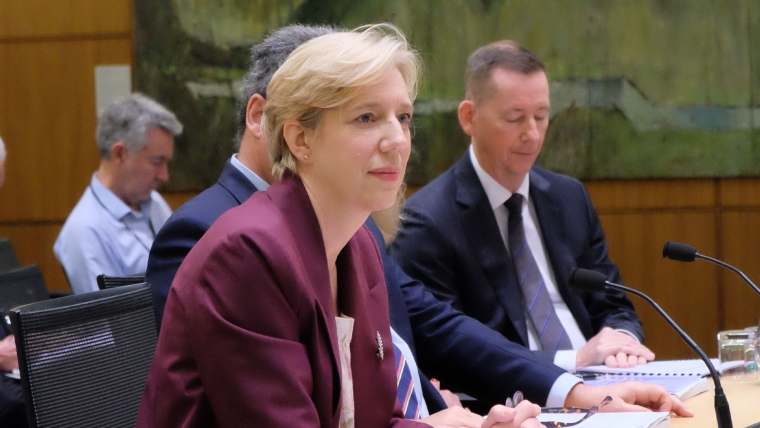
The Governor of the Reserve Bank (RBNZ) says that while parts of New Zealand's economy are performing well, supply disruption and costs will continue to increase prices in the near term, particularly when it comes to the cost of fuel.
Anna Breman told members of Parliament's Finance and Expenditure Select Committee (FEC) this on Thursday, where she appeared alongside Assistant Governor Karen Silk and Chief Economist Paul Conway to discuss the May Monetary Policy Statement released Wednesday.
Speaking to the FEC, Breman said she wanted to stress that the May Official Cash Rate (OCR) call was the first monetary policy statement out of the RBNZ to include the attributed votes and names of the MPC members in the record of the committee’s decisions.
“As a committee, we welcome this increased transparency and we believe it will strengthen New Zealanders’ understanding of our monetary policy going forward,” she said.
Breman, Silk and Conway – who are internal RBNZ Monetary Policy Committee (MPC) members – voted to leave the OCR on hold, while the three external members – Carl Hansen, Hayley Gourley and Prasanna Gai – voted for a 25-basis point increase.
Breman had the deciding vote as chairperson of the committee, so the OCR was kept at 2.25%. She told reporters on Wednesday that her vote was based on an assessment of the upside risk to inflation and the outlook for economic growth.
Public sector job cuts excluded from forecasts
At the FEC meeting, Labour MP Deborah Russell asked Breman if the RBNZ had factored in the public sector job cuts that the Government announced earlier in May into its May MPS employment outlook.
“It's not been formally incorporated into this forecast,” Breman told select committee members.
The RBNZ is currently expecting NZ’s unemployment rate to increase to 5.4% in the June 2026 quarter and remain near this level until mid‑2027.
Breman said the RBNZ used Treasury's Half Year Economic and Fiscal Update (HYEFU) from December 2025 for its forecasts, adjusting for data revisions and some “stronger than expected” official statistics from the December 2025 quarter while awaiting the 2026 Budget.
“So formally, we will take any new announcement into account when they've been formally decided on. That is the formal way that we do the forecasting,” she said.
New Zealand’s jobless rate edged down from 5.4% to 5.3% in the March quarter, with 163,000 people unemployed in the first three months of 2026. This was down from 165,000 unemployed people in the December 2025 quarter.
Supply woes
Russell also questioned whether rising unemployment would still lower NZ’s inflation when external factors like steadily rising fuel prices were complicating the economic situation.
In the March 2026 quarter, annual inflation, as measured by the Consumer Price Index (CPI), was above the RBNZ’s 1% to 3% target range at 3.1%. This was because of the increased fuel prices that New Zealand experienced in March, where petrol prices jumped 18.6% and diesel prices soared 42.6% from February to March.
Fuel prices have jumped globally since the US-Iran War began in February, leading to the closure of the Strait of Hormuz, where a large chunk of the world’s oil used to transit through. ASB has suggested that more than a quarter of New Zealand’s economy has a high, or very high, direct or indirect exposure to disruption from the closure.
In response to Russell, Breman said the May MPS emphasised that supply disruption and cost pushes will increase some prices in the near term – particularly fuel prices and related prices.
“So we can have an environment where, unfortunately, inflation goes up and unemployment stays high for some time,” she said.
“But the fact that the labour market is weak in the near term, we think that will mean that wage growth will be subdued and that means that inflation is more likely to fall back towards target relatively soon because of the weak labour market.”
Conway told the FEC that there were “two really large forces” currently influencing inflation. The first was the weak demand in the economy from slower real income growth, which is reducing inflationary pressures.
“But on the other side of it [...] costs have gone up, the temptation for businesses is to pass that on in the form of higher prices. And if they were able to do that en masse, then that relative price shift in the price of oil would become generalised inflationary pressure. So on the one hand, there’s that going on, but then weak demand in the economy is pushing medium-term inflation in the other direction,” he said.
“And effectively our job is to thread an OCR through that so that we end up at 2% inflation over the medium term.”
‘A safe business partner’
National MP Sam Uffindell questioned Breman on how the OCR would be impacted if the Government surprised the Reserve Bank in the Budget by borrowing and spending more than expected.
“Would that have an upward impact on the OCR and potentially the amount that New Zealand households have to pay through their mortgage interest rates?” he asked.
“We would always look really carefully at all the different details to see if there are any inflationary or deflationary pressures. And I don’t want to speculate until we have the whole picture on that,” Breman said.
“But currently we don't see strong inflationary forces from the fiscal side.”
Green Party co-leader Chlöe Swarbrick questioned Breman in the meeting on where future economic growth was going to come from, as Swarbrick said New Zealand was heading into a higher interest rate environment and public and private sector investment was being withdrawn.
Breman told Swarbrick that while it was a “very challenging” economic environment, there were still parts of the economy that were performing very well.
“For example, the agricultural sector is benefiting from high commodity prices. In terms of meat prices and dairy prices, we're seeing that the global supply chains and the ships are still coming into New Zealand, so exporters can get their goods out,” she said.
“We're seeing that manufacturing is performing reasonably well. The forward-looking sentiment indicators are still okay in terms of those sectors. We're also seeing that globally, some people are looking for different safe, reliable countries to source products from. And New Zealand is considered a safe and reliable business partner. So there are still parts of the economy that are performing well.”
In her final remarks, Breman said she wanted New Zealanders to feel that the RBNZ was “fully focused” on bringing inflation back to target.
“We do consider all the risks to [New Zealand’s] economic development. So our focus is on bringing inflation back to target without causing unnecessary volatility,” she said.
The RBNZ held the OCR at 2.25%, despite half the MPC voting to raise the cash rate by 25 basis points.
However, the lull in OCR moves is likely coming to an end. The RBNZ has forecast in its May MPS that OCR increases will be arriving sooner than initially envisaged in its February MPS, where the central bank wasn’t projecting a rise in the OCR until either late this year or in the first quarter of 2027.
Following Wednesday’s meeting, economists have predicted that the Reserve Bank will start raising the OCR from July.
We welcome your comments below. If you are not already registered, please register to comment
Remember we welcome robust, respectful and insightful debate. We don't welcome abusive or defamatory comments and will de-register those repeatedly making such comments. Our current comment policy is here.