
Bank economists are projecting annual inflation for the June quarter will either reach or crack 4.0%, which means it could potentially be set to rise to a two-year high.
Their forecasts are also above the Reserve Bank’s (RBNZ) projection. The RBNZ's inflation projections were updated at its July Monetary Policy Review, where the Official Cash Rate was raised to 2.50%.
The central bank is now projecting 3.9% in the June quarter. As of the March quarter, annual inflation was at 3.1% for the second consecutive quarter.
Statistics New Zealand will publish its latest Consumers Price Index (CPI) figures next Tuesday. The CPI is New Zealand's official measure of inflation.
If next week’s CPI figure goes the way bank economists are forecasting, and annual inflation reaches 4.0% in the June quarter, it would be at its highest level in two years, matching the March 2024 quarter. And if annual inflation goes above 4.0% in the June quarter, it would be the highest annual inflation rate New Zealand has had in over two years.
Consumer price index
Select chart tabs
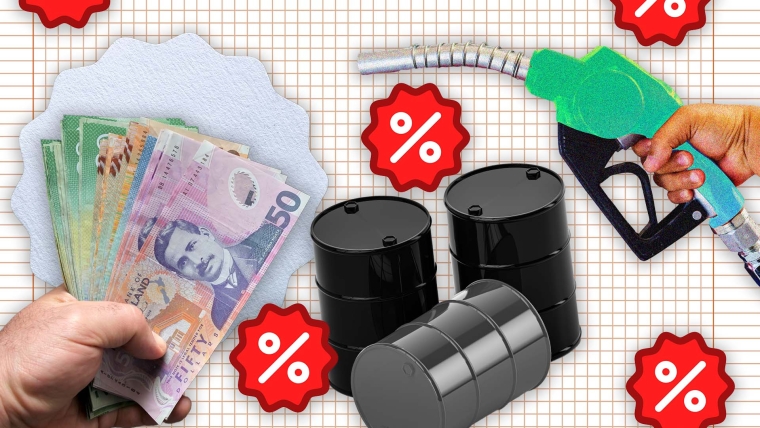
In the lead-up to next week's CPI release, Statistics NZ released the latest Selected Price Indexes (SPI) figures on Friday. This is a monthly series that features about 47% of the contributors to the quarterly CPI. The standout figures from the SPI showed in the year to June, petrol prices rose 23.6% and diesel prices jumped 57.1%.
Following the SPI release, ANZ and ASB economists announced they’re projecting a 4.0% CPI for the June quarter. Westpac and BNZ have gone for 4.1% while Kiwibank is forecasting inflation to reach 4.2% in the June quarter.
When it came to Kiwibank's 4.2% projection for the June quarter, this forecast hasn't been updated since oil prices dropped in June and their economists hope to see a figure closer to 4.0%.
‘Not enough to ease inflation fears’
Kiwibank economists Alexandra Turcu and Elliott Lowe didn’t beat around the bush in their Friday note, saying: “The June quarter inflation numbers will be ugly. That’s to be expected.”
“The oil supply shock eased off a little in June, but not enough to ease inflation fears.”
When the RBNZ changed its inflation projections last week, the central bank said “the lower forecast relative to the May [Monetary Policy] Statement largely reflects smaller direct price effects due to lower oil prices, as well as reduced pass-through to other consumer prices”.
It also comes after a deal in June was announced between the United States and Iran to end conflict in the Middle East, which saw share markets rise and oil prices drop. The deal is now in doubt, however, as Iran earlier in the week said it had closed the Strait of Hormuz, and attacks between the United States and Iran have continued.
Latest SPI figures ‘true to form’
Turcu and Lowe said it was in the June quarter where prices for petrol and diesel have taken off, and they expect this will flow through to the June inflation print.
BNZ senior economist Doug Steel said BNZ’s primary interest in the latest SPI figures was whether the data would alter their thinking for next week’s June quarter CPI announcement. “In short, they don’t.”
“Today’s monthly indicators stayed true to form albeit with considerable volatility in the details. The balance was a touch softer than our expectations, but in being the final month of the quarter was not enough to move our estimate for the June quarter outturn,” Steel said.
“Fuel prices remain a wild card for near-term inflation. Today’s fuel prices were very close to our expectations. But we are in very fast-moving markets.”
Steel said domestic fuel prices started July a bit lower than BNZ had assumed “but renewed hostilities in the Middle East suggest some upside risk ahead compared to our prevailing assumption of a continued drift lower in fuel prices”.
‘Risk that the cost shock spills over into other parts of the CPI basket’
On ANZ’s 4.0% CPI projection, ANZ senior economist Miles Workman said sharply higher fuel prices are set to drive acceleration in headline inflation.
Workman said it was not so much the direct impact of higher fuel prices on headline inflation that would be keeping the RBNZ awake at night.
“Rather, it is the risk that the cost shock spills over into other parts of the CPI basket, lifting inflation expectations and generating a broader inflation impulse that could prove difficult to contain.”
Kiwibank’s Turcu and Lowe said a driver of inflationary pressure in the March quarter came from food prices due to fresh produce and meat.
“We don’t expect cost pressures to have eased in these sectors. The increased price of fertiliser and huge demand for NZ mince overseas is continuing to put upward pressure on food prices.
Crayfish in a pot
Turcu and Lowe said it was not just about how high inflation prints for the June quarter, “but how long that inflationary pressure is sustained. In particular, if imported (tradable) inflation starts seeping into domestic (non-tradable) prices”.
“That is the Reserve Bank’s primary concern.”
Speaking at a BusinessNZ event in Wellington on Tuesday, RBNZ chief economist Paul Conway told the audience: “When inflation is high, people pay closer attention to it.”
“Research suggests that New Zealand businesses pass on cost increases more readily now than in the past and are less likely to reduce prices when costs ease. All else equal, this raises the risk of temporary shocks becoming persistent inflation,” he said.
“The more businesses can pass on higher costs, the more businesses expect inflation to be higher in future, the more persistent inflation becomes, and the harder monetary policy must work to bring it back to target.”
ANZ’s Workman said: “If that proves to be the case [about businesses and their pricing behaviour], and inflation pressures remain above the RBNZ’s assumptions, the MPC (Monetary Policy Committee) may need to lift the OCR by more than otherwise. However, the Q2 data are unlikely to provide much insight into this dynamic, given the recency of the oil price shock."
“Non-tradable, services, core, and diffusion measures (which capture how widespread price pressures are across the CPI basket) are likely to matter most for the monetary policy outlook.”
Turcu and Lowe said: “Kiwi households and businesses are like crayfish in a pot, slowly climbing to a boil.”
“When inflation rises consistently, year after year, expectations anchor to that pattern continuing. This is bad.”
Real cost of oil crisis on inflation will be in later quarters
“All in all, second quarter inflation will be high ... The real cost of the oil crisis on inflation will come out in the third and fourth quarter data," the Kiwibank economists said.
“With the way the war in the Middle East is re-escalating at the moment, we can’t be confident that the supply shock will pass any time soon.”
We welcome your comments below. If you are not already registered, please register to comment
Remember we welcome robust, respectful and insightful debate. We don't welcome abusive or defamatory comments and will de-register those repeatedly making such comments. Our current comment policy is here.