

While there were expectations from economists and the Reserve Bank (RBNZ) that the latest unemployment rate would either remain unchanged or decline slightly, figures for the September quarter went against the grain with the jobless rate rising to 5.7% with 174,000 people unemployed.
This increase takes the unemployment rate to its highest point in more than a decade. The last time the unemployment rate was at 5.7% was in the September 2015 quarter.
“Economic recovery seldom follows an orderly, uniform or straight-line path," BNZ senior economist Doug Steel said, following Statistics NZ’s release of the latest labour market data on Wednesday.
“And, boy, did the Q3 [third quarter] labour market provide a stark reminder of that fact today.”
Steel said perhaps the biggest surprise was the quarterly drop in employment.
“It was a tiny fall at just 0.1%, but quite different to widespread expectations of a moderate lift. The market expected a gain of 0.4%, as did we, while the RBNZ forecast a 0.3% increase.”
Steel said weaker employment flowed through to unemployment. Disconcertingly, the unemployment rate rose despite the participation rate easing to 70.4% from a downwardly revised 70.6%.
The participation rate is the proportion of working-age people employed or seeking employment.
“Sometimes the unemployment rate can push higher when more people enter the labour market. That wasn’t the case in Q3. That gives the release a clearly slacker feel than was anticipated."
‘The Kiwi economy is hurting’
Kiwibank economists Alexandra Turcu and Elliott Lowe said the unemployment rate defied their “optimistic expectations and the market's”.
They pointed out the underutilisation rate “remained uncomfortably high” as many workers had shifted from full-time permanent roles to part-time and casual work, and also brought up the participation rate.
The underutilisation rate is a broad measure of untapped labour market capacity and includes unemployed people, the potential labour force and people who are underemployed. To put more simply, it’s people who would like more work.
“The number of actual hours worked dropped by 1.6% compared to the June quarter, and was down 0.5% compared to the September quarter of 2025. This is a symptom of business stress, as many Kiwi business owners look to cut costs, they first start by cutting hours,” Turcu and Lowe said.
A lot of this movement could be explained by the "sluggish" growth in filled jobs, they said, as filled jobs fell by 0.2% compared to the September quarter of 2025, and there was a 0.1% increase in filled jobs compared to the June quarter.
"This is not what we expected based on monthly filled jobs data. The shift in the size of the population also affected the headline rate. The working age population grew by 13,000 while the number of Kiwis not in the labour force grew by more, 14,000 on a non-seasonally adjusted level.”
But the bad news doesn’t stop there, they said, pointing to the figures showing young people were still struggling to find work.
Alongside this, of the 169,100 people who were unemployed in the September quarter, 21.5% had been unemployed for more than a year. In the previous quarter, this was 19%. These figures are not seasonally adjusted.
Wages were also not keeping up with inflation, Turcu and Lowe said.
“In the September 2026 quarter, prices in the economy went up by 3.7%. Wages on the other hand? 2.1%. The gap did close somewhat compared with June, where inflation was 4.1% and wages grew by 2%. But that's still a sizable gap between people's wages and the prices they're facing."
Annual inflation, as measured by Stats NZ’s Consumers Price Index (CPI) was 3.7% in the September quarter, with petrol prices the main contributor to the rise. Petrol was up 19.1% and accounted for 17.5% of the annual CPI increase.
'We expect the peak in unemployment is still ahead'
“We can’t guarantee that this is the peak in unemployment," Turcu and Lowe said. "We expect the peak in unemployment is still ahead."
“Offshore chaos is still driving prices for transport up across the motu, and many businesses have been facing higher costs, while consumers are pulling back on spending. This does not bode well for workers hoping for a decent pay bump," they said.
‘The RBNZ can’t afford to have the labour market also become a source of CPI inflation’
ANZ senior economist Matthew Galt said: “We were optimistic that the labour market was near a turning point, but today’s data was disappointing all round.”
“The labour market usually lags the economic cycle and the gradual improvement in the economy over the past year has driven a modest improvement in employment growth, but not yet enough to stem the four-year-long upward trend in the unemployment rate.”
He said given inflation pressures are coming from several other directions (think fuel prices, a falling NZ dollar and rising administered prices), “the RBNZ can’t afford to have the labour market also become a source of CPI inflation”.
“The amount of spare capacity remaining in the labour market suggests there is little risk of that happening any time soon; it will take time for this spare capacity to be absorbed.”
Last week, the RBNZ stunned economists and financial markets, by holding the Official Cash Rate at 2.75%, following a 4-3 vote by its Monetary Policy Committee members. The decision to hold was not anticipated by bank economists or financial markets, as they expected the OCR to be increased to 3% to combat inflation and a weak NZ dollar.
Galt said this latest labour market data was consistent with the RBNZ’s assessment at the October monetary policy meeting, which noted a slow recovery in the labour market and subdued wage growth (though it was a "touch weaker" than the RBNZ's projections from the September Monetary Policy Statement).
Market reduces odds on a December OCR hike from 80% to around 50%
“Continued weakness in the labour market will give the Monetary Policy Committee reason to continue their cautious approach to OCR hikes.
“However, given the labour market tends to lag the cycle, this data needs to be weighed up against inflation risks and signs of the economic recovery continuing over recent months. We continue to forecast 25 basis point hikes at each of the next three RBNZ meetings, but are not surprised that the market has reacted to the data by reducing odds on a December hike from 80% to around 50% at the time of writing.”
ASB senior economist Mark Smith said the labour market was not the cause of high inflation at present.
“It is possible that price and wage setting is more sensitive to higher inflation rates following the post-COVID-19 bouts with high and variable inflation. Further, there is evidence in the Q3 CPI that price increases are broadening (56% of the CPI basket had price increases 3% or higher on a weighted basis according to the RBNZ).
“As such, the RBNZ are likely to be wary of the risk of higher consumer prices filtering through into wages,” Smith said.
Sharply rising labour cost growth would make it more difficult for the RBNZ to achieve and maintain inflation at 1% to 3%, he said.
“We expect a steady pace of 25 basis point hikes and a 3.5% OCR peak by March 2027, but we acknowledge risks are skewed to more gradual tightening as the environment we are in is fickle and the OCR forward path is highly uncertain."
BNZ’s Steel said with wages matching the RBNZ’s projection, this meant that the latest labour market data was not uniformly softer than expected.
“However, the employment and unemployment readings were clearly on the slacker side of the Bank’s expectations. It must raise questions around the pace at which the [Reserve] Bank will lift its cash rate ahead.”
“For now, we’ll stick with our view that the cash rate peaks at 3.75% and will be lifted by 25 basis points at each of the next four meetings. However, today’s data increases the chance of more pauses along the way,” Steel said.
“Picking the timing of any potential pauses is fraught with difficulty, especially when data and the [Reserve] Bank’s guidance are at odds.”
RBNZ's decision to leave OCR unchanged feels 'justified'
Kiwibank’s Turcu and Lowe said the RBNZ’s decision to hold the OCR at its October meeting feels “justified”.
“A weak labour market acts as a pressure lid on price growth … The oil shock price increases in the transport sector have had a limited effect on domestic price growth because ordinary Kiwi are not finding it easy to find work and bargain for higher wages, thus their ability to spend is constrained."
“Constrained domestic demand makes it tough for businesses whose costs have increased. To cut costs, they [reduce] hours as well as jobs. So long as the cycle continues, increasing the interest rate is not necessary," Turcu and Lowe said.
Westpac senior economist Michael Gordon said from the RBNZ’s perspective, the details are soft, which was an important consideration ahead of the RBNZ's December 9 OCR meeting as there’s few other major data releases between now and then.
“The unemployment rate is a more reliable signal than the employment measures, and the ongoing rise in unemployment points to more slack in the labour market than the RBNZ was hoping to see in an economy that has been growing for over a year now.
“The doves on the policy committee will be encouraged in their view that there is limited scope for headline inflation shocks to pass through into second-round effects.”
Westpac economists are expecting a 25 basis point hike in December, and continue to expect an eventual peak of 4% in September 2027 but a hike in December is not a done deal and is dependent on data.
‘Damning verdict on Christopher Luxon’s economic mismanagement’ - Labour
With three days to go until Election Day, political parties made time on the campaign trail to give their views on the labour market data.
Labour said the latest figures “deliver a damning verdict on Christopher Luxon’s economic mismanagement”.
Labour finance and economy spokesperson Barbara Edmonds said: “His last chance to show his plan was working has come and gone, and Kiwis are paying the price".
"For working families, the pressure hasn't let up. The cost of living is still biting, bills are piling up and wages are struggling to keep pace."

National’s Nicola Willis expects unemployment to fall in the coming months
National finance spokesperson Nicola Willis said the latest figures reflect the impact of uncertainty on the economy and the need to “stick with the plan that is working to rebuild the economy”.
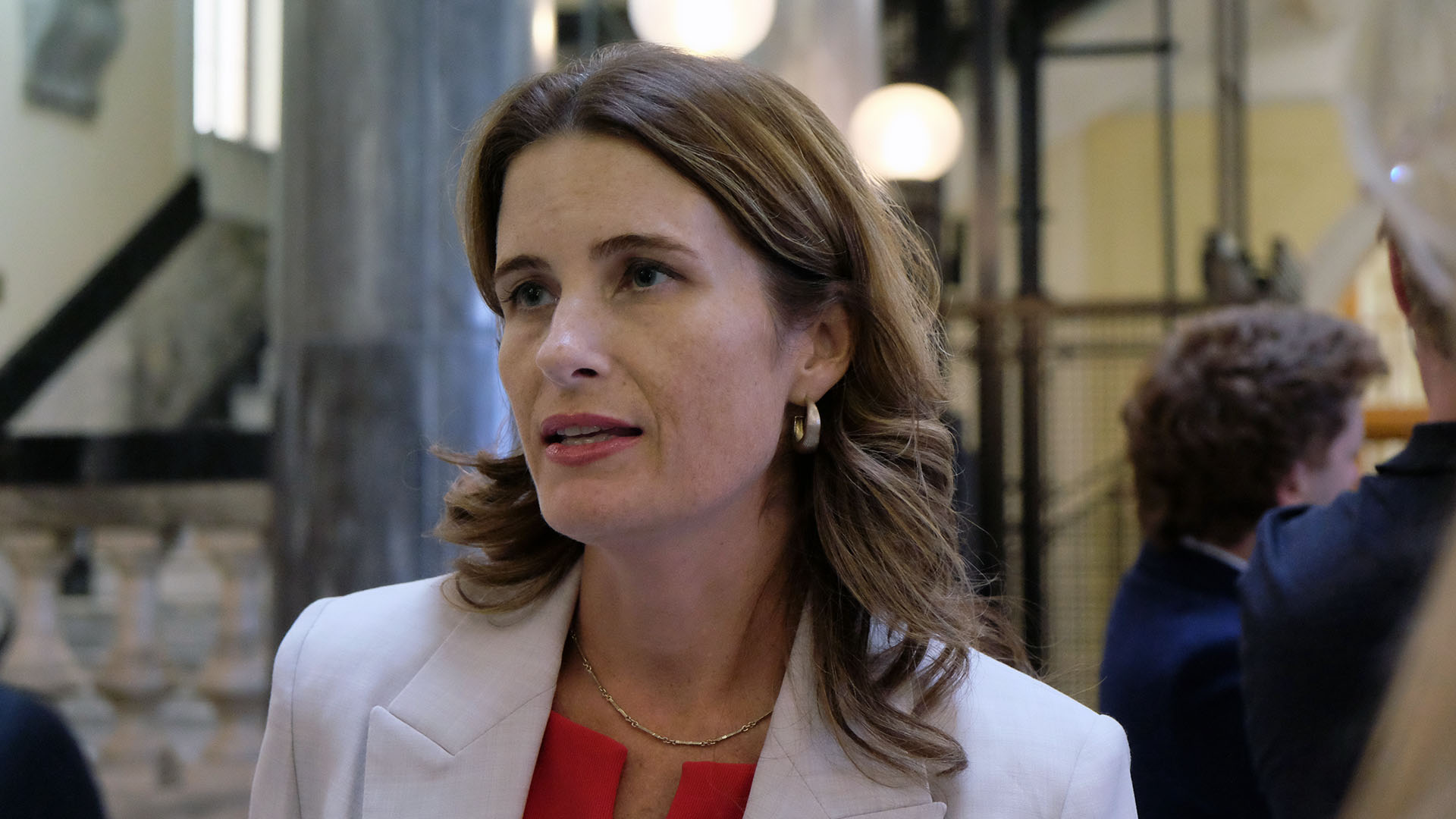
“We can’t control events in the Middle East, but we can control what happens here in New Zealand. What businesses need is certainty about tax settings and regulatory reform, and certainty that the Government will continue to pursue a sensible fiscal course," Willis said.
Willis told reporters that based on the data she had seen, she expected that unemployment would fall in the coming months because the growth rate in the economy was increasing and businesses had said they were more optimistic about the future.
We welcome your comments below. If you are not already registered, please register to comment
Remember we welcome robust, respectful and insightful debate. We don't welcome abusive or defamatory comments and will de-register those repeatedly making such comments. Our current comment policy is here.