
Assistant Reserve Bank Governor Christian Hawkesby says the RBNZ’s main focus at this point of the coronavirus crisis is making sure the banking system remains strong.
Echoing comments Governor Adrian Orr made on Tuesday around confidence and cashflow being key, Hawkesby said the RBNZ is looking at how funding markets and banks’ relationships with their coronavirus-affected clients are holding up.
“That’s really our first point of call and our main focus - at least in these initial stages,” he told interest.co.nz.
“We have a well-capitalised banking system and a well-funded banking system.”
ANZ NZ CEO Antonia Watson on Tuesday told interest.co.nz ANZ NZ is in a good position in a liquidity sense. Concerns in this area were a major issue in 2008 and 2009 during the Global Financial Crisis.
ANZ NZ’s chief economist Sharon Zollner on Monday said that if stresses in the financial system start to emerge, there could be a case for the RBNZ to lower bank capital requirements to help keep credit flowing.
Asked whether the RBNZ was considering pushing out the seven-year phase-in period for its new, more stringent capital requirements, which banks need to start implementing from July, Hawkesby said: “I think that’s a conversation for down the track. It’s not something we’re focussed on at the moment.”
OCR cuts can help increase demand, not create more supply
Hawkesby, like Orr on Tuesday, hosed down expectations of large, if not emergency, Official Cash Rate (OCR) cuts in the immediate future.
He said the government could move with more haste than the RBNZ, targeting those most affected by coronavirus.
Finance Minister Grant Robertson is working with banks on the potential for future working capital support for companies that face temporary credit constraints.
More details around this and a wage subsidy scheme will be revealed next week, when Robertson is expected to shed more light on his “business continuity package” being developed.
Hawkesby said: “What we need to think through is, to what extent is it [coronavirus] a supply-side issue around supply chains; around specific sectors being affected - in which case monetary policy can’t provide direct help.”
He said monetary policy would be useful if there is a spill-over effect and a lack of demand and confidence across the economy.
Asked whether the RBNZ would feel compelled to cut the OCR - not necessarily because it believed this was the most effective response, but because the government wasn’t doing enough - he assured: “We know the government is working really hard on this.
“We can see the amount of coordination that’s going on, we can see the amount of assessment, we can see the number of options that they’re looking at… we can see the will to deliver it, and that’s great from our perspective.”
Hawkesby said the RBNZ needed to “look beyond coronavirus” and consider its inflation and employment targets (which are currently being met).
As for moving in tandem with other central banks, in part to prevent the New Zealand dollar from appreciating and making New Zealand exports relatively expensive, Hawkesby said the RBNZ looked beyond short-term currency volatility.
He noted the New Zealand dollar remains weak against the US, despite the Federal Reserve cutting its benchmark rate by 50 points in an emergency move, as markets have already priced in an OCR cut of between 25 and 50 points for March. The OCR is currently at 1% and is next due to be reviewed on March 25.
Central government sign-offs required for deploying unconventional monetary policy still being worked through
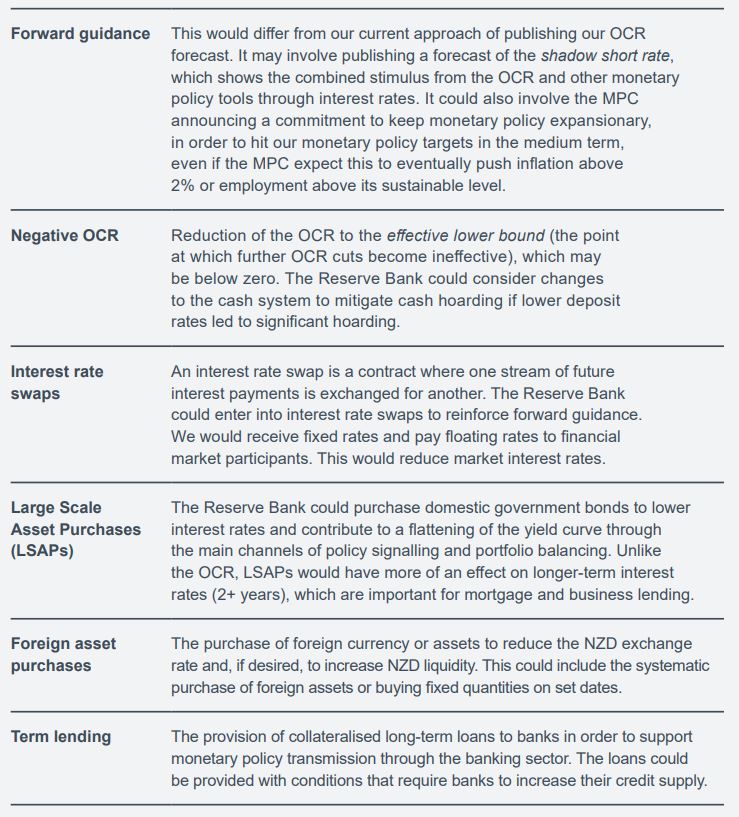
Hawkesby also ran through the unconventional monetary policy tools the RBNZ has been building capability around for some years. These are tools the RBNZ could deploy if the OCR falls to zero and is no longer useful in helping the RBNZ meet its inflation and employment targets.
Hawkesby said the RBNZ, Treasury and Minister of Finance were still working through governance arrangements around deploying these tools, so that “everyone knows where they stand in terms of what they have scope to make decisions on, what they are required to ask for permission to do, what they are required to keep another party informed about”.
The RBNZ indicated on Tuesday its preference would be using tools like forward guidance, a negative OCR, and interest rate swaps that work in similar ways to the OCR by mainly influencing interest rates.
Their side-effects are better understood and they’re known to have smaller financial impacts on the RBNZ and Crown balance sheets than the other tools in its suite - large scale asset purchases, foreign asset purchases and term lending.
Nonetheless, the RBNZ said the tools it may use will depend on what will be most effective, efficient and improve the soundness of the financial system.
Hawkesby and Orr stressed we aren’t at the point where unconventional monetary policy needs to be used.
Here's a run-down of the RBNZ’s unconventional monetary policy tools:
We welcome your comments below. If you are not already registered, please register to comment
Remember we welcome robust, respectful and insightful debate. We don't welcome abusive or defamatory comments and will de-register those repeatedly making such comments. Our current comment policy is here.