
Will the Covid-19 crisis and subsequent economic recovery lead to rising inflation, turning the tide on three decades of deflation?
Yes, according to Morgan Stanley economists.
In a nutshell economists at the investment bank argue because the public health crisis has galvanised policy-makers into a quick response, for the first time in a decade there's coordinated monetary and fiscal policy easing underway. This combination, they say, is essential to get out of the low-growth, low-inflation loop of recent years, and will disrupt the three key deflationary forces of the past three decades, being technology advances, trade rules and corporate titans.
When will this inflation emerge? Morgan Stanley's estimate is 2022.
"For the past six years, I have written a good deal about how the 3Ds of debt, demographics and disinflation are the key structural challenge for the global economy. Pick up a long shelf-life report from this period and you will probably find a comparison of the global macro backdrop to that of the US in the 1930s and Japan in the 1990s, and how macro policies post the global financial crisis (GFC) were unlikely to effectively bring us out quickly from the debt and disinflation trend. Those who are still in the disinflation/deflation camp will argue that the Great Covid-19 Recession (GCR) is a supercharged version of the GFC and will only exacerbate the debt and disinflation trajectory that we have been on," says Chetan Ahya, Morgan Stanley's Chief Economist and Global Head of Economics.
Ahya suggests there are two reasons why the tide is turning in favour of higher inflation.
"First, the GCR will be a sharper but shorter recession than the GFC. The trigger this time is an exogenous shock in the form of a public health crisis, rather than the classic, endogenous adjustment triggered by rising imbalances. The GCR also did not start out as a financial crisis, and the banking system is in better shape today than prior to the GFC. We expect global and DM [developed markets'] output to reach pre-recession levels in four and eight quarters, respectively, compared with six and 14 quarters during the GFC," Ahya says In a report entitled The Return of Inflation.
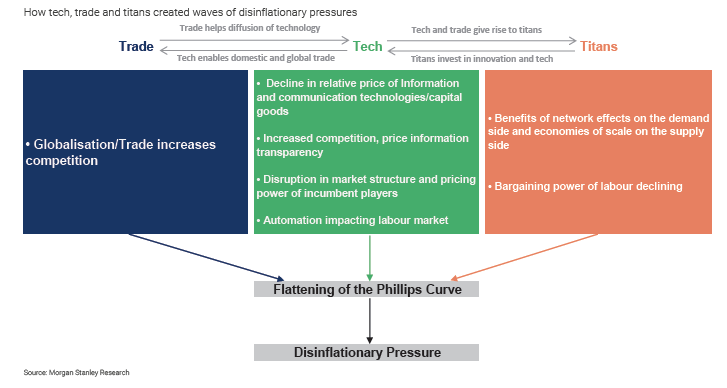
"Second, and more importantly, the public health crisis has galvanised policy-makers to respond swiftly. For the first time in a decade, we are finally getting coordinated monetary and fiscal easing – a policy dynamic that we have viewed as essential to get out of the low-growth, low-inflation loop. The scale of easing is also unprecedented during peace time. With the economic shock driving an even deeper wedge between low- and high-income workers, policy-makers are scrutinising what I have called trade, tech and titans more closely, given their role in driving the wage share of GDP lower and widening the income divide. Disturbing this trio will also mean disrupting the key structural disinflationary forces of the past 30 years."
The GCR, as Ahya puts it, has unleashed forces that will make it a turning point and start "a regime shift" towards higher inflation.
"We see the threat that inflation emerges from 2022 and will overshoot the central banks’ targets in this cycle."
"The consensus remains in the disinflation camp. Just as the consensus underestimated the disinflationary trends of the past 30 years, it is at risk of under appreciating the inflation threat. In response, I would argue that the driving forces of inflation are already aligned and a regime shift is under way. The near-term disinflationary trend will quickly give way to reflation and then inflation," says Ahya.
Where inflation's at
To put the Morgan Stanley prediction of a "regime shift" in context, inflation in the United States, the world's biggest economy, fell 0.8% in April, the biggest monthly decline since December 2008 led by falling petrol prices. Projections in the International Monetary Fund's latest World Economic Outlook, from April, suggest inflation of 0.5% in advanced economies this year, and 1.5% next year. The IMF sees inflation of 4.6% in emerging markets and developing economies this year, and 4.5% next year.
Australia's latest annual inflation rate, released in March, came in at 2.2% its highest level since 2014, and New Zealand's March year inflation rate came in at 2.5%, the highest it has been in more than eight years. However these figures predate Covid-19 lockdowns. The Reserve Bank of New Zealand's Survey of Expectations has since shown inflation expectations plummeting.
And the RBNZ's latest Monetary Policy Statement (MPS), issued on Wednesday, predicts inflation will be much lower by the end of this year, possibly below the central bank's 1% to 3% target range. The RBNZ baseline economic scenario from its MPS is for annual inflation to trough at -0.4% in the first half of 2021, and remain below 1% until the second half of 2022.
The impact of 'tech, trade & titans'
Morgan Stanley points out "tech, trade and titans" have been the key disinflationary forces over the past 30 years. But the three have also contributed to a lower wage share in GDP and rising inequality.
"The discontent about inequality has risen, triggering policy action. Cracks are emerging in global supply chains and slowbalisation trends are being accelerated by geopolitics," says Morgan Stanley.
"The emergence of trade tensions was partly motivated by rising inequality and has already led to scrutiny of the tech and telecommunications sectors. Trade now faces even closer scrutiny after the outbreak of Covid-19, given the need for more resilient local supply chains, especially in areas such as pharmaceuticals and medical equipment. Fears have risen that continuing technological change combined with workplace automation will widen the skill and income gap."
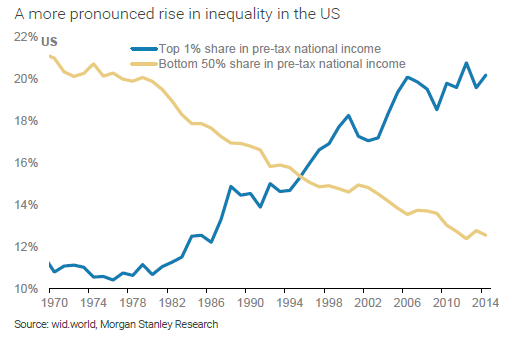
Morgan Stanley says the US is the most exposed developed country to the risk of higher inflation in this economic cycle, because its monetary and fiscal policies are the most expansionary and inequality is most extreme in the US.
'Underlying political pressures to address inequality will rise further'
Morgan Stanley lays out the startling details of where the US deficit is at, and where it's heading.
"The US fiscal deficit is projected to reach 19.2% of GDP this year (and will still be relatively high at 14% next year), and there are reports of a further US$1 trillion of fiscal easing, which would lift the 2020 deficit to 24% of GDP, its highest level since 1942, when it stood at 27%."
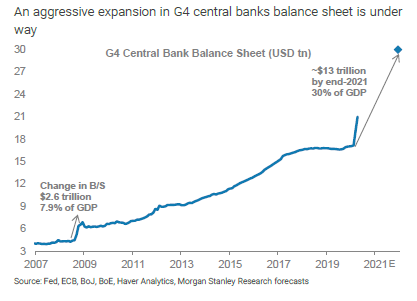
Additionally the Federal Reserve’s balance sheet will expand by 38% of GDP by 2021, more than the 20% during its GFC era quantitative easing 1, 2 and 3 programmes combined.
"Recessions tend to hit the lower-income population the hardest, but the impact of Covid-19 on lower-income workers has been outsized. As a result, we believe that the underlying political pressures to address inequality will rise further, and see both fiscal activism and continued action to check tech, trade and titans continuing for longer. We see the US as being most exposed to the risk of higher inflation in this cycle, as the monetary and fiscal policies are the most expansionary and the issue of inequality is the most pronounced," Morgan Stanley says.
"The forces that will bring about inflation are aligning. We see the threat of inflation emerging from 2022 and think that inflation will be higher and overshoot the central banks’ targets in this cycle. This poses a new risk to the business cycle, and future expansions could also be shorter. Central banks are now more tolerant of inflation and will be keen to make up for some part of the lost inflation during downturns, in particular for the Fed, given its focus on the symmetry of the inflation goal."
The forces that will determine the speed and magnitude of inflation
Morgan Stanley's economists argue the speed and magnitude of inflationary forces will be determined by; firstly, the size, duration and spending mix of expansionary fiscal policy; secondly by the extent to which tech, trade and titans are disrupted; thirdly by the pace of recovery and normalisation post-Covid-19; and fourthly by the reaction of central banks.
"We would view policies that boost spending on infrastructure, education and the public healthcare system as more beneficial to productivity growth and less distortive than transfers to households. Severe disruption to tech, trade and titans could also create a regime shift in the outlook for corporate profitability."
The Morgan Stanley report argues a precise timeframe for a return to inflation is challenging to predict because it hinges on the evolution of the virus and the pace of economic normalisation/recovery post-Covid-19.
"Private sector confidence (AKA animal spirits) has clearly been dented by the outbreak, but our base case is for a fairly quick recovery. The trigger for this recession is an exogenous shock in the form of a public health crisis, rather than the classic, endogenous adjustment triggered by rising imbalances. Indeed, prior to the GFC, non-financial private sector debt/GDP had risen by 36 percentage points in the US from 2000 to 2007. But prior to the GCR, private debt remained flat after a 23 percentage point decline."
"We see the shock as more akin to a natural disaster than a financial crisis, hence the GCR should not trigger the big balance sheet recession dynamics that we have seen over the past decade. This also did not start out as a financial crisis, and the banking system is in better shape today than prior to the GFC. Financial sector debt/GDP has been declining persistently since its 2009 peak. Moreover, this recession has prompted the most coordinated and aggressive monetary and fiscal easing that we have witnessed in modern times. We expect global and developed markets output to reach pre-recession levels in four and eight quarters, respectively, as compared with six and fourteen quarters during the GFC," Morgan Stanley says.
"We expect inflation to emerge from 2H22 [the second-half of 2022], but we caution that expectations may precede the re-emergence."
A two pillar inflation framework
Morgan Stanley says its "inflation framework" rests on two pillars being the new-found activism in monetary and fiscal policy, and collective action to address inequality, which will disrupt the disinflationary forces of tech, trade and titans.
"Hence, the key question for us is when but not if we get inflation in this cycle."
"We see three phases in the journey – a shift from disinflation in the near term to reflation and finally to inflation. The timing of this sequence depends on the pace of the economic recovery post the Covid-19 shock," Morgan Stanley says.
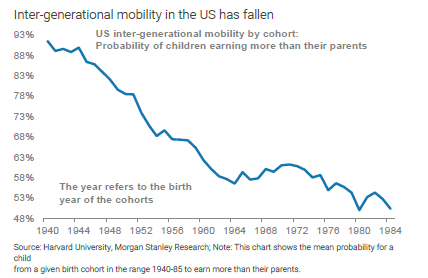
The sluggish cyclical recovery since the GFC has exacerbated the long-term trends of rising inequality and reduced inter-generational social mobility, as the US labour market didn't reach full employment until 32 quarters after the economic expansion started, Morgan Stanley says.
"Across the OECD, median incomes have grown by only 4.6% over the past decade, while the pace of income growth for wealthy households is much higher at 10.3%. In the US, real mean household incomes for the bottom quintile did not recover to pre-recession levels until 2017. The discontent over rising inequality has already affected election outcomes in several economies and has been receiving more attention from policy-makers in recent years, typified by the rise of the progressive political movement."
*The charts and diagram below come from Morgan Stanley.
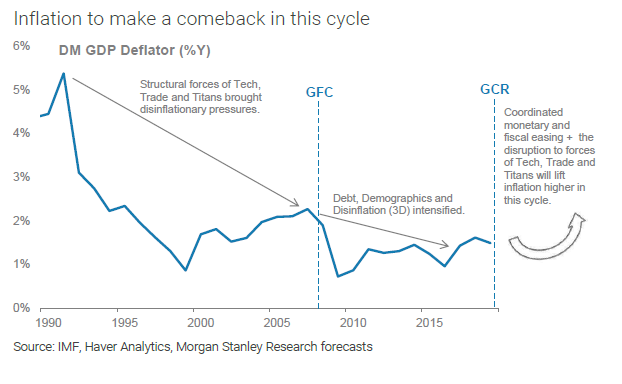
*DM = developed markets.
*This article was first published in our email for paying subscribers early on Wednesday morning. See here for more details and how to subscribe.

We welcome your comments below. If you are not already registered, please register to comment
Remember we welcome robust, respectful and insightful debate. We don't welcome abusive or defamatory comments and will de-register those repeatedly making such comments. Our current comment policy is here.