
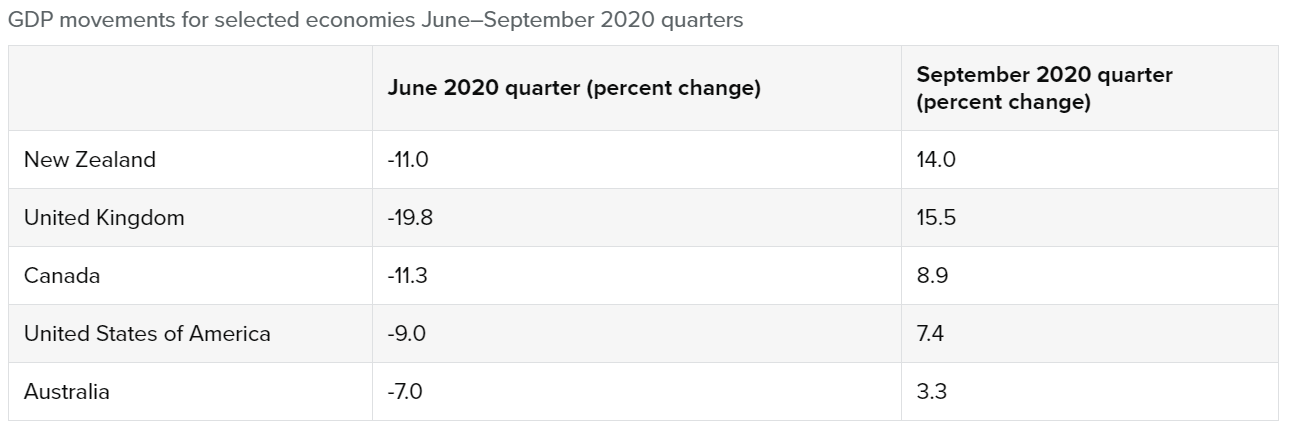
The economy grew by a record 14% in the September quarter as the country bounced back from the lockdown earlier in the year.
The result is in line with many economist's projections and slightly ahead of the forecast from the Reserve Bank of a 13.4% rise.
It follows on from a record drop in economic activity in the June quarter, which was first recorded as a 12.2% drop, but which Statistics New Zealand has now revised down to an 11% drop.
While the bounce back has been an extremely sharp one, it still means GDP has shrunk by 2.2% in the year to September.
ASB chief economist Nick Tuffley and senior economist Jane Turner said the NZ economy looked to have been "even more resilient than expected" and has recovered from the impact of the lockdown earlier this year, with quarterly GDP now above pre-Covid levels.
"This is a phenomenal result, and an achievement made by very few other countries in 2020," they said.
"The key question going forward is whether the Q3 momentum can be sustained. Early Q4 indicators look promising, particularly retail spending and housing-related sectors. However, there are a number of headwinds, and this summer will test many tourist operators with international borders still effectively closed. Nonetheless, there is light at the end of the tunnel, with travel bubbles back on the agenda for early 2021 and the first wave of vaccines set to roll out over the coming months."
Stats NZ said there were fewer restrictions on activity in the September 2020 quarter than during the Covid-19 lockdown-impacted June 2020 quarter, though Auckland was at alert level 3 in August.
“This resulted in the strongest quarterly growth in GDP on record in New Zealand, as the economy bounced back from the lockdown earlier in the year when non-essential businesses closed,” national accounts senior manager Paul Pascoe said.
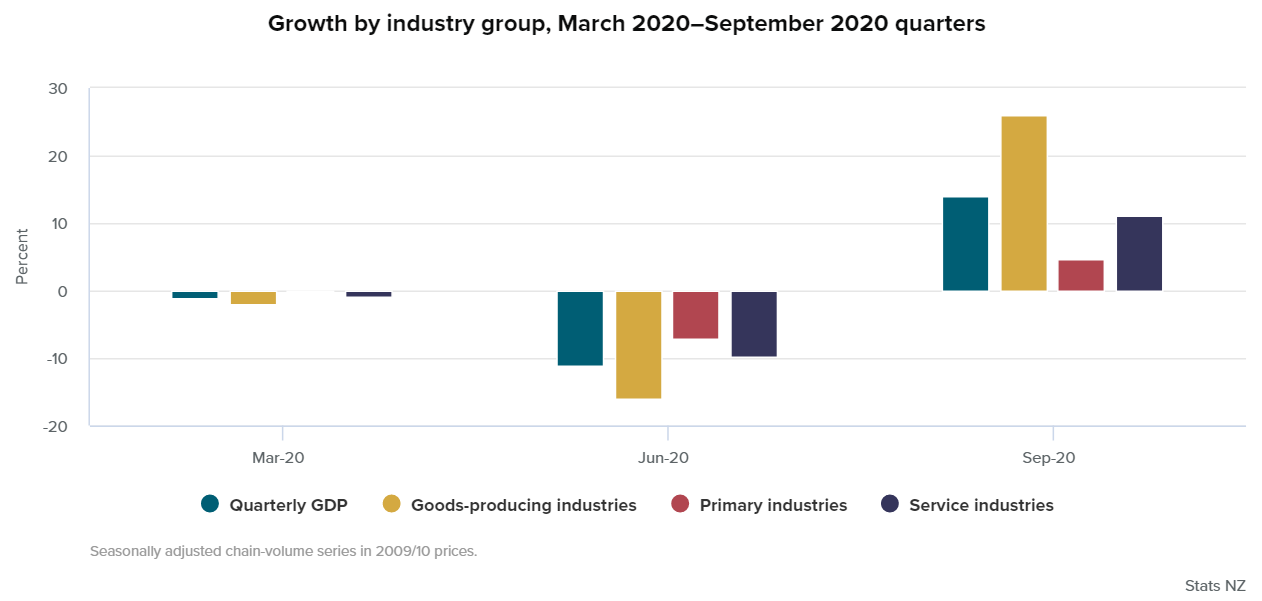
Service industries, which produce about two-thirds of New Zealand’s GDP, rose 11.1% in the quarter, after declining 9.8% in the June 2020 quarter. Goods-producing industries grew 26% and primary industries 4.6%, after falling 15.9% and 7.1% in the June 2020 quarter respectively.
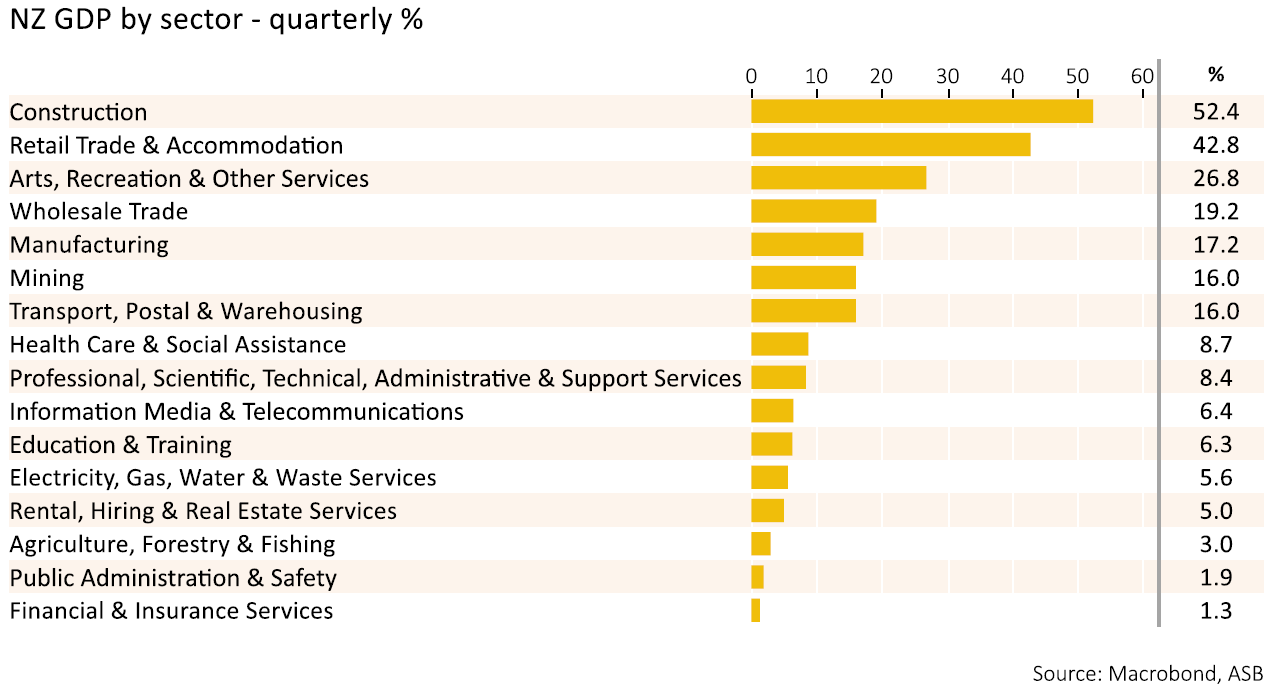
The industries contributing the most to quarterly growth included retail trade and accommodation, up 42.8%, construction, up 52.4% and manufacturing up 17.2%.
“Retail sales values recorded the largest September 2020 quarter rise since the series began in 1995, as people spent more on household goods, cars, and food, while residential building was at the highest-ever levels by volume,” Pascoe said.
“The retail trade and accommodation, and construction, industries were both significantly affected by the alert level 4 restrictions in the previous quarter. Accommodation, restaurants, and bars have also been affected by New Zealand’s border being closed to international travellers since mid-March. This sub-industry is down 11.8% through the year to September 2020.”
Pascoe said GDP was up compared with the September 2019 quarter, indicating that overall the country managed to return to a pre-Covid level of activity.
"However, the effects of Covid-19 have had specific and varied impacts at industry level and, for some industries, these may persist for some time.”
Even though activity across the country largely returned to pre-Covid-19 levels, "we haven’t recouped all the activity or production lost as a result of the lockdown in the June 2020 quarter", Pascoe said.
Kiwibank economists said the economy "bounced back with a vengeance in the third quarter".
"...This is as close as you get to a true V shaped recovery," they said.
"...All industries recorded large increases in activity as we came out of lockdown. The Auckland lockdown over the quarter appears to have had a muted impact.
"The quarterly numbers are hard to digest. Following a lockdown, we saw activity increase substantially with the likes of construction up 52%, retailing up 42%, and accommodation up 107%. So it’s important to look at activity over the year. And our economy is tracking nicely, all things considered. GDP fell 2.2% over the year to September. Sure, that’s the largest annual decline ever recorded. But we’d take that with a smile. Especially when you consider the 5-7% declines originally forecast.
"It’s clear that 95% of our economy is performing particularly well. But we must spare a thought for the other 5%. The true test of the tourism and education sectors is right now, over the peak summer season. And there’s a risk we see activity decline over the 4Q, and/or 1Q 2021. The Australian travel bubble will help, if implemented soon. But there’s billions of international tourist dollars not flowing through our economy over summer."

We welcome your comments below. If you are not already registered, please register to comment
Remember we welcome robust, respectful and insightful debate. We don't welcome abusive or defamatory comments and will de-register those repeatedly making such comments. Our current comment policy is here.