
By Alex Tarrant
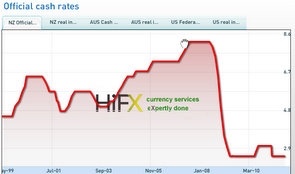
Lower-than-expected inflation in the September quarter and a new set of Treasury forecasts have bank economists pointing to the next hike in the Official Cash Rate in June 2012, later than their previous forecasts for a March quarter hike.
Inflation in the September quarter from the June quarter came in at 0.4% on Tuesday morning, below median economist and Reserve Bank expectations for a 0.7% rise. Then on Tuesday afternoon, Treasury released its pre-election fiscal update pointing to big risks to growth from global turmoil.
On top of that, Fonterra then downgraded its forecast payout for the current 2011/12 year by 45 cents per kg due to softening commodity prices and high New Zealand dollar.
Following the day's data, BNZ's Head of Research Stephen Toplis noted Finance Minister Bill English's comment at the PREFU release that interest rates looked like they would be 'lower for longer'.
"We are now of a similar view, following this morning’s low CPI. We now have the next OCR hike not occurring until the middle of 2012. This afternoon’s Fonterra dairy payout forecast reduction only adds to the likely delay in raising rates," Toplis said.
"Still, interest rates will eventually head higher in the medium term. Look at the PREFU too, and it still has a rising OCR. Indeed, all the way to a 5.00% peak (from its present 2.50%)," he said.
'Monetary policy has a fiscal mate'
After the PREFU was released, ANZ economists said they saw greater co-ordination between fiscal policy and monetary policy over coming years, which would assist the Reserve Bank in keeping interest rates lower than would otherwise be the case.
"Fiscal policy will start to exert a contractionary impact on aggregate demand from FY2012, thereby providing the RBNZ with greater scope to take its time. If the revenue line disappoints, the risk is that the Government crunches expenditure by more, further taking pressure off monetary policy," ANZ economists said.
Following the inflation figures this morning, ANZ economists said they thought the first OCR hike would be in mid-2012.
'March, but with risks'
ASB economists tentatively stuck with March for the resumption in rate hikes following the inflation figures, but noted the risks due to global uncertainties.
"We continue to expect the RBNZ will remain on hold until March next year, commencing then a steady series of 25bp increases. However, today’s result raises the risk of a slightly later and more gradual tightening cycle. Much would depend on how the European debt crisis unfolds, and we expect this will have a material impact on the RBNZ’s timing," economist Christina Leung said.
After the PREFU was released, ASB economists noted Treasury had pared back its inflation forecast slightly.
"Relative to our forecasts, the Treasury is more optimistic, with its forecast of annual inflation remaining below the top of the RBNZ’s target band throughout the projection. Part of this is likely to reflect its expectations the NZ dollar will hold up over the coming years, which would likely weigh on tradable inflation," they said.
'We'd already said June'
Following the inflation figures, Westpac chief economist Dominick Stephens said he had already shifted his call for the first OCR hike to June 2012.
"Today’s result was significantly below the RBNZ’s forecast of a 0.7% increase. More importantly, the surprise was almost entirely on the ‘stickier’ non-tradables side, and in at least one industry (electricity) where limited competition and persistent price increases have long been a bugbear of the RBNZ," Stephens said.
"It’s not obvious that this result can be repeated in coming quarters, though – the pace of switching of electricity providers is apparently slowing, and further downward pressure on airfares depends on more new entrants to the market. In other cases, such as internet services, the downward pressure on prices is likely to continue for some time," he said.
"In the September Monetary Policy Statement the RBNZ projected annual inflation to fall below 2% by the second half of next year, once last year’s GST hike and other government charges (and their apparent impact on inflation expectations) had dropped out of the equation. Today’s results will greatly strengthen the RBNZ’s confidence in that forecast, and with the global situation a clear negative for the interest rate outlook since September, it’s possible that the RBNZ will explicitly signal a slower track for OCR increases in this Thursday’s review."
No chart with that title exists.
We welcome your comments below. If you are not already registered, please register to comment
Remember we welcome robust, respectful and insightful debate. We don't welcome abusive or defamatory comments and will de-register those repeatedly making such comments. Our current comment policy is here.