

By Bernard Hickey
The Reserve Bank has reported back from stress tests of bank dairy lending that the banks faced posting losses of up to an average of 8% of their dairy loans - or about $3 billion - in the most extreme scenario.
But it said the banks were able to handle the losses through lower profits, rather than having to eat into their capital.
Banks had lent over NZ$38 billion to dairy farmers as at the end of June last year, although this is expected to have increased substantially since then as the banks supported loss-making farmers with working capital lending. The Reserve Bank's stress tests suggested the banks -- including ANZ, ASB, Westpac, BNZ and Rabobank -- could collectively book losses on their loans of more than NZ$3 billion over the five years in the scenarios included in the stress tests.
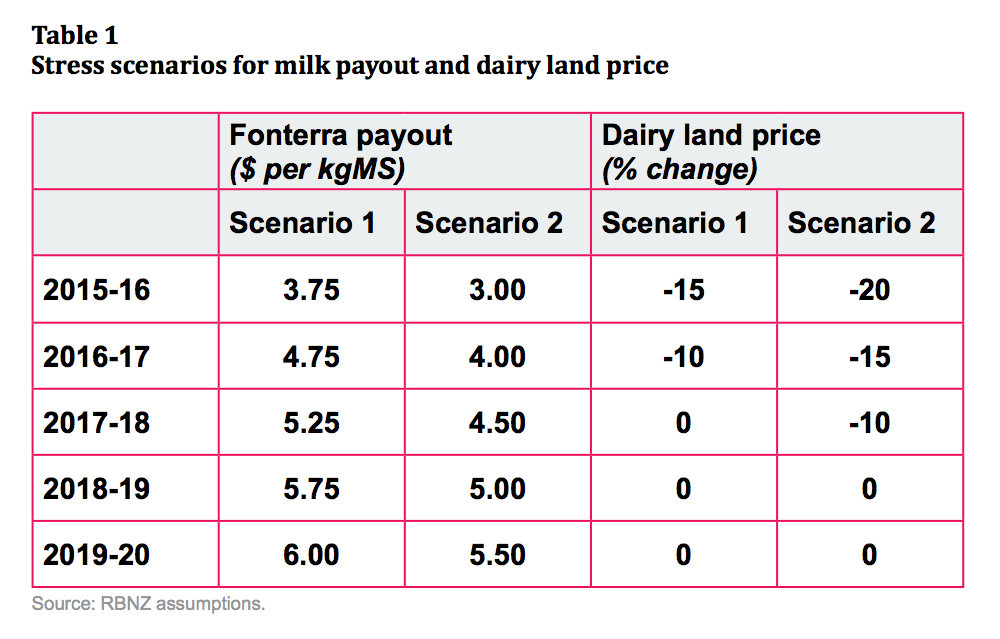
The tests included two scenarios: one where the payout recovers to NZ$5.25/kg by 2017/18 and land prices fall 20%, and a second scenario where the payout was NZ$3/kg this year and remained below NZ$5/kg until 2019/20. The second scenario generated land price falls of 40%.
"On average, banks reported losses under the two scenarios ranging between 3 to 8 percent of their total dairy sector exposures,” said Reserve Bank Head of Macro-Prudential Bernard Hodgetts.
“Bank lending to the dairy sector stands at around NZ$38 billion, which is approximately 10 percent of the banking system’s total lending. We would expect losses of the order seen in the stress scenarios to be absorbed largely through lower bank earnings rather than through an erosion of bank capital," Hodgetts said.
The Reserve Bank reported the results of the stress conducted by the banks on their dairy loan portfolios in October and November in this bulletin article.
"Consistent with earlier work, the scenarios generate significant increases in loss rates that are manageable for the banking system as a whole," article author Ashley Dunstan wrote in the article.
"There is a risk that the time taken to resolve stressed dairy exposures could be longer than reported in the tests, creating an ongoing source of uncertainty for banks," he said.
The stress test scenarios are detailed in this table:
The test results found that 40% of the debt was held by farmers with a break-even payout of NZ$5/kg or higher, and a current loan to value ratio of over 50%.
The Reserve Bank said the tests showed that most of the impact on bank profitability would occur in the first three years of the scenarios and it published a chart showing the cumulative bad debt estimates under the two scenarios.
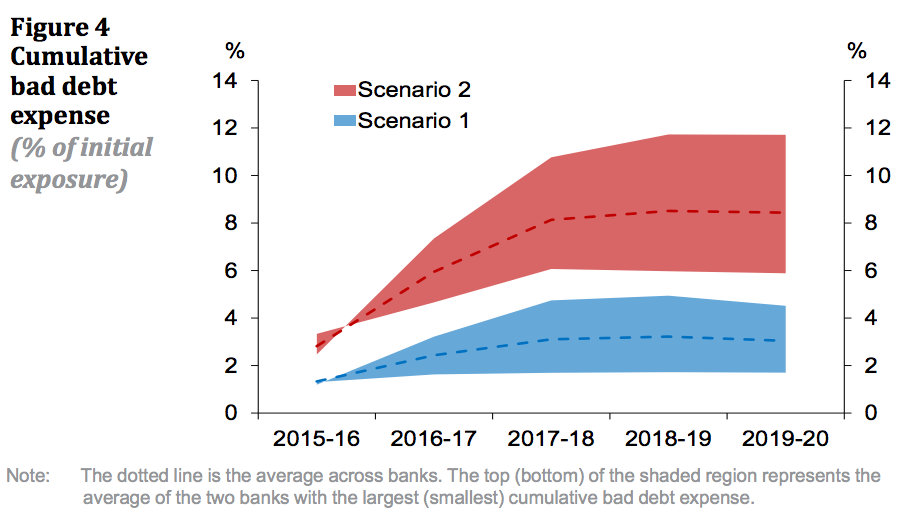
"Throughout the entire scenario, the average bank reports a cumulative bad debt expense equivalent to about 8 percent of initial dairy exposures in scenario 2, and 3 percent of exposures in scenario 1," the Reserve Bank said.
The Reserve Bank reported that banks found up to 25% of dairy loans would be written off in the most severe scenario, although this does not account for recoveries on loans, which generated the lower net bad loss average in the worst scenario of 8%.
Risk of long lag of 'managed turn-arounds'
The Reserve Bank warned the scale of loans written off would likely result in "very challenging conditions in the market for dairy farms, particularly in the last two years of the scenario," given the number of farms the could be sold would be larger than the number of buyers with sufficient capital.
"This analysis suggests that banks should plan for the possibility that the time taken to write off stressed dairy exposures could be significantly longer than assumed in the tests," the bank said.
"Under these circumstances, banks could be left needing to manage a large portfolio of foreclosed assets for an extended period of time. This would mean that uncertainty about the scale of eventual write downs would persist for longer, potentially requiring the banks to hold additional capital to boost confidence," it said.
"Losses on written-off loans could also increase if ongoing management costs and forgone interest income are larger than initially provisioned for (possibly offset by any growth in dairy land values that occurs in the interim)."
Reaction
New Zealand Bankers Association acting CEO Antony Buick-Constable said the results showed the banking system was resilient and the long-term outlook for dairy remained positive.
"It’s very much in the banks’ interests to support farmers through both the tough times and the good," Buick-Constable said, adding that banks worked with customers with a range of measures to maintain the viability of of their businesses.
"Depending on individual circumstances, banks might be able to look at reducing or suspending principal payments on loans and temporarily moving to interest-only payments. Banks might also consider allowing term deposits to be broken without associated costs," he said.
"Banks can also help by providing affected farmers with financial management and budgeting assistance, and access to workshops on enhancing farm productivity and performance."
Labour Leader Andrew Little said the stress test results showed the banks had room to stand by farmers.
"National has done nothing but make excuses for banks, instead of ensuring they stick by farmers. This report shows that banks have the room to be flexible and stand by good, efficient farmers," Little said.
"Those who have profited during dairy’s good times must now come to the table to work through a long-term solution. That should start with passing on interest rate cuts and doing everything possible to keep Kiwi farmers on their land," he said.
(Updated with more detail, reaction and charts)
We welcome your comments below. If you are not already registered, please register to comment
Remember we welcome robust, respectful and insightful debate. We don't welcome abusive or defamatory comments and will de-register those repeatedly making such comments. Our current comment policy is here.