

Outgoing Reserve Bank Governor Graeme Wheeler is rejecting clamouring from real estate agents and politicians for restrictions on banks' high loan-to-value ratio (LVR) residential mortgage lending to be eased.
In a speech entitled Reflections on the stewardship of the Reserve Bank made at the Northern Club in Auckland, Wheeler said LVR restrictions aren't expected to be permanent, but their removal would require a degree of confidence that financial stability risks won’t deteriorate again.
"However, debt-to-income ratios have risen in recent years, and with the underlying drivers of housing demand - population growth [and] low interest rates - remaining strong and demand outstripping supply, there’s a risk of a housing market resurgence, and a sharp lift in high LVR lending, if LVRs were removed at this time," Wheeler said.
“LVR restrictions have reduced financial stability risks as house prices became increasingly stretched. Requiring new borrowers to have a greater equity contribution in their house purchases reduced the overall riskiness of banks’ mortgage portfolios," Wheeler said.
“Nationwide annual house price inflation has declined to 1% due to LVR restrictions, the tightening in bank lending, the rise in mortgage rates and increasing concerns about housing affordability."
Wheeler's comments on LVR restrictions come after both National Party leader Bill English and Labour Party leader Jacinda Ardern, speaking as the September 23 election approaches, expressed dissatisfaction over how LVRs were perceived to be impacting first home buyers. English and Ardern's comments followed the Real Estate Institute of New Zealand calling on the Reserve Bank to remove LVR restrictions for first home buyers.
Economic prospects promising
Meanwhile, Wheeler said in the absence of major unanticipated shocks, prospects look promising for continued robust economic growth in New Zealand over the next two years.
“The greatest risk we face at this stage relates to the inflated global asset prices and the continuing build up in global debt," Wheeler said.
“If growth in the global economy slows, we have some scope to buffer our economy. We’ve greater room for monetary policy manoeuvre than central banks in many advanced economies. Our official cash rate is 1.75% – above the zero and negative interest rates of several advanced country central banks – and the [Reserve] Bank has not grossed up its balance sheet by buying domestic assets. With a budget surplus and low net debt relative to GDP, there’s also flexibility on the fiscal policy side.”
Wheeler's due to leave the central bank when his five year term as Governor ends on September 27. He'll be succeeded by Deputy Governor Grant Spencer for six months until an as yet unknown permanent replacement takes the reins in March.
Big drop in highly leveraged loans as 1st home buyers still get their share
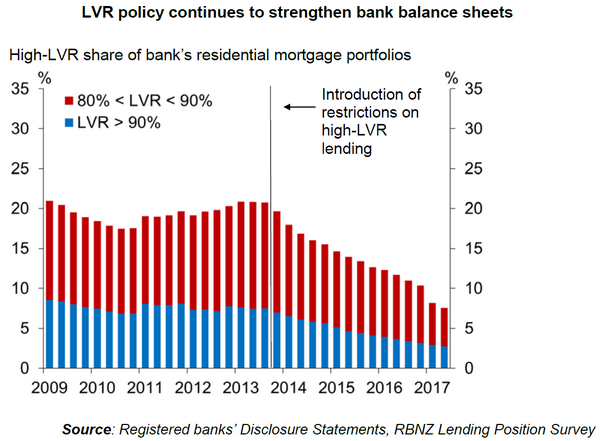
Wheeler noted that when LVRs restrictions were introduced in October 2013, 21% of the stock of mortgage lending across the New Zealand banking system was at LVRs of 80% or higher. With a third of new mortgage lending at that time happening at LVRs of 80% or higher, the overall stock of high LVR mortgages was "likely to approach" 25%.
"As a result of the LVR restrictions, the stock of highly leveraged loans across the banks’ mortgage portfolios is now around 8%," said Wheeler.
"While some first home buyers wanting high LVR loans have been affected by the restrictions, banks have given priority to first home buyers within their 10% speed limit," he added. "Over the past 2½ years the share of first home buyers in real estate transactions has been around 21%, its level in early 2013. Over this period, first home buyers have taken out nearly $21 billion of mortgage loans from the banking system, with 28% of that lending at LVRs greater than 80%."
He went on to say that the LVR restrictions have targeted reducing financial stability risks as house prices became increasingly stretched. The restrictions aren't expected to be a permanent fixture. The conditions for their removal, Wheeler said, would be signs that financial stability risks have eased, and a degree of confidence that these risks won’t worsen again when LVRs are removed.
"On the former measure, the financial risk picture is improving. Banks are carrying a lower share of high LVR mortgages as a result of the LVR limits having been in place, and the slowdown in house price inflation is positive - although prices remain very elevated relative to incomes and rents," Wheeler said.
"However, the underlying drivers of housing demand [being] population growth [and] low interest rates, remain strong with housing demand still outstripping supply. There is a risk of a housing market resurgence and a sharp lift in high LVR lending if LVRs were removed at this time. The [Reserve] Bank will continue to review developments, bearing in mind that removal could be made in stages as a safeguard to a resurgent market."
The case for debt-to-income ratio restrictions
Wheeler said it’s encouraging that NZ-wide annual house price inflation has dropped from a peak of 21% in August 2015 to 1% now. He attributed the decline to several factors including the tightening of investor LVRs in October 2016 by the Reserve Bank, more restrictive lending conditions by banks, the rise in mortgage rates early this year, and increasing concerns about housing affordability.
However, he remains cautious.
"A strong resurgence in house price inflation would increase the risk of a subsequent future correction. With a debt to income ratio of 167%, up from the 2009 peak of 159%, households are already heavily exposed to the risk of rising interest rates or falling house prices," Wheeler said.
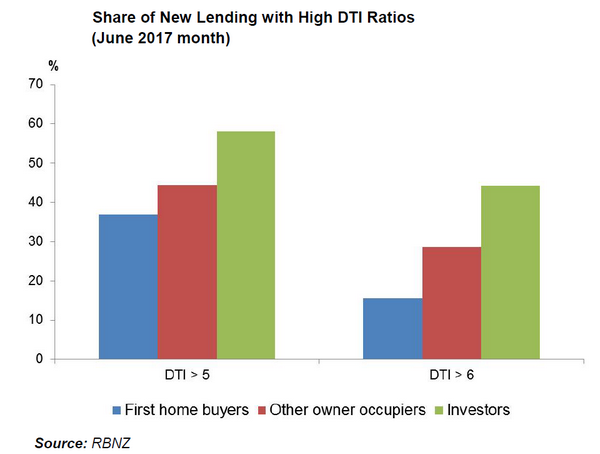
"In addition, the share of high debt-to-income (DTI) lending to first home buyers, other owner-occupiers and investors is high, making borrowers more vulnerable to rises in interest rates and/or reductions in income, e.g. associated with unemployment. This increases the risk of forced sales in a downturn leading to falls in house prices and flow-on effects on bank balance sheets and the broader economy. This is why we have been consulting on whether a DTI instrument should be included in the macro-prudential toolkit. We wouldn’t seek to use it while the housing market continues to moderate."
We welcome your comments below. If you are not already registered, please register to comment
Remember we welcome robust, respectful and insightful debate. We don't welcome abusive or defamatory comments and will de-register those repeatedly making such comments. Our current comment policy is here.