

Well, the great journey into the unknown of rising mortgage interest rates - for really the first time since the mid-2000s - is now about one-and-a-half years in.
How are we doing so far, and what are some of the visible trends?
It will come as no surprise to anybody who's had to re-fix their mortgage that there have been some smelling-salt-requiring hikes in mortgage payments going on.
The Reserve Bank's latest residential mortgage loan reconciliation figures for the December 2022 quarter showed that interest charged in the quarter was some $3.549 billion, the highest figure since the RBNZ started this data series in 2014. The latest figure compares with the record low $2.323 billion interest charged in the September 2021 quarter.
Those latest stats show few visible signs of homeowner stress as yet. Repayment deficiencies, at a bit above $200 million in the December quarter, were not appreciably different to what we've seen since mid-2020, while excess payments of over $4.2 billion are in line with (if not even a bit stronger) than the trends over the past several years.
Will the situation change though?
To go back a bit, the low point in interest rates can pretty much be taken as June 2021. Wholesale interest rates began heading skyward in July 2021 as there was grim confirmation that inflation was starting to get red hot.
Enter the RBNZ and rate hikes.
A point often made in mid-2021 was that the RBNZ would get good 'bang for its buck' in this hiking cycle. Put simply, homeowners would be affected by the interest rate rises more quickly this time than has been the case sometimes in the past - notably in the mid 2000s.
That's because most mortgage holders had as of 2021 gone pretty 'short' with their fixed terms, presumably not anticipating rising rates.
This meant that once interest rates went up many mortgage customers would be faced with soon having to refix - at a higher rate - and this would help the RBNZ more quickly achieve its job of slowing things down and taking the steam out of spending and the economy as a whole. And taking the steam out of inflation.
If we look at the RBNZ's detailed data looking at the time to next refixing, we can get a good snapshot of how things were when we started to see interest rates move up in mid-2021.

For the purposes of this stroll through the numbers, I'm using a starting point of June 2021, which as said above is pretty much the low point for the previous interest rate cycle. And then I'm comparing that with December 2021 and December 2022 - the latest figures available.
As of June 2021 just under 70% of the whole outstanding mortgage stock - then totalling $318.4 billion - was either on floating rates or due to be refixed in up to a year's time.
But by December 2021 the percentage of floating and due to be refixed in up to a year's time mortgage money had reduced to 63%.
And by December 2022 this was down further to a touch under 60%.
So, the profile of the outstanding mortgage book is gradually changing as homeowners face higher rates and as they make changes, particularly to how long they fix for.
Looking specifically just at fixed mortgages and over a shorter (three-month) timeframe, we can see that in June 2021 over 17% ($48.5 billion) of fixed rate mortgage monies were due to be refixed within the next quarter.
By December 2021 that percentage had fallen to a little over 13.5% and by December 2022 just over 11%, representing nearly $34.5 billion worth of mortgages.
So, we as a mortgage paying public, are going 'longer' to avoid the risk of being hit maybe by higher rates in future.
In June 2021 just under 25% (nearly $69 billion worth) of the fixed-rate mortgage stock ($278.6 billion) was fixed for terms in excess of a year. That's all.
However, as at December 2022 nearly 45% ($139.5 billion worth) of the fixed-rate mortgage stock was fixed for longer than a year.
That's quite a change. So the homeowners are moving with the times and the conditions when it comes to managing their interest rate risk and what they can afford.
Is the RBNZ losing bang for its buck?
Does this mean the RBNZ is now losing that 'bang for the buck' it had at the start of the interest rate hiking cycle?
Well, not really. While a lot of people have already felt significant impact from rate rises, plenty more people are still facing future hikes.
As mentioned above, as at December 2022 there was nearly $34.5 billion worth of fixed rate mortgages due to be reset in the first quarter of this year. That's still a very significant amount, with potentially a significant impact.
Let's highlight a specific example looking at the particularly popular two-year fixed rates.
Anybody who took up a two-year fixed rate mortgage in February 2021 is now refixing, or indeed already has refixed.
A look at the RBNZ's monthly mortgage figures shows us that in February 2021 there was a bumper $7.6 billion worth of mortgages taken on. This amount was split between some 23,852 mortgages, giving an average sized mortgage of around $320,000.
Working on the idea that somewhere between about a fifth and a sixth of those mortgages (based on averages at the time) will have been fixed for two years, we can deduce that possibly something like 4000 to 4500 of those mortgages were two year ones that are now resetting or just have been reset. That's a small number in the context of the overall population, but a reasonable crowd if you were to get them all together!
The average two-year (special) rate as of February 2021 was Just 2.65%. Happy days. Now it is 6.63%. So, using the friendly interest.co.nz calculator gets us this outcome when we compare a $320,000 mortgage fixed for two years in February 2021 with what a two-year rate will be costing now:
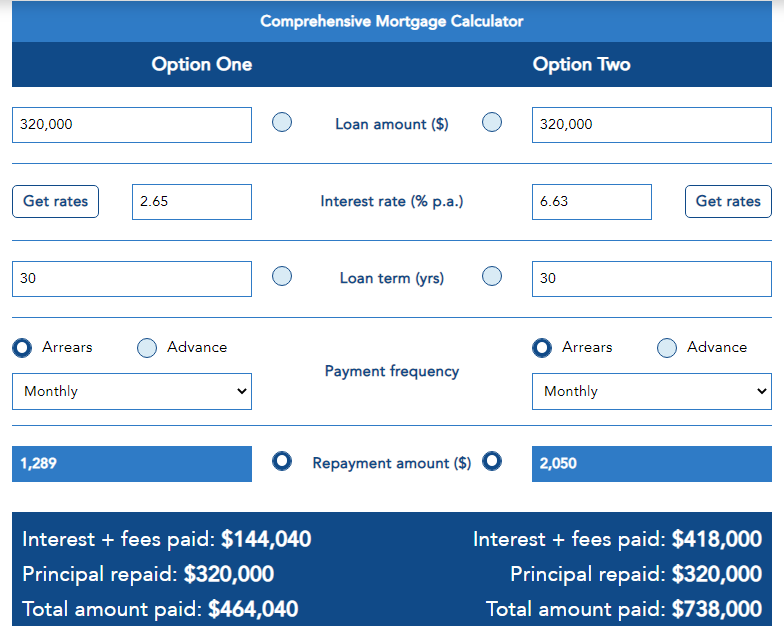
The monthly payments are $761 (59%!) higher, representing an annual increase of over $9000. Total payments now would be $24,600 a year, which runs to $473 a week.
That's what our 4000 to 4500 mortgage holders are facing.
Now I guess human nature at this point is to say, well, that's a one-off shock. But of course the higher payments are ongoing till such time as rates start coming down again and the point is that some people might have money put aside at the time they start higher payments, but this extra saving is gradually sapped as time goes by. So, it could become more of a struggle.
Repeated shocks
Another thing to consider is, I talk about a 'one-off-shock' of higher rates. But of course for some people the shocks are repeating - if they have fixed for shorter terms.
For example, If you took at a one-year fixed mortgage in February 2021, you would have needed to refix in February 2022. Interest rate rises were already well under way and the average one-year rate had risen from 2.41% in February 2021 to 3.61% in February 2022. Using the same information as above, IE a $320,000 mortgage, would see payments of $1249 a month in February 2021 and $1457 a month at the higher rate prevailing in February 2022.
Monthly payments would therefore be over $200 more. Bit of a blow to the finances. Doable though.
But wait. There's more. These one-year fixed people are now 'going around' again. And assuming they refix for another year they now face a rate in the region of 6.48% (current one-year market average) and monthly payments of $2018 - a further increase of over $550 on what was being paid as of February last year. Ouch.
Anyway, that's where we are at the moment. As I say, the RBNZ figures suggest there's no obvious rise in stress for mortgage holders - yet. But as more and more people are put on higher rates, and they have to keep meeting the new higher payments month by month, well we shall have to wait and see.
It's hard to imagine there won't be a significant slowdown in spending this year - of which there are already signs. But then from the RBNZ's perspective, I believe that is the point...
*This article was first published in our email for paying subscribers. See here for more details and how to subscribe.
We welcome your comments below. If you are not already registered, please register to comment
Remember we welcome robust, respectful and insightful debate. We don't welcome abusive or defamatory comments and will de-register those repeatedly making such comments. Our current comment policy is here.