

New Zealand's rate of inflation could get "stuck" above the targeted 1% to 3% if services-sector price rises don't slow down, according to ANZ economists.
In an NZ Insight publication titled 'Inflation Rotation', ANZ economist Finn Robinson and chief economist Sharon Zollner note that New Zealand is following a global trend of "the inflation pulse rotating away from goods and towards sticky services prices".
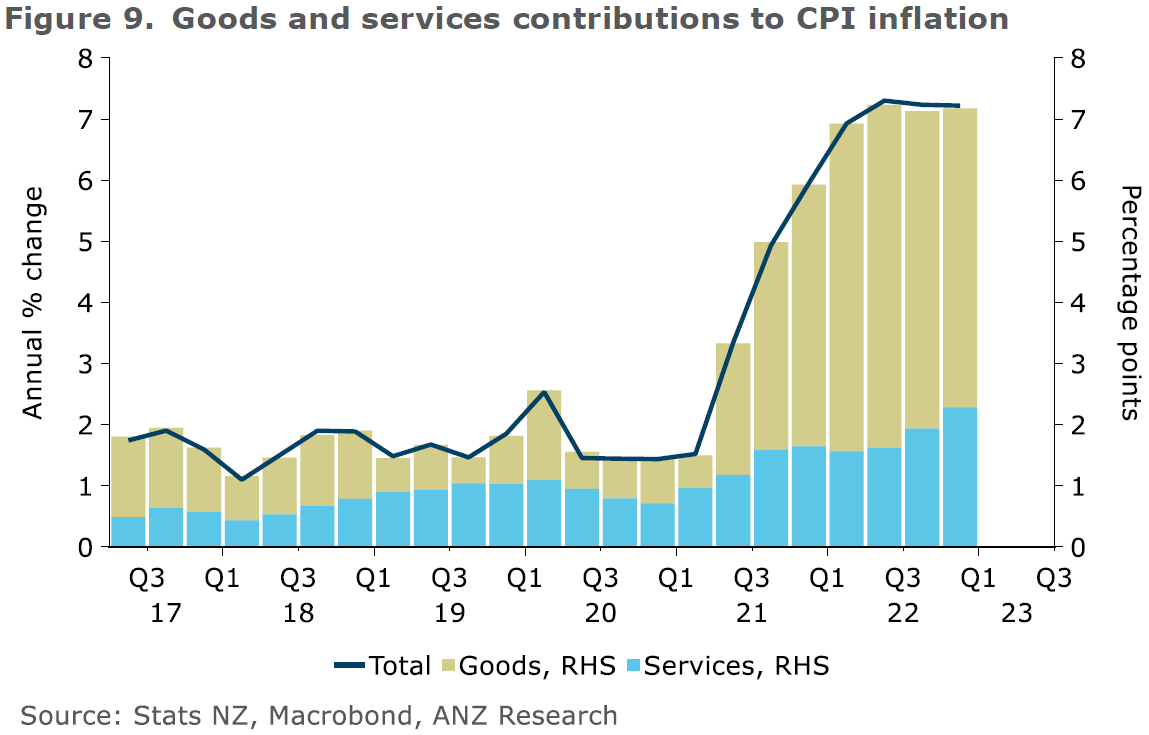
They say services prices are now contributing more than 2-percentage-points to our annual CPI inflation (which was 7.2% as of the December quarter), "and are showing no signs of slowing".
"Should that continue, we could see CPI inflation get ‘stuck’ above the RBNZ’s [Reserve Bank] 1-3% target band, even if goods inflation returns to historically average levels.
"...Combine a sticky services inflation pulse, with the risk of stubbornly high goods inflation due to the cyclone [Cyclone Gabrielle] or a renewed round of global goods inflation, and it’s worryingly easy to imagine overall CPI inflation remaining above the RBNZ’s 1-3% target range over the next few years."
The economists say the "relentless upside surprises" of inflation in 2021 and 2022 are "hopefully over".
"But it’s a long journey from 7.2% inflation back to the 2% midpoint of the RBNZ’s target band. And there are already significant bumps in that road. All of this points to the risk that interest rates will remain high for longer than markets currently anticipate. We therefore continue to expect the RBNZ will hike the OCR to a peak of 5.25% by May 2023, before holding rates at this level until at least the end of 2024."
The RBNZ itself is still forecasting a peak for the OCR (currently at 4.75%) of 5.5% towards the end of this year.
Robinson and Zollner note that central banks globally are "entering a new stage of the hiking cycle". Having rapidly lifted rates to a level that is broadly considered to be "contractionary", many central banks have slowed the pace, as they enter the ‘fine tuning’ stage, as opposed to ‘urgent catch-up’.
"But it remains highly uncertain how high interest rates need to be (and for how long) to ensure inflation returns to target. Goods disinflation is real, but for services inflation to fade, we need to see a realignment of labour demand with supply. This inflation rotation into services and away from goods will set the scene for monetary policy around the world as 2023 unfolds," they say.
Mirroring the global picture, goods inflation in New Zealand has peaked, but services inflation, has continued to build, they say.
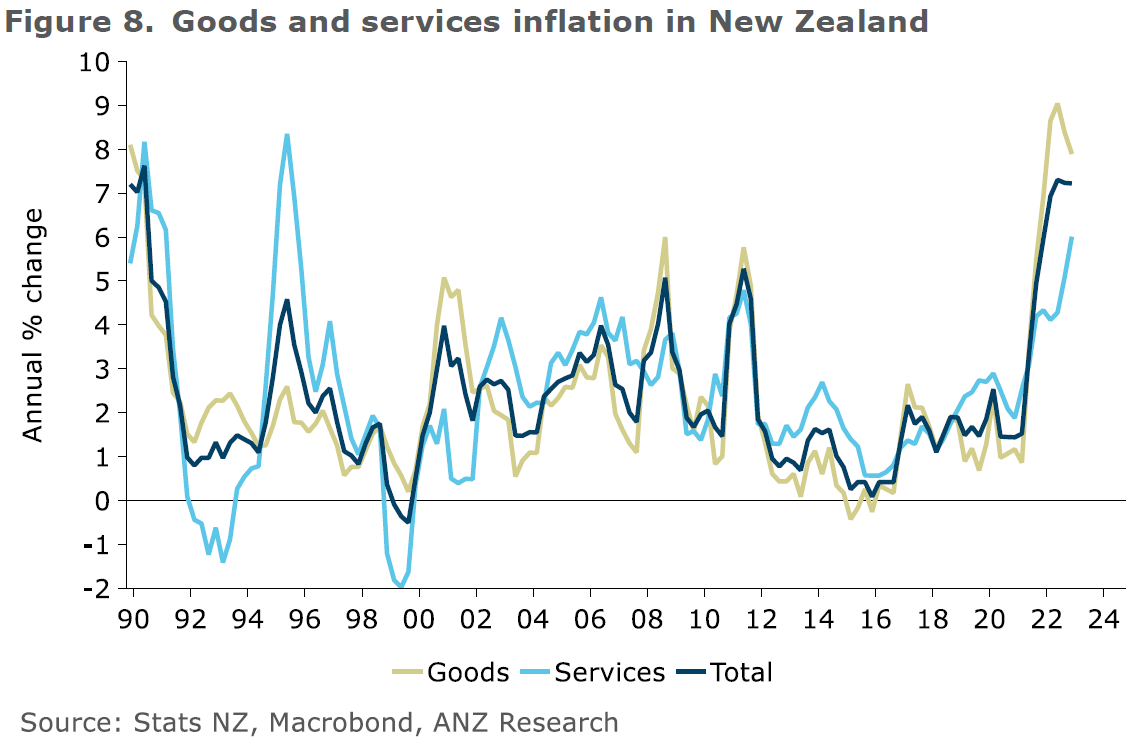
"This really highlights the risk that even as the global inflation pulse starts to fade, domestically generated inflation and our super-tight labour market will keep the pressure on the RBNZ to remain tough on inflation."
So, why might services inflation remain stubbornly high? Robinson and Zollner say one reason could be if the domestic labour market remains hot.
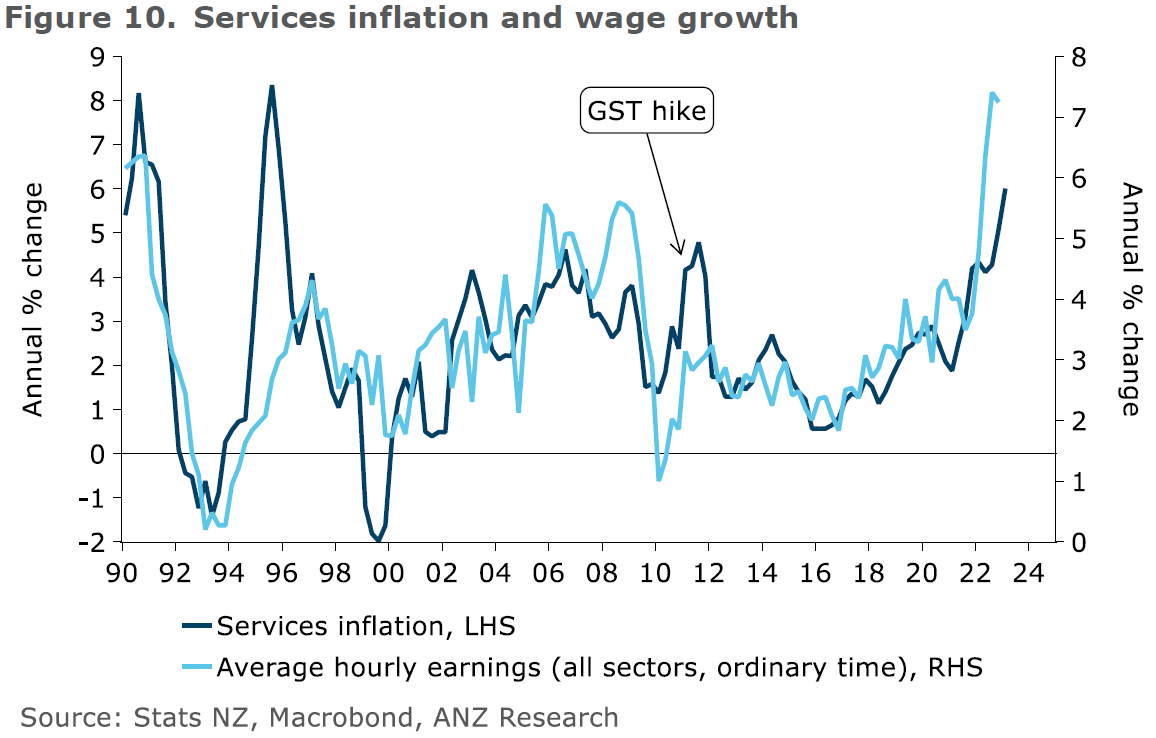
"The interplay between services and wage inflation means that for this component of inflation to ease, we need to see demand and supply in the labour market become better aligned. Until this happens, we run the risk of seeing inflation remaining too high over the medium term (even if it eases from current levels)."
The economists say that until recently it was looking like the gap between labour demand and labour supply was starting to close. But labour market indicators over January and February 2023 point to the labour market "getting something of a second wind".
The "spectacular increase" in net migration in recent months does, however, point to an improvement in the availability of workers, which should ease some of the logjam in the labour market.
"The evolution of labour market pressures over 2023 will be key for understanding the likely path of interest rates over the next few years. Should the labour market remain tight, despite the RBNZ’s rapid rate hikes and high levels of net migration, it would be difficult to see the RBNZ feeling comfortable easing up on the hawkishness much any time soon. Feedback loops between wage growth and the cost-of-living have the potential to see inflation remain high without making the average worker any better off in real terms."
Robinson and Zollner say The devastating impacts of Cyclone Gabrielle are "another complicating factor" for the RBNZ.
"While the full cost of this disaster will not be known for some time, it’s clearly going to be inflationary both in the near and medium term. The very items in the CPI which were expected to help drive disinflation over 2023 (construction costs, food prices, and rents) now face significant upside risks due to immediate cyclone impacts (at least at a regional level), as well as what’s looking like a significant and lengthy repair job to houses and infrastructure."
The economists say there are "plausible scenarios" in which the OCR ends up significantly higher or lower than their baseline forecast.
"However, with global economic momentum picking up again in early 2023, the labour market still beyond maximum sustainable employment, and Cyclone Gabrielle posing further upside risk to domestic inflation pressures, it’s fair to say that we see the risks being tilted firmly towards the OCR being lifted higher than our current expectation of a 5.25% peak.
"That’s not to suggest the risks are one-sided. Monetary policy acts with a lag, and its impact on the housing and construction sector is just getting going. The spill-over impacts of this could be larger than we are reckoning on. Globally, the end of the era of practically-free and certainly easy money is unlikely to be all smooth sailing, and that could at some point make a more abrupt and deep hole in demand than expected.
"But assuming the wheels stay on, we do see the risks as tilted towards inflation not falling either as fast or as far (or both) as we and the RBNZ are forecasting, which is pretty much a straight line back to 2%.
"Real life tends to get in the way of tidy stories like that."
We welcome your comments below. If you are not already registered, please register to comment
Remember we welcome robust, respectful and insightful debate. We don't welcome abusive or defamatory comments and will de-register those repeatedly making such comments. Our current comment policy is here.