

The Reserve Bank says it expects more borrowers will fall behind on their mortgage payments this year "given the ongoing repricing of mortgages and expected weakening in the labour market".
The comment is made in an excerpt from the RBNZ's latest six-monthly Financial Stability Report being released on Wednesday. The RBNZ disclosed that about a quarter of the current outstanding mortgage stock in the country was taken out in the period from late 2020 to late 2021. Of this about a fifth went to first home buyers.
The significant point about this is that this time period coincided with the peak of the housing market - from which prices have subsequently fallen by about 16.2% (specifically from November 2021). That time period also coincided with very low mortgage interest rates - under 3% in many instances.
As of March RBNZ figures indicate that there was $347 billion outstanding in mortgages in this country. A quarter of that would represent a touch under $87 billion, while a fifth of that figure (IE for the FHBs) would be over $17 billion.
"While we are not currently seeing widespread financial distress amongst households or businesses, in part this reflects the fact that the repricing of the stock of mortgage lending will take some time," the RBNZ said.
"Households are also adapting by reducing discretionary spending and drawing on savings, including working with their banks to extend the durations of their mortgages where they are ahead of their repayment schedules. Furthermore, the lack of acute stress showing up in banks’ lending portfolios reflects the strength in the economy and labour market to date."
The RBNZ reiterated its earlier statements that for a household with a mortgage, the share of disposable income required to service the interest component of their mortgage debt will more than double from its recent low of 9% to around 22% by the end of this year.
"Despite the significant rise, this would still be lower than the peak experienced in mid-2008," the RBNZ said.
"However, this increased debt servicing burden is distributed highly unevenly, with some borrowers, such as those who fixed at the low of mortgage rates in mid-2021, seeing far greater rises in their debt servicing costs than others."
The RBNZ said it expected most borrowers will be able to continue to service their debt obligations without significant stress, given the servicing test buffers that banks have applied when assessing borrowers’ loan affordability and the current strength in the labour market.
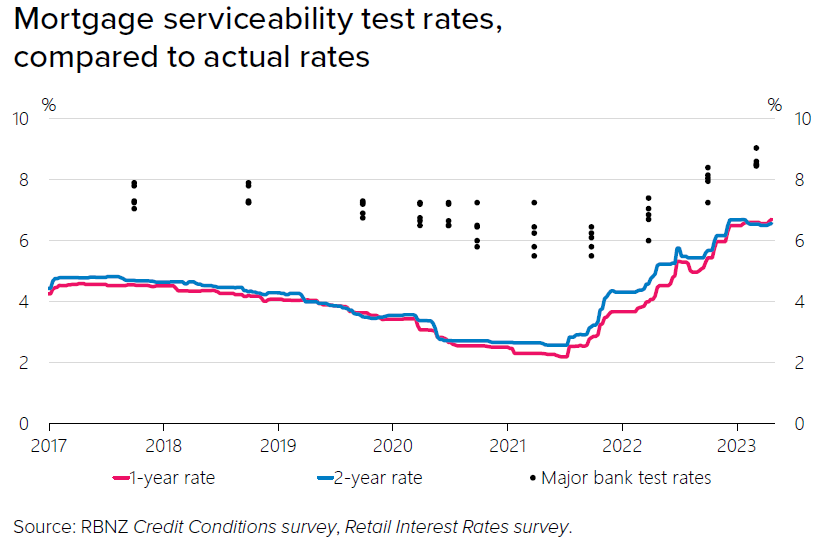
"However, for households that borrowed during the period of very low interest rates between late 2020 and late 2021, current interest rates exceed some of the test rates used by banks during this period. Therefore, some of these borrowers and other borrowers with high debt-to-income levels may begin to struggle to meet their repayment obligations as they reprice onto the higher rates."
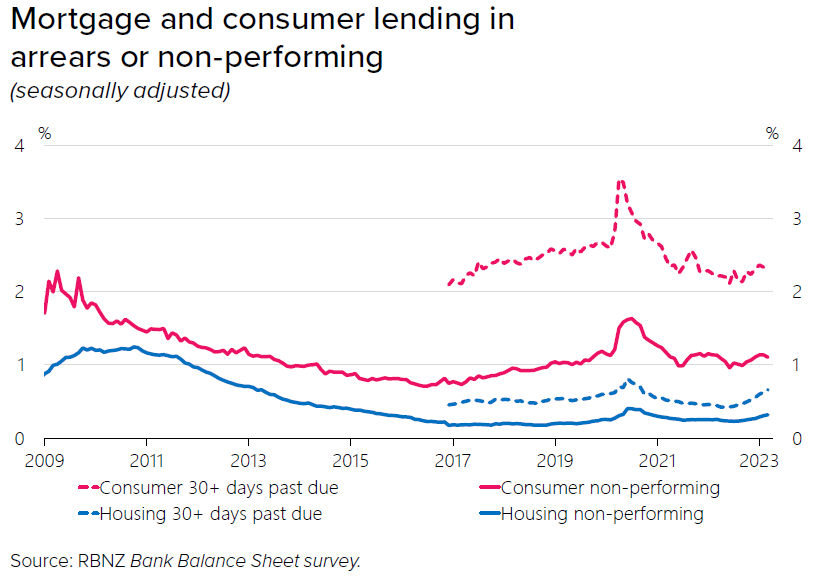
The RBNZ said early-stage arrears (missed payments by a borrower of one to three months) have been increasing in recent months, and are currently back to where they were before the pandemic. Compared with the Global Financial Crisis, these indicators so far remain low. Rates of non-performing mortgages and the number of mortgagee sales are also low albeit growing.
"Evidence from previous debt servicing distress periods shows that households with multiple forms of debt generally try to prioritise mortgage and utility bill payments. Data provided by Centrix has shown that those with multiple forms of debt including a mortgage are increasingly missing payments on non-mortgage debts. When encountering stress, a borrower may be able to move onto a hardship programme at their bank. This could involve temporarily switching to interest-only payments or increasing the remaining term of the loan," the RBNZ said.
Talking more broadly on business lending, the RBNZ said in general, there has been a deterioration in business performance across most sectors.
"However, banks have maintained conservative lending standards in recent years and businesses appear to be adjusting to higher debt servicing costs without significant increases in loan arrears so far. No industry is showing a marked increase in debt servicing stress, including those most disrupted by the pandemic. Banks have reported that businesses that survived the pandemic are generally quite resilient. "
The RBNZ said that in the commercial property sector, capital values have started falling across property types, particularly for retail.
"...But we expect further declines as values adjust to high interest rates and lower demand, for example due to increases in people working from home.
"Liquidity and credit demand in commercial property markets has been low. Higher interest rates and a poor outlook for the sector have contributed to an increase of 10 percentage points in closely monitored lending, from a low level since mid-2021."
We welcome your comments below. If you are not already registered, please register to comment
Remember we welcome robust, respectful and insightful debate. We don't welcome abusive or defamatory comments and will de-register those repeatedly making such comments. Our current comment policy is here.