
Mortgage holders on average could be paying "roughly 22%" of their disposable income to service the interest payments on their mortgages by the end of this year according to the Reserve Bank.
As recently as December 2021, interest payments for mortgage holders were taking up only around 9% of disposable income.
On Wednesday the RBNZ increased the Official Cash Rate to 4.75% from 4.25%. In its report on the meeting of the RBNZ's Monetary Policy Committee ahead of the rate rise, the RBNZ said the committee discussed the resilience of household balance sheets in the context of rising interest rates and the outlook for reduced labour demand.
"This was seen as a downside risk – with the potential for monetary policy to have larger effects on the economy in an environment of elevated debt levels. However, it was noted that while measures of financial stress have increased marginally, they remain low. The committee agreed that as debt servicing costs rise, spending decisions for many households will become increasingly constrained. These constraints would be felt most by recent home buyers with a high debt servicing commitment relative to their income."
In the RBNZ's latest Monetary Policy Statement (page 16) that was released on Wednesday, the RBNZ commented that Many mortgage borrowers are re-pricing to new interest rates that are higher than the ‘stress’ test rates used by banks in recent years to assess loan affordability.
"To date, the share of mortgages for which scheduled payments have fallen behind remains very low, likely reflecting that household incomes have also increased during this time. However, this share is expected to increase as the economy contracts and employment declines from very high levels."
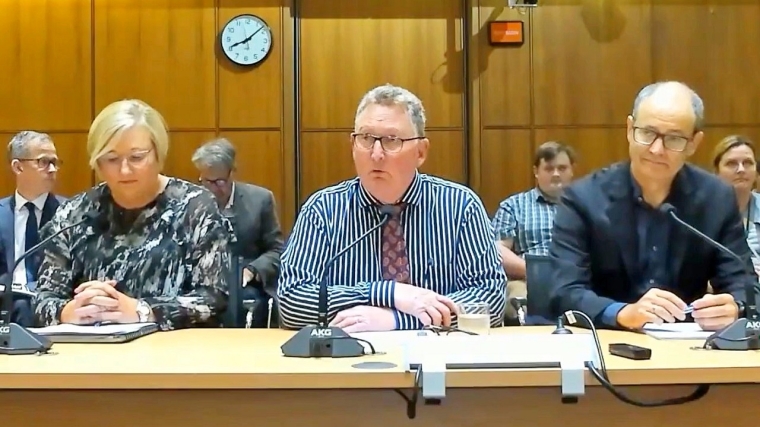
Appearing before Parliament's Finance & Expenditure Committee on Thursday after Wednesday's latest OCR hike, RBNZ officials were asked about the stress on homeowners with mortgages.
RBNZ Assistant Governor Karen Silk said it was not easy to quantify numbers of households that might be specifically impacted, but she provided information based on the total mortgage stock outstanding and current interest rates.
"The average mortgage rate on stock today is roughly 4.5%," she said.
"Fifty percent of loans, is our understanding, will be repriced over the next 12 months.
"Our estimate therefore of current mortgage rates is that would take the average rate to around 6.5%.
Silk said the RBNZ estimated that at a 6.5% average rate the percentage of disposable income being spent on mortgage interest costs "would move to roughly 22% - on average - by the end of this year".
This last comment produced some audible "oohs" from MPs.
RBNZ Governor Adrian Orr said the central bank's focus had been on making sure that very high loan to valuation ratios have been constrained - "and they have been - so the total balance sheet is looking good".
"But without doubt people who took out highly leveraged loans in the 2020-21 period will be facing very high interest servicing costs.
"These were stress tested by the banks at the types of interest rates that they are doing now so whilst it will be harder to pay they have been stress tested with the ability to pay - but it will mean compromise," he said.
On Wednesday Orr had called on banks to increase their deposit rates by as much as they have lifted their mortgage rates.
National MP Simon Watts asked the RBNZ officials on Thursday about the widening of the margin between what banks charge for mortgages and what they offer for deposits, and overall levels of bank profits.
Silk said the widening of that gap between deposit and mortgage rates "has been more extreme over recent times" and well beyond the historic average.
"So, yes, that is something that we are definitely noting and engaging with the banks on.
"If you think about what we are actually trying to achieve here, we need to see an increase in the term deposit rates as well. That will improve saving and will also help to dampen inflation.
"So, what we are noting is the lag that has occurred there - and our expectation is it should have been increasing at a similar pace," Silk said.
Orr observed that the margin gap was “always one of those difficult things".
"We can explain it, we can rationalise it. It doesn’t mean we are comfortable with it.
"Banks will say that is not our total profitability because it’s just the margin and there’s all the costs and so on and so forth.
"But we want to see deposit rates move along with these mortgage lending rates."
Expanding further, Orr said the RBNZ wants a sound an competitive financial system.
"...And if profits are becoming beyond what you would expect or the risk that they are taking on, then you have issues around are they being sufficiently competitive?
"Are those margins being competed away as they are chasing customers and servicing customers?"
We welcome your comments below. If you are not already registered, please register to comment
Remember we welcome robust, respectful and insightful debate. We don't welcome abusive or defamatory comments and will de-register those repeatedly making such comments. Our current comment policy is here.