

First home buyers took a record-high share of the mortgage money advanced last month, according to the latest Reserve Bank mortgage lending by borrower type figures.
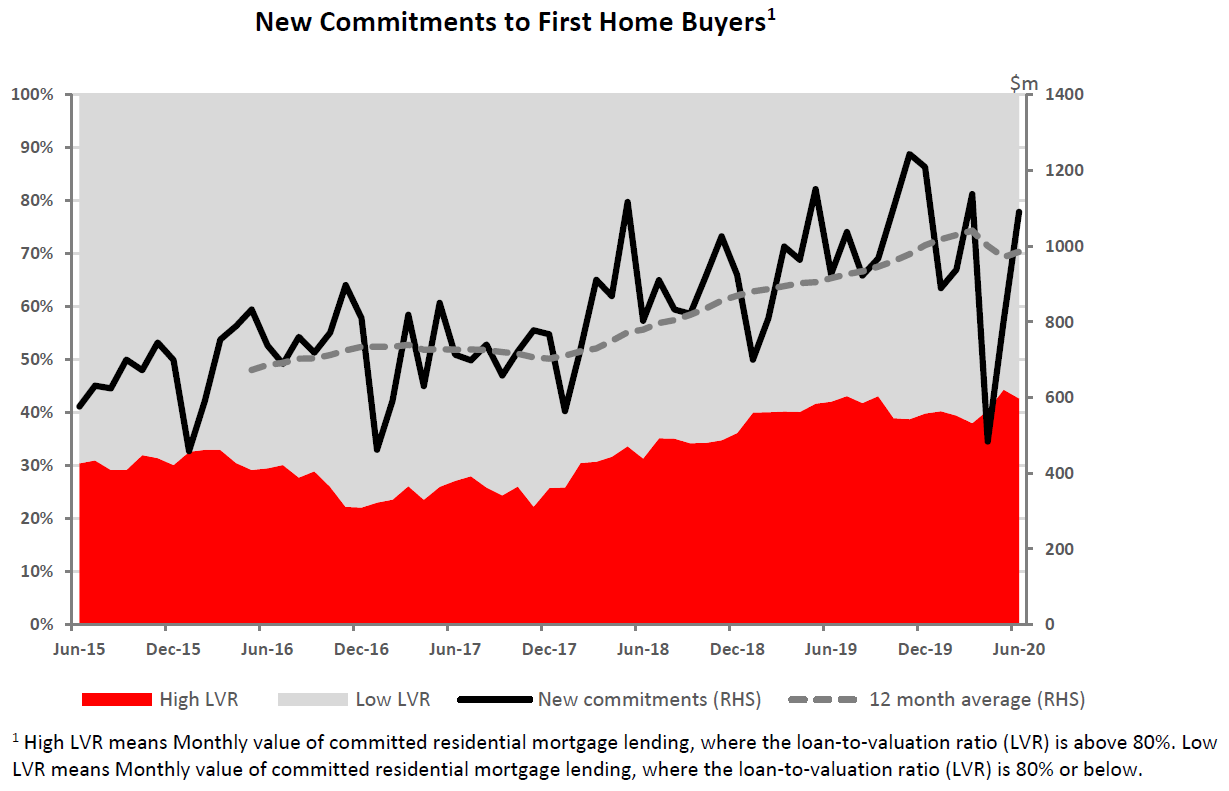
In June the FHBs accounted for $1.09 billion of mortgages, which made up 20.3% of the $5.364 billion total advanced during the month. The RBNZ said that was the highest percentage recorded by the FHBs since it had started collating the information in 2013.
Additionally, the FHBs actually out-borrowed the investors in June, which is only the second time that's happened (the first time in May last year) since the RBNZ started publicly releasing the data in August 2014.
Compared with the same month in 2019 the FHB borrowing was up 17.7% from $926 million.
In terms of the outright biggest amount of money borrowed by the FHBs in a single month, that remains the $1.243 billion borrowed in November 2019.
In its description with the data, the RBNZ describes a first home buyer as "a borrower entering the home ownership market in New Zealand for the first time".
"In the case of more than one borrowing parties to a loan, borrowers are classified as first home buyers only if none of the borrowing parties have previously drawn down on housing finance for owner occupation.
"If the borrower, or at least one borrowing party, has previously drawn down on housing finance for owner occupation they are classified as 'other owner occupier'."
Investors were fairly notable by their relative absence in June - and this is despite the fact that the previous requirement for them to find 30% deposits has now gone, lifted by the RBNZ when it removed the limits on high loan to value ratio (LVR) lending for at least 12 months at the end of April.
The $1.04 billion borrowed by the investor group in June represented 19.4% of the total advanced, which was the lowest share of mortgage money taken by the investors since August last year.
And it's all a far cry from the bull rush during mid 2016, when investors were accounting for about 35% of all monies advanced.
It was in mid-2016 that the RBNZ hit investors with a then a very stringent 40% (gradually more recently dropped to the 30% level) deposit requirement. Since then investor involvement has shrunk markedly.
In terms of the total amount of money borrowed in total during June, this represented a continued bounce-back of the housing market after the April lockdown month.
The June total of $5.364 billion, was up 24.2% on the $4.318 billion borrowed in May, while the May total was up some 57.1% on the $2.749 billion borrowed in April.
However, while the June 2020 figure represents a big bounce-back from the days of lockdown, the monthly total was still down on the $5.441 billion advanced in the same month a year ago.
And if we look at the figures combined for the past three months (April, May and June 2020) we can see the total amount borrowed during that period was down by nearly $5 billion (28.4%) compared with the same three months in 2019.
In the first half of this year, total mortgage borrowing has averaged $4.818 billion a month ($28.905 billion for the six months) compared with a monthly average in the first six months of last year at $5.33 billion (total $31.981 billion).
Just looking at some further detail in the first home buyer figures for June, we can see that of the $1.09 billion borrowed by the FHBs, some $466 million of it (42.8%) was for high LVR (above 80% of the value of the property) loans.
In recent times the amount of high LVR money borrowed by the FHBs has tended to make up just short of 40% of the total advanced to that grouping, although the percentage did blow out in May 2020 to 44.3%.
In June the $466 million of FHB mortgage money borrowed on high LVR loans was shared among 930 mortgages - giving an average mortgage size of just over $500,000. Figures for Auckland are not broken out separately in this category.
We welcome your comments below. If you are not already registered, please register to comment
Remember we welcome robust, respectful and insightful debate. We don't welcome abusive or defamatory comments and will de-register those repeatedly making such comments. Our current comment policy is here.