
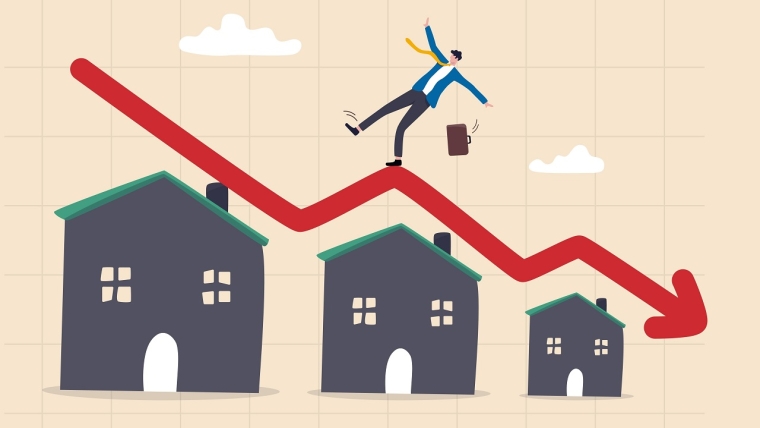
House sales fell off a cliff in December as the country saw volumes fall to levels not seen in years, indeed, with some regions hitting all-time lows.
At the same time, the Real Estate Institute of New Zealand (REINZ) says the annual median house price fell 12.2% to $790,000.
The national median is now down 14.6% from the peak of $925,000 in November 2021.
Wellington, Auckland, Gisborne, and Tasman had the largest drop in median sale price with –20.2%, -18.0%, -17.3%, and -14.1% respectively year on year.
Auckland's median, at $1,050,000 is now down about 19% from peak ($1,300,000). Wellington's at $790,000, dropped just over 20% during the year.
Northland and Taranaki were the only two regions seeing an increase in median sale price, up 3.3% and 5.1% respectively.
REINZ's House Price Index was down 13.7% for the year, while compared with its peak in November 2021 it's now down 15.2%.
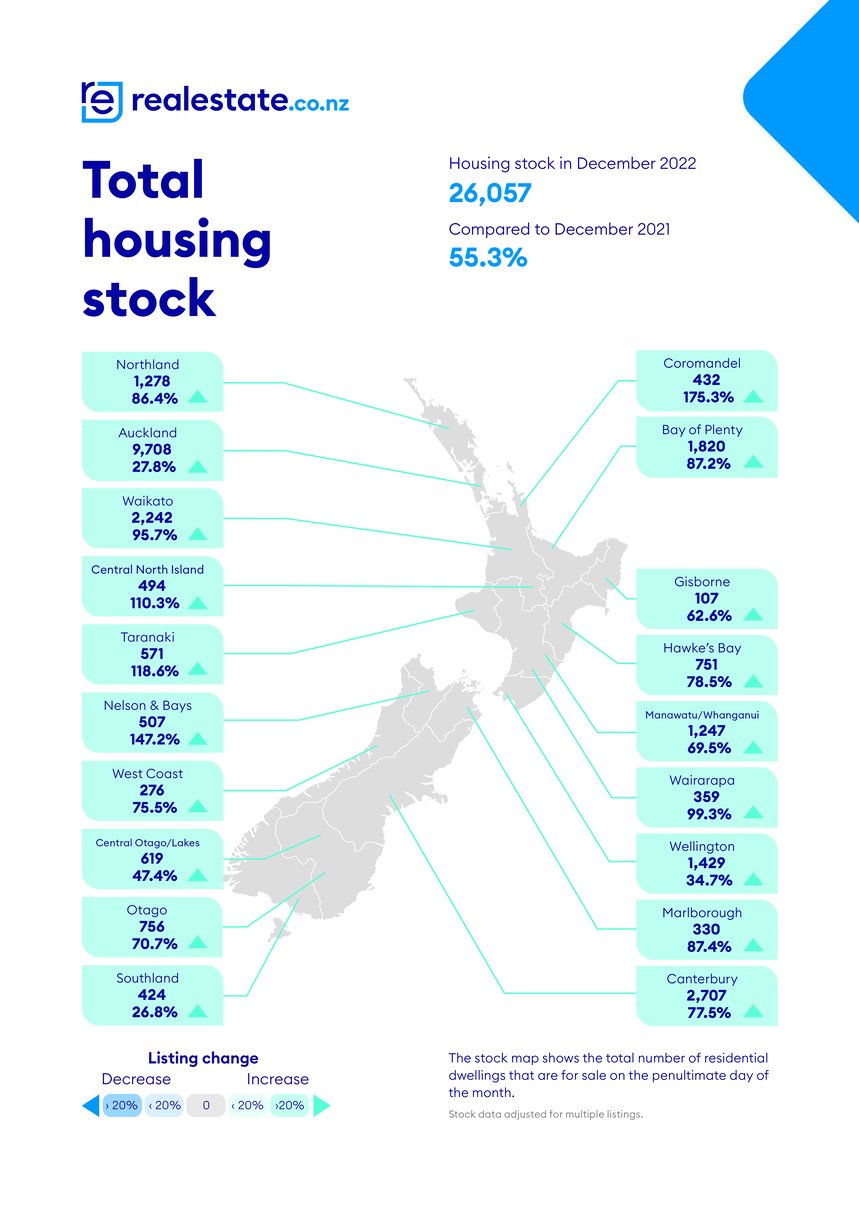
Inventory shot up 55.3% year-on-year, with 26,057 properties available as at the end of 2022.
The days to sell figure nationally rose by 11 days compared with December 2021 to 40.
In terms of sales, nationally, the figure dropped to just 4336, which was down 23.6% on the figures for November 2022, and down an enormous 39% on the December 2021 figure.
The latter point can't be stressed enough because sales had actually plummeted in December 2021 after banks struggled with imposition of new credit rules. The 7104 sales in December 2021 actually represented a 29.4% drop on the 9573 sales that had been reported in December 2020.
So, in other words, December sales have tanked by well over half compared with what the market was doing two years ago.
In Auckland, sales in December 2022 were just 1,327, which was down on the 1,834 for November 2022 and some 45% lower than the 2415 in December 2021.
ASB economist Nat Keall said "beyond the near-certainty" of further short term cooling, the broader headwinds facing the housing market (and indeed the NZ economy in general), "suggest we are still a fair way off the market turning around".
"We retain our present house price forecasts and, based on the quarterly QV index, we expect prices to ease 25% from peak-to-trough – about another 15-17% from here. In real terms, that fall looks to be a little north of 40%," Keall said.
"We don’t expect the market to turn around in any meaningful way until mid-2024, though earlier OCR [Official Cash Rate] cuts from the RBNZ (Reserve Bank), and thus lower mortgage rates, have the potential to trigger an earlier recovery."
Kiwibank economists including chief economist Jarrod Kerr, senior economist Jeremy Couchman and economist Mary Jo Vergara said in reviewing the figures that it was "a disappointing end to a tough year in the housing market".
"Given the current backdrop of a slowing economy, and a large chunk of mortgages rolling onto higher fixed rates, house prices have further to fall. We still see house price falls trough in annual terms at -15% in the current quarter. And house prices will continue to fall beyond the current quarter, but just at a slower pace. Our forecast suggests a peak to trough fall in house prices of 21% in the current correction. A recovery in the market appears a long way off, perhaps a 2024 story. However, on the demand side net migration is turning around quickly and will see population growth pick up," they said.
They said there "are clear risks" to their outlook for the housing market this year.
"We believe the RBNZ may deliver too much in the way of rate hikes and monetary tightening. That includes the likely 75bp hike in the cash rate [OCR] next month to 5%. Although we would advocate a lesser move (25, not 75). And financial markets are moving in favour of reduced rate hikes. The economic pendulum is clearly swinging towards downside risks, rather than upside risks. We continue to forecast a peak in the RBNZ’s cash rate in coming months, and a likely cut to that cash rate by year-end."
ANZ senior economist Miles Workman said the market was now "just over two thirds of the way through the 22% peak-to-trough decline we have pencilled in".
He said the latest REINZ data "were pretty close to our expectation, suggesting relatively balanced risks to our outlook".
"Our forecast assumes downward pressure on house prices will dissipate shortly after the RBNZ is convinced they have knocked pipeline inflation on the head, and can therefore stop lifting the OCR.
"But that assumes the household sector broadly holds it together as higher mortgage rates bite, meaning forced house sales are relatively rare," Workman said.
"Anecdotally, there certainly appears to be some households out there really struggling in the face of rising interest rates, but the macro-level data still looks relatively robust, with non-performing housing loan data remaining low and stable. But before we get too comfortable with our forecast, let’s not forget there’s more to the housing market than just the interest rate and household sector outlook. Net migration, housing market sentiment (animal spirits), and housing policy all have the potential to throw us a few curve balls this year."
Westpac acting chief economist Michael Gordon said with financial markets now turning their attention to the prospects of recession and OCR cuts at some point in the future, "we think that term mortgage rates have now peaked or are close to it".
"However, the increases in borrowing rates to date will take some time to work their way through the housing market. We’re still seeing a drop-off in new listings, as property owners choose to hold back rather than sell at a loss. That tends to slow the process of finding the new equilibrium price level, and suggests that we’ll see further falls in sale prices over the coming months. Our forecast remains for a 21% total drop in prices from their peak," he said.
REINZ chief executive, Jen Baird says prices are continuing to ease but the pace of the decline is slower, and the market has settled at its new pace.
“Buyer caution is evident in the drop in count of sales, down 23.6% month-on-month and down 39.0% annually from December 2021. Comparing this activity to the long-term trend, we can see the current market is weaker than this trend. This is leaving a lot of choice for buyers with a 55.3% increase in inventory – now sitting at 26,057 properties.
"With interest rates rising and banks stress testing at 8.1-8.5%, buyers’ ability to secure finance and service a mortgage remains a key driver to buyers taking their time. As a result, properties are spending longer on the market with 40 being the median days to sell, 11 days longer compared to December 2021," Baird said.
"The median sale price has decreased nationally by 12.2% overall to $790,000 and decreased 7.9% for New Zealand excluding Auckland to $700,000. The REINZ House Price Index (HPI) showed an annual decrease of 13.7% in the value of residential property nationwide which is in line with the sale price changes we are seeing.
"Again, cheaper prices coupled with more choice for buyers means sellers have to be realistic about their price and timing expectations.” Regional median house prices have decreased across the board except for Northland which saw an increase of 3.3% and Taranaki 5.1%. These were the only regions to see a rise in median price compared to December last year."
Baird says Wellington is now into its 14th consecutive month of being in the bottom two ranked regions for the year-on-year House Price Index movements.
With Auckland, all seven Territorial Authorities (TAs) had negative year-on-year median price movements with Papakura the largest fall at -23.6% from $1,010,000 to $772,000, followed by Waitakere City at -20.5% from $1,170,000 to $930,000. The region has recorded eight consecutive months of year-on-year median price decreases for the first time since June 2008 - January 2009.
In Wellington, seven of the eight TA’s had negative year-on-year median price movements with Upper Hutt City largest fall at -24.5% from $920,000 to $695,000, followed by Wellington City at -24.2% from $1,161,000 to $880,000. At a regional level, this is the first time since records began that this region recorded seven consecutive months of year-on-year median price decreases.
REINZ says in terms of sales counts, if we exclude the month of January (usually the lowest month for sales count) and the two Level 4 lockdown-affected months of April 2020 and May 2020, December 2022 had the lowest sales count in:
- Northland since October 2011
- New Zealand excluding Auckland since February 2011
- Taranaki and Waikato since December 2010
- New Zealand since October 2010,
- Auckland since December 2008,
- Wellington since June 2008,
- Nelson since records began
In terms of inventory, 12 of the 15 measured regions (80%) had at least a 60% YOY increase in inventory Listings
Nationally, new residential property listings have decreased 25.9% year-on year. Regionally, all but two regions (Gisborne and Taranaki) have had a decrease in listings since December 2021. Over half of the regions have had listings decrease by more than 20% year on year.
In auctions, nationally, 11.7% (509) of properties were sold at auction in December 2022, compared to 30.4% (2,162) in December 2021. New Zealand excluding Auckland saw 8.7% of properties (262) sell by auction compared to 21.7% (1,018) the year prior. Gisborne and Canterbury had the highest percentage of sales by auction for December 2022 with 50.0% and 18.9% respectively.

We welcome your comments below. If you are not already registered, please register to comment
Remember we welcome robust, respectful and insightful debate. We don't welcome abusive or defamatory comments and will de-register those repeatedly making such comments. Our current comment policy is here.