

Economists at the country's largest bank are tipping that the Reserve Bank will further relax - slightly - the rules around low deposit mortgage lending next month.
The RBNZ will review its loan-to-value ratio (LVR) limits as part of its latest six-monthly Financial Stability Report to be released on November 28.
In the ANZ's latest monthly Property Focus publication, ANZ chief economist Sharon Zollner, senior economist Liz Kendall and senior macro strategist Philip Borkin say based on recent housing and credit developments, they do expect the RBNZ will ease loan-to-value ratio restrictions at the November FSR.
In their view, the RBNZ's criteria for a further relaxation of the rules have been sufficiently met to justify a continued gradual easing in the restrictions at the FSR, "especially since risks around the housing market outlook appear skewed to the downside".
"And given that investor demand appears particularly soft, we expect that any change would involve a marginal loosening in investor restrictions."
The LVR rules were relaxed slightly from the start of this year.
At the moment the rules are that banks must:
- Make no more than 15% of their residential mortgage lending to high-LVR (less than 20% deposit) borrowers who are owner occupiers.
- Make no more than 5% of residential mortgage lending to high-LVR (less than 35% deposit) borrowers who are investors.
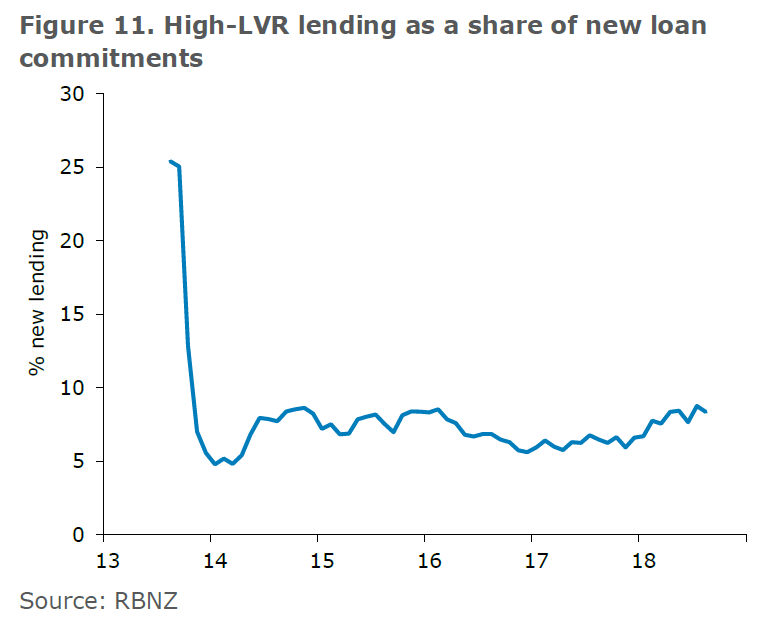
"In our view, a neutral level for the restriction – that neither boosts nor dampens the housing market – might be consistent with lower-deposit loans being somewhere in the realm of 15-20% of lending, as opposed to under 10% now. We expect that the RBNZ will ease the restrictions only a little, such that they are still at levels consistent with the restrictions exerting a continued dampening force on the market," the economists say.
They say the RBNZ will want to keep the restrictions “tight” until they are satisfied that the risk of resurgence associated with further easing would be small.
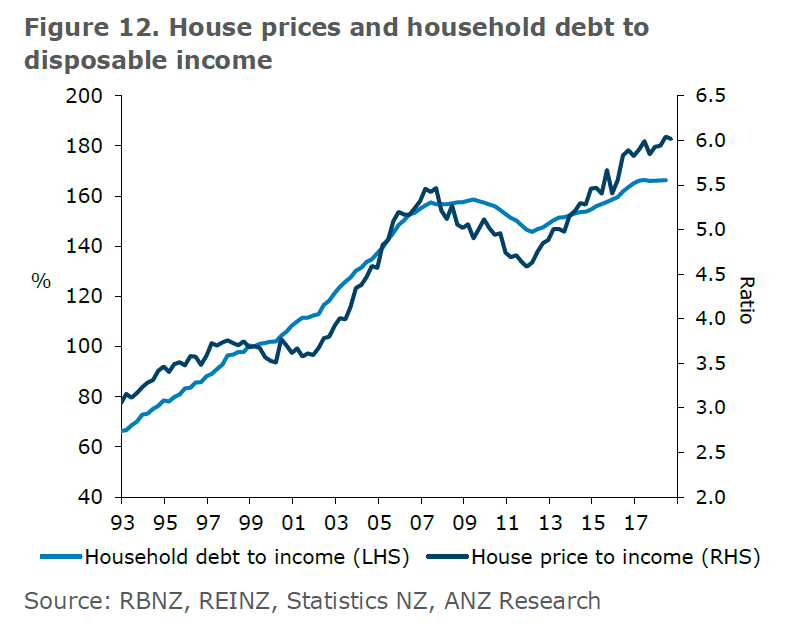
"Given the risks associated New Zealand’s high levels of house prices and household debt, they will want to be sure that there is no more fuel in the tank before taking their foot completely off the brake."
The criteria as previously set out by the RBNZ in order to loosen the LVR restrictions are:
- Evidence of house price and credit growth falling to around the rate of household income growth.
- A low risk of housing market resurgence if the restrictions are eased.
- Confidence that an easing in policy will not undermine the resilience of the financial system.
"Currently, housing market pressures are contained and while resurgence would certainly not be desirable, the Auckland market could perhaps benefit from a little more support," the economists say.
"Markets outside Auckland are very tight, but it does not appear that there is a large speculative element at play that could lead to a boom-bust cycle – nationwide house price expectations are fairly contained and rental yields do not appear unsustainably low."
The economists say that high-LVR lending remains low as a share of new loan commitments and lending standards are prudent.
"Credit growth remains stable and has been tracking at a consistent rate of 0.5% m/m for the past year, with no signs of a pick-up. Indeed, given recent softening in market turnover, a softening in the pace of new lending from here is possible. But importantly, house prices and household debt remain high relative to incomes, warranting continued caution with regards to financial stability risks."
The economists say the impacts of changes in the LVR restrictions on activity, inflation and the Official Cash Rate are likely to be fairly small, particularly relative to the magnitudes of other developments that the RBNZ is contending with when weighing up the outlook for monetary policy.
"But even so, at the margin an easing would allow the RBNZ a little more time to watch how conditions evolve – with the OCR comfortably on hold."
The economists say they would, more generally, expect the effect of an easing in the restrictions on the housing market would be small, especially if it is gradual and targeted at investors.
"There would likely be an increase in demand at the margin, as some low-deposit buyers enter the market, which would lead to an increase in sales and prices, all else equal. But the magnitude of the effect depends on how binding the constraint currently is – that is, how many marginal buyers are currently locked out of the market. With the housing market soft, property investment less attractive and pent-up demand appearing to have waned (especially in Auckland), we suspect the constraint is not particularly binding at present."
We welcome your comments below. If you are not already registered, please register to comment
Remember we welcome robust, respectful and insightful debate. We don't welcome abusive or defamatory comments and will de-register those repeatedly making such comments. Our current comment policy is here.