

By Rodney Dickens*
The bank economists are competing to predict the largest Official Cash Rate (OCR) hikes without any consideration of the implications.
You don’t have to go back too far and the economists at the banks were predicting that inflation wouldn’t be a problem and interest rates would stay low for many years. And some were predicting the OCR would go negative. Having been wrong on these fronts they have done huge about faces. They are now running around like headless chooks because of the inflation they didn’t see coming, even aside from that related to Covid-19 and Russia’s invasion of Ukraine.
They are calling for even larger OCR hikes, as the ANZ and ASB economists did this week.
Aside from the evidence presented below that points to the increase in interest rates so far being more than is required to cool inflation, sane thinking about the scale of the increase in mortgage interest rates so far should be enough to caution against charging ahead with an even larger hike next month.
The green line in the chart below is the average of the various floating and fixed mortgage rates offered by the major four banks. It tends to front-run the OCR a bit. If the Reserve Bank hikes the OCR as it predicted in the May Monetary Policy Statement, the average mortgage rate could peak around 7%.
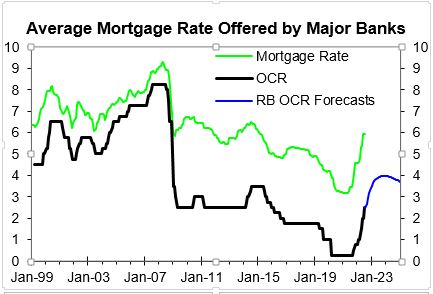
To put the increase in the average mortgage rate in perspective, during the Reserve Bank’s last battle with inflation from 2004 to 2008, it increased from a low of 6.1% in June 2003 to a peak of 9.3% in April 2008, a 3.2 percentage point increase in just under five years.
In the last 16 months the average rate has increased from a low of 3.2% to 5.9% currently, an increase of 2.7 percentage points. If the average rate increased to 7% it would be a 3.8 percentage point rise. But the increase this time around is dramatically larger than it seems from these numbers.
The starting point for the latest battle against inflation is dramatically lower at 3.2% versus 6.1% in 2003. In terms of interest costs faced by borrowers there has already been an 84% increase based on the average mortgage rate in just 16 months versus a 47% rise in almost five years during the last inflation battle. And if the average rate were to rise to 7%, it would be a 119% increase in mortgage interest costs.
In an extremely short period interest costs have risen dramatically more already than was needed to cool inflation last time. Considering this and it taking up to two years for changes in interest rates to impact on inflation, sound judgement points to a need to wait to see what impact the largest increase in interest costs on record will have rather than charge ahead with even more aggressive OCR hikes.
I cannot see any flaw in this logic, but it escapes the economists and is likely to escape the Reserve Bank until it sees the scale of the damage being done. A scale that is likely to fuel a market-led fall in interest rates.
The Reserve Bank and bank economists are way off the mark in assessing the fallout from the OCR hikes delivered already.
The first chart below shows what the Reserve Bank and four main bank economists predict for economic growth. The second chart shows what the Reserve Bank predicts for growth in residential building activity based on the GDP component. Residential building is important because it plays a pivotal role in economic growth. The bank economists’ forecasts are based on their latest forecasts as surveyed today and the Reserve Bank’s are from its May Monetary Policy Statement.
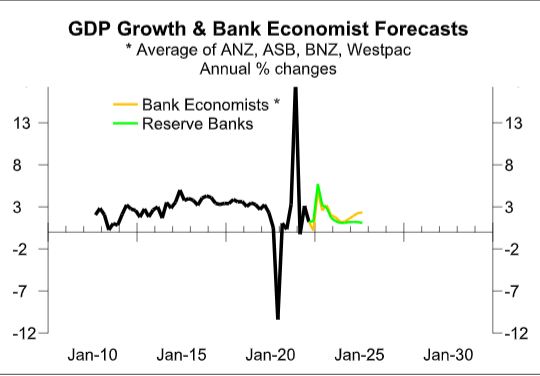
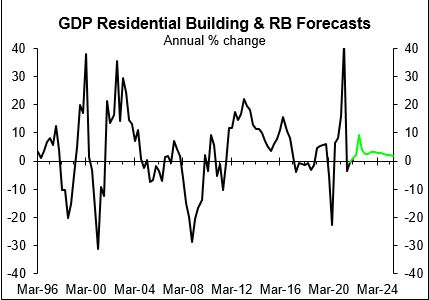
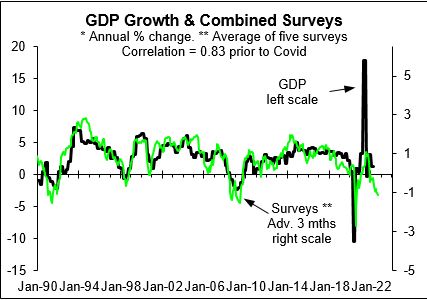
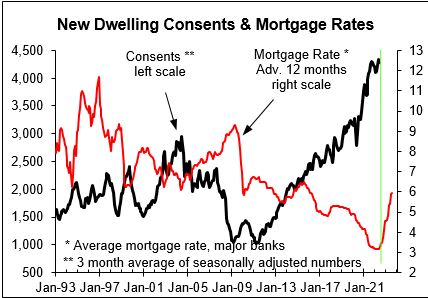
None of the bank economists predict anything close to a recession and the Reserve Bank predicts moderate growth in residential building activity despite it being highly sensitive to interest rates. By contrast, the first chart below shows a combined business and consumer survey that predicts an imminent recession or fall in GDP, and the second and third charts show leading indicators of new dwelling consents that predict an imminent and large fall.
It should be no wonder a large fall in residential building activity is coming considering interest rates are the major driver of new dwelling consents and take around 12 months to impact.
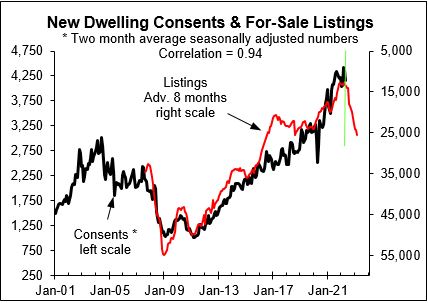
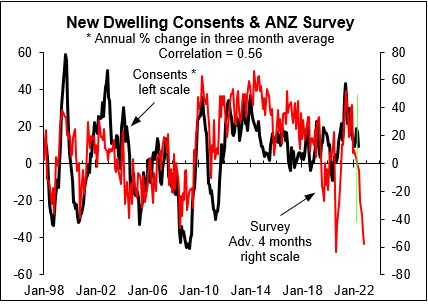
Just as the major fall in interest rates from 2019 to 2021 was the main driver of the huge increase in new dwelling consents since 2019, it should be no surprise the leading indicators point to a major fall in consents in response to the dramatic increase in interest rates in the last 16 months.
This is not rocket science, it is basic analysis the Reserve Bank and bank economists should do as a basis for their views on interest rates and more. For reasons I do not understand they have yet again failed to do such analysis or if they have done it, they have ignored it. The outlook for GDP growth is dramatically worse than the Reserve Bank and bank economists predict, as should be no surprise given the scale of the increase in interest rates so far. While the outlook for residential building is dramatically worse than the Reserve Bank predicts.
*Rodney Dickens runs Strategic Risk Analysis. His roles prior to that include Group Strategist and Head of Research at ASB, and roles at the Reserve Bank including being a member of the Monetary Policy Committee.
We welcome your comments below. If you are not already registered, please register to comment
Remember we welcome robust, respectful and insightful debate. We don't welcome abusive or defamatory comments and will de-register those repeatedly making such comments. Our current comment policy is here.