
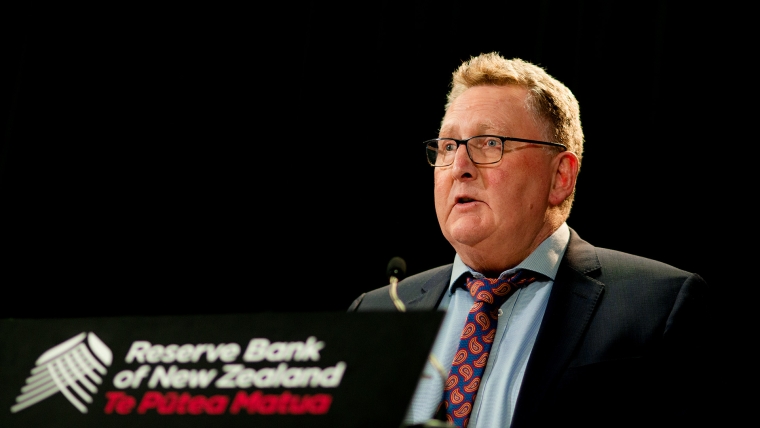
The Reserve Bank of New Zealand (RBNZ) is facing heightened scrutiny as it works to restore price stability after the chaos of the pandemic and in the run up to a general election.
Criticism of the central bank has begun to move beyond economics and into the political realm as inflation has become a key election issue and a political football.
The situation has been made worse by a lack of bipartisan support for RBNZ governor Adrian Orr, who was reappointed last year despite opposition from the National and Act parties.
While the Minister of Finance formally appoints the Governor, they can only do so if that person has been recommended by the bank’s board of directors.
The Minister is also required to consult with other political parties before appointing a governor, although the minister doesn’t have to listen to their feedback.
When Orr’s first five-year term ended last year, Finance Minister Grant Robertson opted to follow the board’s recommendation, saying it would politicise the central bank to refuse.
Robert MacCulloch, a macroeconomics professor at Auckland University, said in an ideal scenario the governor would have the support of both major parties.
For example, the US Federal Reserve chair Jerome Powell was appointed by Donald Trump and then subsequently reappointed by Joe Biden — despite intense partisanship in the US.
New Zealand has lost the best-practice bipartisan consensus that keeps politics out of monetary policy, he says.
Allegations refuted
MacCulloch said not having broad political support cast doubt on the independence of the Governor and the motivations behind some decisions.
The academic has alleged, without providing any evidence, that the bank may hold the Official Cash Rate at 5.50% to improve Labour’s chances of re-election.
Since April 2019 monetary policy decisions have been made by a monetary policy committee, and not by the governor alone.
The RBNZ has now increased the OCR by 525 basis points since first raising it from its record low of 0.25% in October 2021, its fastest hiking cycle ever. Orr last year said the RBNZ was trying to engineer a recession to rein in inflation that had topped 7%.
RBNZ Assistant Governor Karen Silk told Interest.co.nz the seven-person committee did not consider political factors when making policy decisions.
“You will always get political commentary and different political perspectives on where monetary policy sits, or it might be politicised by what the media is saying,” she said.
“But in terms of the monetary policy committee, you have to ride above that and focus on the job that you're there to do, with the information you have at hand.”
Silk said when the committee was making its April decision, it had become clear the inflation impact from the cyclone rebuild would be greater than it had thought in February.
This was one of the factors, along with tourism and migration, that prompted the committee to opt for the 50 basis point rate hike in the meeting prior to the budget.
The RBNZ’s interest rate projections have not changed materially since November and the monetary policy committee has stuck to the path it signalled months ago.
After another 25 basis point increase in May, the committee has brought the OCR to a level it expects will restrict spending enough to bring inflation back into its 1% to 3% target band.
Some economists think the central bank will need to do one more hike, while others think it has already been too aggressive and will have to start cutting rates sooner than planned.
Timing tilted?
Stephen Toplis, head of research at BNZ, said some observers thought the central bank had opted for a bigger rate hike in April, so that it could afford to be less aggressive in May.
Getting the increase ahead of Budget 2023 was being interpreted by some as an effort to avoid being “embroiled in the political process” while fiscal policy was being debated, he said.
These comments related only to the timing of interest rate decisions, not their extent or direction.
Politicians and media were setting up a showdown between the Budget and the Bank, which could generate headlines that would impact public opinion and the outcome of the election.
An Act Party press release claiming government spending would force more hikes was titled: “Thank Grant Robertson for your next interest rate rise”.
In response, the Finance Minister told Newshub he did not think there was any cause for another rate hike as a result of his recent budget.
When Orr eventually said fiscal policy was not inflationary across the forecast period, some suggested this was a politically-motivated interpretation.
'The independence of the Reserve Bank is really important'
Robertson told Interest.co.nz that talking about interest rates was unavoidable but he’d always tried not to comment on the merits of Reserve Bank decisions.
“I do think the independence of the Reserve Bank is really important, and the integrity of the Governor and the Monetary Policy Committee should not be brought into question”.
“There is no justification to bring them into question and I think it is not good for the operation of good public policy,” he said.
Act Party leader David Seymour said Adrian Orr had contributed to politicisation with his “flamboyant character” and for focusing on things beside inflation.
He wants price stability to be the central bank’s sole monetary policy objective, removing its other objective to support maximum sustainable employment, which he thinks would prevent any opportunity for political influence.
“If there is a clear objective to achieve on a clear timeline, and if they don’t do it they are fired, then I don’t think they will care what any politician says”.
We welcome your comments below. If you are not already registered, please register to comment
Remember we welcome robust, respectful and insightful debate. We don't welcome abusive or defamatory comments and will de-register those repeatedly making such comments. Our current comment policy is here.