
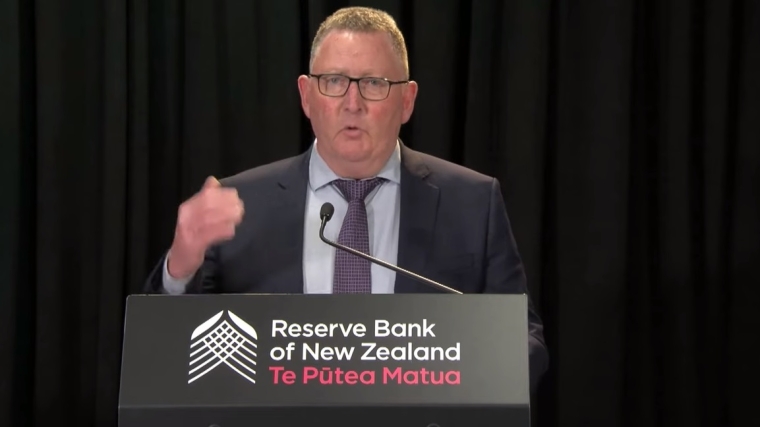
Reserve Bank Governor Adrian Orr says the central bank is "sorry" that Kiwis are being buffeted by significant shocks and inflation is above target - but he's also conceding that the RBNZ is deliberately engineering a recession.
In opening remarks before Parliament's Finance & Expenditure Committee (FEC) on Thursday, Orr said that "as we’ve said before, inflation is no one’s friend and causes economic costs".
In later comments in response to questions, Orr conceded that the RBNZ was effectively deliberately engineering a recession.
It is forecasting four consecutive quarters of negative GDP growth from the middle of next year. The technical definition of a recession is often described as two consecutive negative-growth quarters.
The RBNZ has an official target of keeping inflation in a 1% to 3% range. As of the September quarter annual inflation was 7.2%.
On Wednesday the RBNZ increased the Official Cash Rate by a record 75 basis points to 4.25% in an attempt to get on top of inflation.
In his opening remarks to the FEC, Orr said he wanted to reaffirm the RBNZ Monetary Policy Committee’s "determination and confidence we will return annual inflation to within our 1% to 3% target range".
Orr referred to the RBNZ's recent five-year review and said that the MPC "would have had to lift the OCR to around 7% in early 2020 to have achieved annual CPI inflation within our 1-3 percent target range now".
"Such a policy shift would have been inconsistent with the Committee’s Remit and led to many other severe and persistent economic challenges."
He said the MPC could have commenced its tightening cycle earlier in 2021 than it did, in order to better contain core (domestic demand-led) inflation pressure.
"However, the subsequent rise in international food and energy prices would still have led to headline CPI inflation exceeding 6% now."
He said these examples "are not excuses" for inflation not being at 2%.
"They highlight the extent of the economic shocks that buffeted the economy, and the importance of being forward-looking when setting policy, with flexibility in achieving our targets. The lags between our monetary policy actions and inflation outcomes remain long and highly variable.
"Other central banks are in the same boat, and we are learning the lessons together. In an absolute sense, actual and expected inflation is too high and needs to be reduced. However New Zealand is in a strong macroeconomic position relative to most OECD nations."
During the appearance, Orr was asked what he made of commentary on Wednesday's OCR announcement to the effect that the RBNZ was deliberately engineering a recession.
“I think that is correct," he said.
"We are deliberately trying to slow aggregate spending in the economy. The quicker inflation expectations come down the less work we need to do and the less likely it is that we have a prolonged period of low or negative growth."
In response to earlier questioning on recession, Orr gave a detailed view on what might be entailed.
“What we are talking about is, aggregate spending needs to slow. If the supply capacity can’t increase and everyone’s employed and so on, spending has to slow. To do that we are raising interest rates and making people have to pay more for their mortgage and reduce their spending.
"What we are looking at is a 1% of GDP slow down over the period of three to four quarters in the second half of next year into 2024. So that’s 1%.
"So, it’s a very shallow and short period of negative GDP growth. And what it would do if successful, if we slow down and inflation comes out, it would mean that per capita consumption is still in real terms at pre-covid 2019 levels.
"It would mean that participation and employment is still very high but it would be a slowing in spending.
"Ways of reducing the need to have negative GDP growth?
"People could just start expecting lower inflation in the future and start working that way. It’s an inflation expectation.
"So the power is in the hands of the people. If you just start behaving 1% different around inflation expectations and wage growth then our job is easier. We don’t have to pay that cost."
Orr said the next one to two quarters ahead "is going to be really important for us".
"We originally had inflation about 7% and then 7.5% and then tailing off into the 6s pretty early on next year.
"We are now seeing it persisting around 7% to 7.5% for three quarters.
"That starts to become a long period of heightened inflation that seeps into inflation expectations and creates that horrible environment that we need to head off.
"So that’s why we’ve stepped up and said we need to do more and sooner, to break that spiral."
We welcome your comments below. If you are not already registered, please register to comment
Remember we welcome robust, respectful and insightful debate. We don't welcome abusive or defamatory comments and will de-register those repeatedly making such comments. Our current comment policy is here.