
The Reserve Bank reviewing its regulatory capital settings, accelerated open banking progress, and a better bank switching service are among recommendations from the Commerce Commission in its draft report from its market study into retail banking competition.
Commission Chairman John Small says limited competition is contributing to persistently high profitability.
"There's no silver bullet here. There's a need for multi-faceted solutions," Small says.
He says the report is a draft and the Commission retains "a very open mind."
Below is the Commission's announcement on the draft report into its market study into retail banking competition that focuses on deposit accounts and home loans. I've added the full list of recommendations to this.
Disruptive forces needed to drive change in NZ’s personal banking sector
The country’s first competition study into personal banking services has revealed a two-tier sector with limited competition and no disruptive forces to drive change and deliver consumer benefits.
Commerce Commission Chair, John Small, says that the Draft Report from the Market Study released today reveals that an apparent focus by the four major banks on maintaining profit margins has resulted in ongoing underinvestment in their core technology platforms, low levels of innovation, stable market shares, and sustained high levels of profitability.
Dr Small says “ongoing disruption needs to be baked in” to address the lack of obvious and aggressive competition for the major banks that means Kiwi consumers are missing out.
Two-tier oligopoly
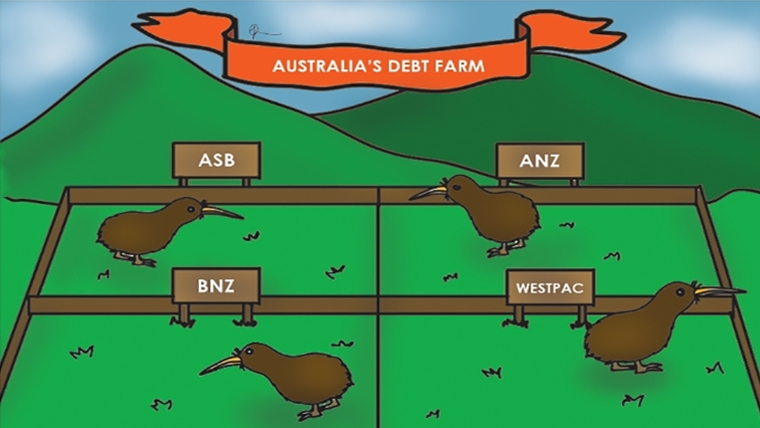
Dr Small says the Commerce Commission’s analysis shows the status quo is a “stable two-tier oligopoly” where the top tier – ANZ, ASB, BNZ and Westpac – enjoy sustained high levels of profitability compared with their global peers.
“In a well-functioning banking market, we’d expect to see strong competition driving innovation and choice for customers, rather than the price-matching strategies we see here in New Zealand, which result in very stable market shares.
“The lack of a disruptive force in our banking market means competition between the majors is sporadic and not sustained.”
Dr Small says that while there are periods of relatively intense competition between the major banks, this tends to be linked to events like changes to interest rates triggering price-matching, rather than price-beating behaviour.
“Ongoing disruption is key to promoting enduring competition in this sector. Today’s maverick could be tomorrow’s oligopolist, so the aim should be to ensure contestability over the longer-term.”
Recommendations to drive change
Dr Small says that the Commission’s draft recommendations are designed to promote enduring competition and include measures to more directly improve consumer outcomes.
“Many of the issues we’ve identified are systemic, so this isn’t about quick fixes, but we would expect to see sustained and enduring improvements in competition across personal banking services over time.”
Dr Small says the draft recommendations are aimed at reducing barriers to competition for those seeking to challenge the majors – by encouraging market entry and expansion for innovative players, and empowering consumers to make informed decisions about their banking providers.
“We are now keen to hear from stakeholders about the directions we have set out in our Draft Report. Ultimately, we want New Zealanders to be better off and confident that they are getting great value, clear choices, and innovative offerings in their banking services.”
Draft recommendations
The draft recommendations are grouped into four interdependent areas that reflect the regulatory, behavioural and strategic impediments that make it difficult for new and existing providers to enter and expand in the market.Improve the capital position of smaller providers and Kiwibank:
- Access to capital is one of the key constraints affecting the ability of smaller providers and Kiwibank to grow and compete.
- The Draft Report recommends that the Reserve Bank reviews its prudential capital settings to ensure they are competitively neutral and smaller players are better able to compete.
- It also suggests that Kiwibank’s owner considers increasing its access to capital, and converting it into a disruptive competitor.
Accelerate progress on open banking:
- Open banking has the potential to revolutionise banking over the medium to long-term. However, fintechs are facing severe barriers and are unable to provide disruptive innovation.
- The Report recommends setting a clear deadline to have open banking fully operational by mid-2026 and having regulatory backstops available so that the minimum requirements are delivered to support the acceleration of open banking.
- It also recommends that the Government does more to reduce the barriers imposed by the Anti Money Laundering and Countering Financing of Terrorism regime on banks working with fintechs.
Ensure the regulatory environment better supports competition:
- The Report recommends that policy makers and regulators responsible for the personal banking sector explicitly and transparently consider the competitive effects of their decisions.
- The recommendations are intended to reduce unintended consequences of decisions on competition and ensure that any trade-offs with other policy goals (such as financial stability and consumer protection) are specifically considered.
Empower consumers to better access the benefits of competition:
- The Report sets out how consumers will directly benefit from reduced barriers to switching providers.
- The recommendations include the introduction of better tools and services to help consumers get the best deal, an enhanced switching service, and the introduction of a basic bank account service that is accessible to any New Zealander.
Some demographics are disproportionately affected
The draft findings suggest that some customer demographics are more affected by the lack of competition in personal banking services than others. This includes consumers who can struggle to access basic bank accounts, as well as those who have difficulty understanding banks’ terms and conditions, interest rates, and comparing products and services.
The Commission also heard that some Māori can be disproportionately impacted by factors affecting other consumers. A particular issue related to access to capital to build housing on Māori freehold land. The draft recommendations include measures that seek to address these concerns.Full list of draft recommendations
Improve the capital position of smaller providers and Kiwibank
1. The Reserve Bank should review its prudential capital settings to ensure they are competitively neutral and smaller players are better able to compete.
2. Kiwibank’s owner should consider what is necessary to make it a disruptive competitor, including how to provide it with access to more capital.
Accelerate progress on open banking
3. The Government should set clear deadlines and work with industry to ensure opening banking is fully operational by June 2026.
4. The Government should reduce the barriers imposed by the Anti-money Laundering and Countering Financing of Terrorism (AML/CFT) regime on banks working with fintechs.
Ensure the regulatory environment better supports competition
5. The Reserve Bank should use its new decision-making framework under the Deposit Takers Act (DT Act) to explicitly and transparently consider competitive effects.
6. The Reserve Bank should explicitly and transparently articulate how it is applying the purposes and principles of the DT Act to its Deposit Compensation Scheme levy advice.
7. The Reserve Bank should consider broadening access to Exchange Settlement Account System accounts.
8. The Government should amend the DT Act to allow the Reserve Bank to promote competition, rather than maintain competition.
9. The Government and policy makers should seek competitive neutrality across banks and other providers in their decision-making wherever possible.
10. The Credit Contracts and Consumer Finance Act should be competitively neutral with respect to home loan refinancing to make it easier for consumers to switch providers.
Empower consumers
11. Industry should create an enhanced switching service with appropriate Government oversight.
12. Home loan providers should present offers in a readily comparable manner.
13. Mortgage lenders should pro-rate all clawbacks for broker commissions and cash incentives.
14. The Financial Markets Authority should produce guidance and monitor mortgage advisors’ compliance with their duties under the Financial Markets Conduct Act.
15. Industry and Government should prioritise work to reduce the barriers to lending on Māori freehold land.
16. Industry and Government should prioritise ensuring widespread availability of basic bank accounts.
Consultation with the sector and stakeholders
The Commission was directed to open a market study into personal banking services by the Minister of Commerce and Consumer Affairs last June to examine how well competition is working and consider options for enhancing it for the long-term benefit of Kiwi consumers.
Dr Small says the Commission has analysed significant volumes of internal bank documents and engaged with a wide range of stakeholders during the course of its study.
“There’s been significant interest in this market study, and our thinking and preliminary findings have been guided by the feedback and evidence we’ve received. This has included broad engagement with the sector – the major banks and the smaller banks, as well as non-bank participants – and communities and demographics who have taken the time to share their experiences of personal banking services.”
Next steps
The Commission’s Draft Report is subject to consultation prior to its final report being published in August 2024. Consultation opens tomorrow (22 March) and closes on 18 April. The full report is available here.
Background
About market studies:
A market study, referred to as a ‘competition study’ in Part 3A of the Commerce Act, is an in-depth look at the factors affecting competition for particular goods or services, to determine how well competition is working and whether it could be improved.
By gathering and analysing information on an industry, the Commission can identify whether there are features preventing competition from working well, as well as considering how things might be improved for the long-term benefit of New Zealand consumers.
Outcomes of the Commission’s work may range from a ‘clean bill of health’ for the sector to recommendations for changes to enhance market performance. The Commission’s recommendations are non-binding, but the Government must respond to any recommendations within a reasonable period.
And here's a response from Commerce and Consumer Affairs Minister Andrew Bayly.
Government response to draft market study into personal banking services
“I welcome the release of the Commerce Commission’s draft report into personal banking services.” announced Commerce and Consumer Affairs Minister Andrew Bayly.
The Commission is scheduled to publish its final report by 20 August 2024.
“I encourage everyone interested in improving outcomes for personal banking services to provide feedback to the Commission to help with refining these recommendations.
“The Commission’s report is still underway. This is an independent process and I look forward to receiving the final report in August.
“The Coalition Government is committed to delivering better banking outcomes and a more productive economy for New Zealanders.
“I am working with our coalition partners to determine any possible response including the option of the select committee inquiry, but will determine what actions to take following the release of the final report.”
We welcome your comments below. If you are not already registered, please register to comment
Remember we welcome robust, respectful and insightful debate. We don't welcome abusive or defamatory comments and will de-register those repeatedly making such comments. Our current comment policy is here.